
Betting Academy
Why Do Betting Odds Change After Bet Placement?
The other day, I opened an app, checked the odds for a Chiefs game, and they were -6.5 at -110. From experience, this was a good, easy bet, so I placed it and sat down waiting to walk away a few dollars richer. About 15 minutes before kickoff, the -110 had moved to -115. My instincts kicked in to change the bet, but I could not.

SportsBoom offers honest and impartial bookmaker reviews to help you make informed choices. While we may earn commissions through affiliate links, our content remains independent and free from promotional influence. For more information, see our Content Transparency and How We Review pages.
Why Odds Change After You Place a Bet
The market had moved, leaving me with the original ticket price, which was quite frankly a disappointment. So, this had me asking, “Why did it move?” and “How can I not get caught unaware again?”
The answers came after I did some research, and I have categorized them into 5 rules for you.
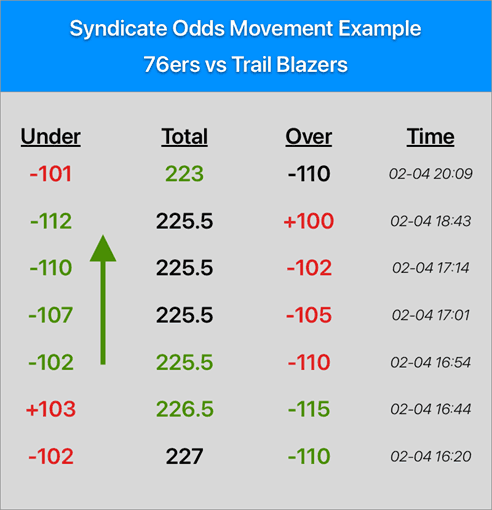
Caption: How Odds moved in the 76ers vs Trail Blazers game
Rule 1: Once You Place a Bet, it’s Locked In
Once a site confirms your bets, the odds taken in at that time are also locked in. No level of line movement will change your payout after this. [1] This happens because there is new information that influenced the move. It is not random. You just bought the position before something changed.
Rule 2: Lines Move To Balance The Books
Bookies make money from the percentage of each dollar spent on either side of the market. The predictions aren’t really the money-makers; they’re a complementary service. The vig, what others call the juice, is the determining factor, and you’ll find the vig incorporated into the -110 pricing model of a standard spread.
Vig collection is consistent and conditional. That condition is that bookies have to balance the line. For example, suppose 80% of the total bet price is on the Chiefs -6.5; the books react by reducing exposure, making the other side of this scale more attractive. That side of the scale is the Cowboys' seeming like the more attractive deal. [2]
In short, the adjustment is influenced by the distribution of money, making the book uncomfortable. Not because something happened in the game.
Rule 3: Different Markets Move Differently
Public money, the one that the casual bettor, the fan, uses to back their team, moves gradually. Sometimes this movement can be predictable. Sharp money, which is driven by experienced, often well-funded sportsbooks, moves differently.
They are different in this way: when a sharp bettor places a wager on a position, books take a different approach even if the public volume sits on the opposite side. Something called a steam move happens when multiple sportsbooks shift simultaneously. The steam move is the signal that says, “Multiple sharp bettors waged on this position, and that’s why I moved.”[3]
A line can move against the public simply because books trust the data and references sharp bettors used more than it trusts raw public volume. When this happens, it is referred to as a reverse line movement: a signal that can also help you if you know what you are looking at.
Rule 4: Injuries, Weather, and Late News May Move Lines
Once a quarterback is listed as “questionable” before a game, say, a Friday afternoon, the odds may change. It becomes apparent after confirmation unfolds (sometimes before the official report on X), causing the spread to move a few points in just 5-10 minutes. [4]
Beyond news (and injury), the weather is a factor. Reports that do not favor the game, like stronger winds during game time, may move the totals just as fast.
Bookies are always on high alert to such changes, and they set their prices as soon as new drops. Casual bettors sadly never catch up and are caught with a fixed ticket price, like I was.
Rule 5: Different Line Movement Tells Different Stories
Whenever a line moves toward you after you’ve placed a bet, you’ve captured Closing Line Value (CLV). Say you took Chiefs -6.5, and it moved to -7, the line movement means you have a ‘better’ number compared to the rest of the market.
When it goes against you, from -6.5 to -5, that's a reverse line movement, and it means the sharps are betting the Cowboys so heavily the book is moving the line down to make the Cowboys side less attractive and encourage more money on the Chiefs.
If you find yourself on this side, it means you were on the public side. This move could also mean that you were late to react because the information that emerged after your bet was absorbed by the market quickly.
Conclusion
There's the trick I’ve mastered from all five rules:
Public games move predictably. Sharp games take a different route, opposite to the public. So, know what kind is in front of you before placing a bet.

Mitchelle is a skilled iGaming writer who is passionate about creating precise, trustworthy, and well-researched casino content. She specializes in gambling, betting, casino, and iGaming content. She has extensive experience working with leading writing agencies and gaming platforms. Her main focus is creating fact-based content across reviews, guides, and betting insights.
Comments
0 comments
No comments yet. Be the first to share your thoughts!
References
- 1.What Happens If Odds Change After A Bet - Responsible Gambling.org. US sports betting guide.. Accessed May 8, 2026
- 2.Why Do Sports Betting Odds Change? Line Movement Explained - OddsShopper. Sports betting odds analysis.. Accessed May 8, 2026
- 3.Bookmaker Line Movements: Why Odds Drop and What Steam Moves Are - Betlab. Sports betting analytics.. Accessed May 9, 2026
- 4.What Line Moves Can Tell Us - OddsShark. Sports betting analysis.. Accessed May 8, 2026
Related Resources to Betting Academy
- Why NFL Betting Is Bigger Than Every Other US Sport Combined
- How Loss Aversion Affects NFL Bettors When They Lose bets in the 4th Quarter
- Instant Wins Games and NFL Bettors: Why the Speed Is the Point
- Can AI Accurately Guide Your Betting?
- How Discord & Twitter Groups Shape NFL Betting in 2026
- NFL Crash Games: Why the Cash Out is a Two-Minute Drill Win
- NFL Bettors Are Moving to Online Slots: The Science Behind the "Hybrid" Shift
- How Weather Changes NFL Betting Odds and Game Outcomes
- Cash-Out Strategy: When to Lock In Profit or Let Your NFL Parlay Run
- Player Props Betting Explained: Odds, Strategy & How It Works
- Buffett Warns Sports Betting Lets Governments Cash In on the Naïve
- The CFTC Takes 5 States To Court Over Prediction Markets & Betting
- Buenos Aires Blocks 251 Unlicensed Online Betting Platforms in Sweeping Regulatory Crackdown
- Responsible Gambling USA: Setting Limits on Betting Apps
- NFL Betting Guide: How to Enjoy the Playoffs & Super Bowl on a Budget
- Parlay Betting Explained: Hidden Vig, EV & Real Profit Math
- What does “Free Bet” Mean in Gambling Marketing?
- Teaser Betting Explained: Odds, Spreads & Strategy
- Here’s how a Hamstring Injury During an NFL Game Impacts Spread
- How Online Casino Games Can Keep NFL Bettors Engaged Between Games