
Betting Academy
Micro Betting: How These Fast Bets Really Work
I'm watching Milic serve at 40-15 in a Challenger match. He's paying -250 to win the next point on the micro market while serving. With the game on the line, I put $50 on the Serbian. He rips a forehand winner down the line, and my bet was settled in under three seconds.

SportsBoom offers honest and impartial bookmaker reviews to help you make informed choices. While we may earn commissions through affiliate links, our content remains independent and free from promotional influence. For more information, see our Content Transparency and How We Review pages.

Micro Betting How These Fast Bets Really Work.
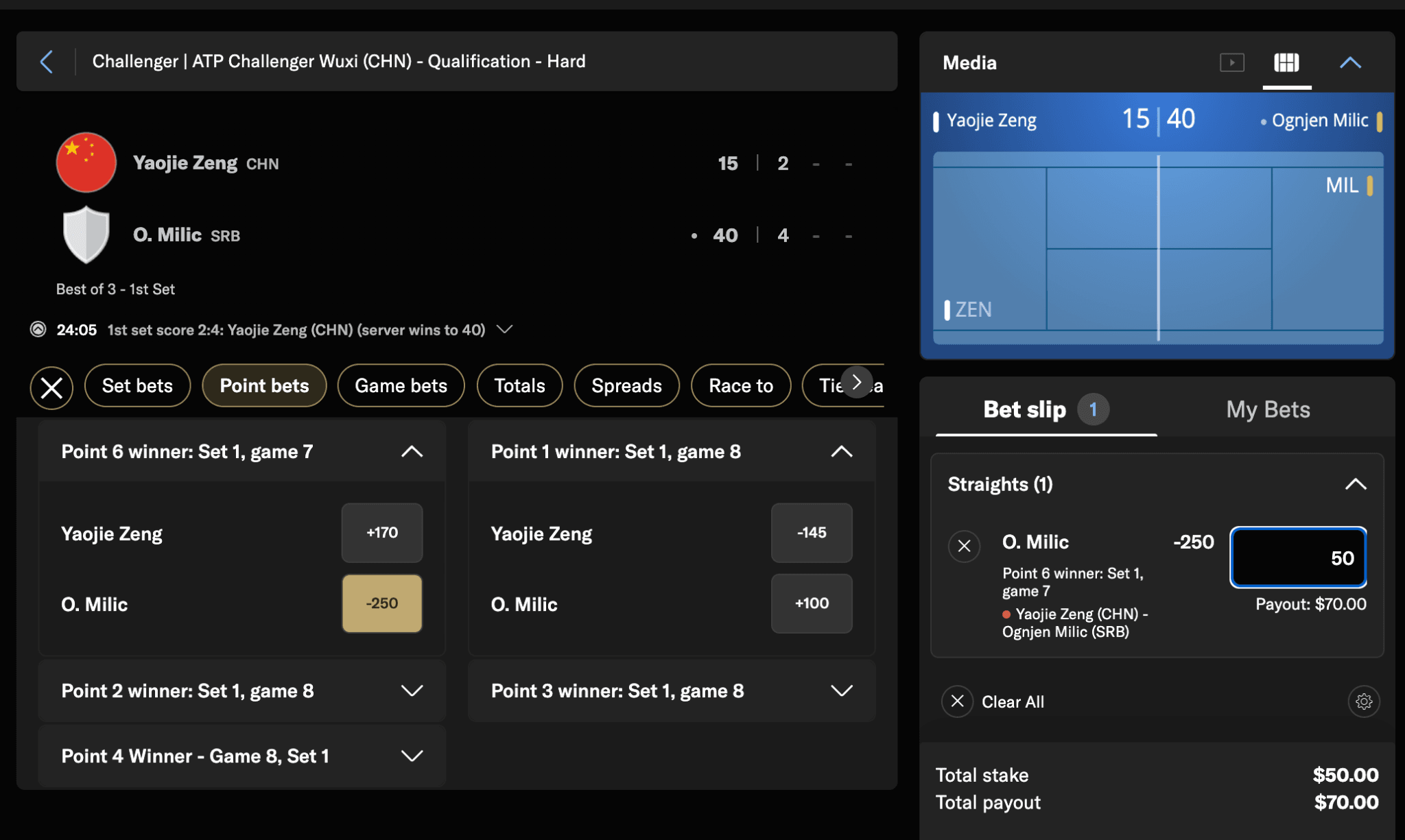
Credit: BetMGM Sportsbook – Screenshot captured by Felix Dubler on May 3
Micro betting inserts you in the middle of sporting events as you wager on thousands of potential in-game moments through platforms offering live NFL odds. However, if you don't understand the math, the vig, and the speed involved, you'll bleed money faster than almost any format in sports betting.
Every micro bet is independent and probability-based, past outcomes don’t influence the next result.
What Is Micro Betting?
Micro betting is a form of in-play wagering that focuses on the smallest events within a game, like next point in tennis, next play in the NFL (pass, rush, or punt), or whether the next NBA possession ends in a score.
DraftKings acquired Simplebet, the company that built the technology underpinning most micro markets in 2024 [1]. In-play handle now accounts for more than half of DraftKings' total betting volume [2].
How Micro Betting Works
Every micro bet begins with a data feed. Real-time betting systems connect to official real-time data providers, companies like Sportradar and Stats Perform, that track live game events with near-zero delay [3]. That data flows into an AI-powered pricing algorithm that generates odds for the next micro-event in milliseconds.
Once a point, play, or pitch resolves, the market closes, settles, and a new one opens. The whole cycle can take 3-10 seconds in tennis, and in the NFL, a new market opens in the window between the previous play being blown dead and the next snap.
Latency is the tricky aspect of this format. If you're watching a broadcast on TV, you're seeing the action 7 to 15 seconds after it happens due to encoding and transmission delays[4]. That means by the time you see Milic serving at 40-15, the reliable NBA wagering platforms’ algorithms already know the point is underway. If you bet based on what you see on screen instead of what's actually happening on court, you're effectively betting blind.
How Bookmakers Price Micro Markets
Pricing a next-point market in tennis is intuitive, as it's a two-outcome event. The book takes the player's serve statistics, the current game score, surface, recent form, and head-to-head data and then runs it through a model to generate a win probability. It then adds a market and converts the win probability to American odds.
The algorithm reprices continuously based on real-time inputs, including the current game score, set score, match score, momentum indicators, and who is serving. A server up 40-0 on a fast hard court gets priced very differently from the same server down 0-40.
The vig on micro markets is significantly higher than on standard pre-game lines [5]. On a standard NFL spread or NBA total, you're typically paying around 4.5% vig at -110 on both sides, but for micro bets the vig often runs between 5% and 10% and can push higher in fast-moving or ambiguous situations where the book is protecting its exposure.
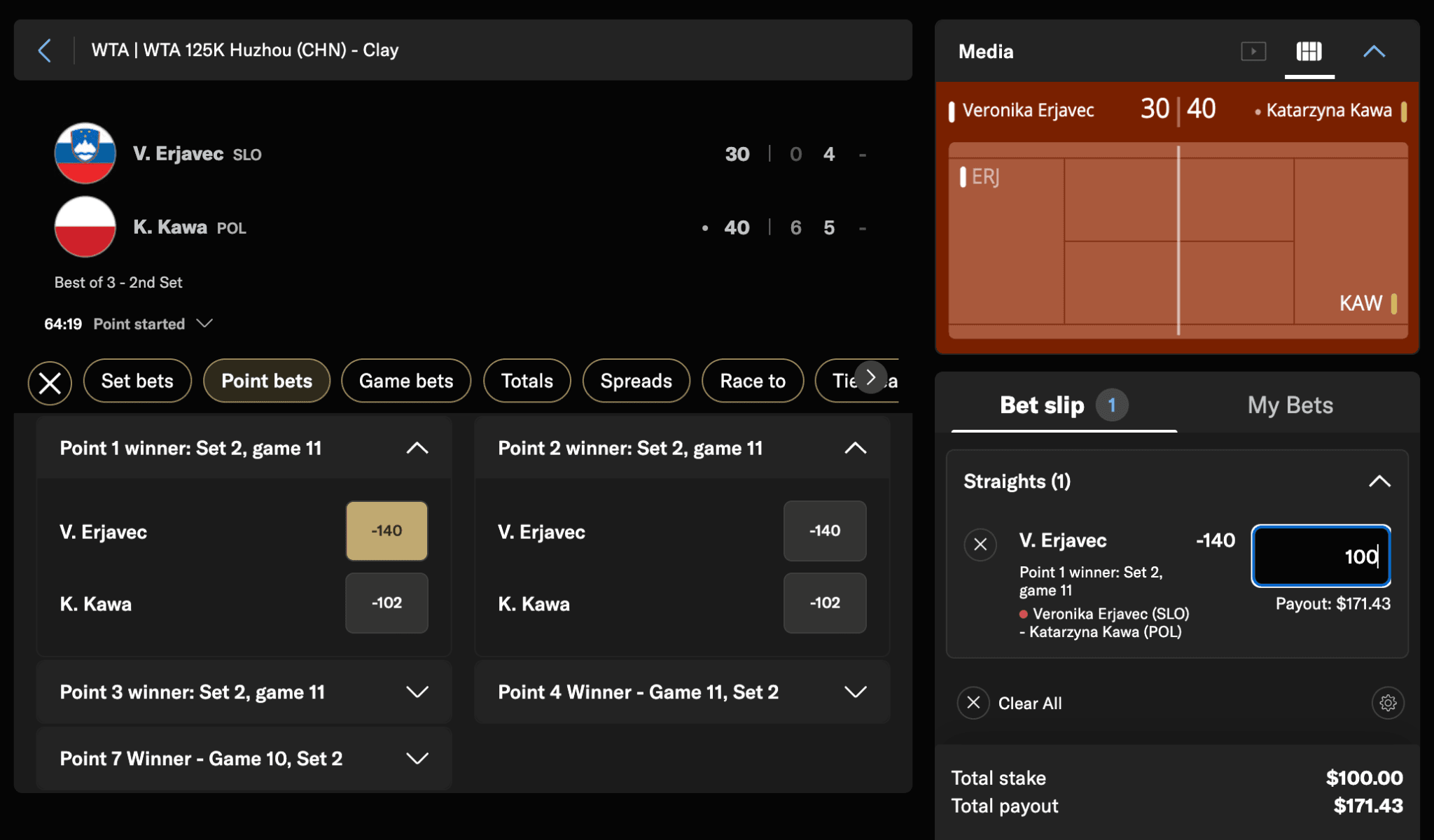
Credit: BetMGM Sportsbook – Screenshot captured by Felix Dubler on May 3
Consider a next-point market priced at Erjavec at -140 vs. Kawa at around -102. Erjavec's implied probability is 140/240 = 58.3%, and her opponent's implied probability is 50.50%, which results in an 8.83% vig, which is double your standard pre-match moneyline vig.
Understanding Probability in Micro Betting
The skill in micro betting is knowing when the book's implied probability is wrong and in which direction.
Take my $50 bet on Milic at -250 to win the next point. He was serving at 40-15. At -250, his implied win probability is 250/350 = 71.4%. However, this year Milic has won 79% of his first serve points and was serving very well in his match against Zeng.
I’ve also found that when players are up 40-0 or 40-15, they’re much more likely to serve fluidly and produce big first serves. So I estimated Milic’s chances of winning the next point at 80%. The book's price was lagging the true probability. I took the soft odds, and the Serbian’s forehand winner netted me $20 in profit.
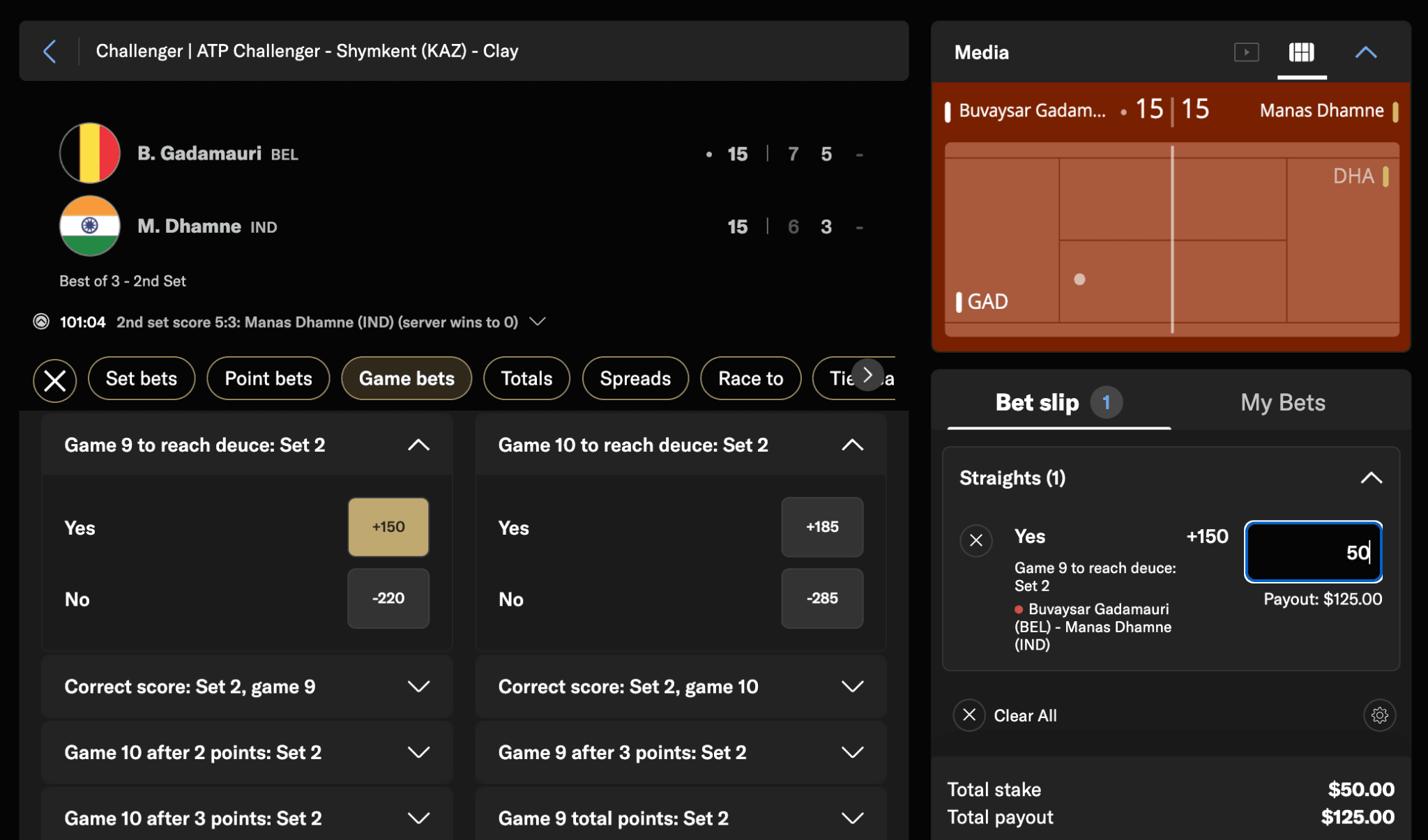
Credit: BetMGM Sportsbook – Screenshot captured by Felix Dubler on May 3
Contrast that with the Gadamauri/Dhamne match in the Final of the ATP Challenger Shymkent. I bet $50 on game 9 reaching deuce at +150. The score was 40-30 with Gadamauri serving. For deuce to happen, Dhamne had to win that one point.
In a relatively even Challenger match between 444 (Dhamne) and 320 (Gadamauri) in the world with an implied probability of 40%, the value was marginal at best. However, with Gadamauri winning only 58% of his points on first serve and Dhamne being such an immense talent, I thought it was worth a shot.
After a lengthy rally, Dhamne did force deuce, but the value was probably too thin, and in the future I’ll look for micro wagers with a greater spread between implied and true probability.
After researching the latest betting insights and predictions, the framework I use for every micro bet is
- Calculate true probability
- Compare to implied probability
- Only bet if there's a gap in your favor.
For serve-based markets specifically, a server's first-serve win percentage and second-serve win percentage are the two most predictive inputs. A player winning 75% of first-serve points and 55% of second-serve points who hits 65% of first serves in will win approximately 65-70% of their service points overall. If the market prices them at 60% on the next point, that's an edge. If it prices them at 75%, I pass.
When Micro Betting Works
I prefer to focus on tennis and have found three scenarios where micro betting makes sense:
Serve advantage in tennis
The serve creates a statistical asymmetry that micro markets don't always fully price. On fast surfaces, a dominant server like a Milic figure serving at 40-15 is a much stronger favorite than their general match odds suggest. Backing the server at the right score, particularly at 40-0 or 40-15 on markets that are slow to update, can produce value.
Score-context arbitrage
Books sometimes lag on repricing after a rapid sequence of events. If a game swings 0-40 to 40-40 in three quick points, the book's model may take a moment to fully integrate the momentum shift [6].In that window, the server who just won three straight points may be underpriced.
High-pressure point identification
In tennis, certain points like break or set points carry outsized psychological weight [7]. Research shows that servers underperform on break points relative to their baseline stats [8]. If a book prices a server at 40-AD as if they're holding serve at their standard rate, there may be value on the returner.
Conclusion
Micro betting is the most technically demanding format in US sports betting and also one of the most entertaining. There are windows to exploit like serve-score dynamics and pressure-point underperformance in tennis as well as situational play-calling in the NFL, but they're narrow and they close fast.
The vig is higher than standard markets, and the format's pace, where a new market opens every few seconds, creates constant psychological pressure to bet more than you should.
I pick one sport and one market type and master it before expanding. Tennis next-point betting on serve-heavy hard-court Challenger matches is where I've found the most identifiable patterns. Remember to watch the lowest-latency streams and calculate probability before every bet, and flat stake!
FAQs
What is micro betting?
Micro betting is a form of live in-game wagering where you bet on the outcome of the smallest moments within a sporting event like the next point in tennis or the next play in the NFL.
How fast do micro betting markets update?
Micro betting markets update in near real time, typically within 1-3 seconds of a new event beginning and powered by official data feeds from providers like Sportradar. TV broadcasts run 7-15 seconds behind live action.
Is micro betting profitable?
For the vast majority of bettors, no. The vig on micro markets is often close to 10%, which is much higher than standard pre-game lines, and the speed of markets leaves little time for analysis.
What sports offer micro betting?
In the US, micro betting is most widely available on the NFL (next play type, drive outcome), MLB (next pitch result, at-bat outcome), NBA (next possession score, next basket scorer), and tennis (next point winner, game-to-deuce). DraftKings and bet365 offer the broadest coverage.
How risky is micro betting?
Micro betting carries higher risk than standard sports betting for several reasons. The vig is steeper, the pace encourages over-betting, and latency puts casual bettors at a disadvantage.

Chad Nagel is a passionate sports fanatic who has worked in the sports and betting industry for over a decade. He spent most of his career as an editor-in-chief for Soccer Betting News, South Africa’s leading soccer betting newspaper, owned by Hollywoodbets. His articles have also featured in some of the most respected sports media platforms in the world, such as SPORTbible, Sports Illustrated, Combat Sports UK, and many others.
Comments
0 comments
No comments yet. Be the first to share your thoughts!
References
- 1.[1] - This official DraftKings press release verifies the article's claim that DraftKings acquired Simplebet. Accessed May 3 2026.
- 2.[2] - This source verifies the article's claim that in-play handle accounts for more than half of DraftKings' total betting volume. Accessed May 3 2026.
- 3.[3] - This source verifies the article's claim that sportsbooks connect to official real-time data providers like Sportradar. Accessed May 3 2026.
- 4.[4] - This source verifies the article's claim about TV broadcast latency, confirming that live broadcasts run significantly behind real time. Accessed May 3 2026.
- 5.[5] - This source verifies the article's claim that micro market vig runs significantly higher than the standard. Accessed May 3 2026.
- 6.[6] - This source verifies the article's score-context arbitrage concept, confirming that bookmakers can lag. Accessed May 3 2026.
- 7.[7] - This Tennis Abstract research verifies the article's claim about high-pressure points in tennis carrying outsized psychological weight and statistical significance. Accessed May 3 2026.
- 8.[8] - This peer-reviewed PubMed study on serve performance at break points at Wimbledon 2016 directly supports the article's claim that servers underperform on break points. Accessed May 3 2026.
Related Resources to Betting Academy
- Player Props Betting Explained: Odds, Strategy & How It Works
- Buffett Warns Sports Betting Lets Governments Cash In on the Naïve
- The CFTC Takes 5 States To Court Over Prediction Markets & Betting
- Buenos Aires Blocks 251 Unlicensed Online Betting Platforms in Sweeping Regulatory Crackdown
- Responsible Gambling USA: Setting Limits on Betting Apps
- NFL Betting Guide: How to Enjoy the Playoffs & Super Bowl on a Budget
- Parlay Betting Explained: Hidden Vig, EV & Real Profit Math
- What does “Free Bet” Mean in Gambling Marketing?
- Teaser Betting Explained: Odds, Spreads & Strategy
- NFL Interim Coach Bump: What the Data Actually Says
- Here’s how a Hamstring Injury During an NFL Game Impacts Spread
- How Online Casino Games Can Keep NFL Bettors Engaged Between Games
- Best NFL-Themed Slots to Play When There's No Game On
- Future of Casino Loyalty Programs
- How to Build a 15-Leg NFL Parlay with $10
- How to Complete KYC Before NFL Sunday Kickoff
- Why $1 Crash Game Bets Are Popular with US Sports Bettors
- Kalshi’s Masters Trading Surge Shows Sports Becoming a Bigger Growth Engine
- States Are Cracking Down on the Entire Gambling Frontier
- Over/Under Betting: Everything You Need To Know