
Betting Academy
Player Props Betting Explained: Odds, Strategy & How It Works
With the Lakers leading the Rockets 3-1 and Game 5 on Tuesday, April 29th, at Crypto.com Arena, I was running through my options. Luka Dončić remains out with a Grade 2 left hamstring strain and hasn't played a single minute this postseason.

SportsBoom offers honest and impartial bookmaker reviews to help you make informed choices. While we may earn commissions through affiliate links, our content remains independent and free from promotional influence. For more information, see our Content Transparency and How We Review pages.
Player props!
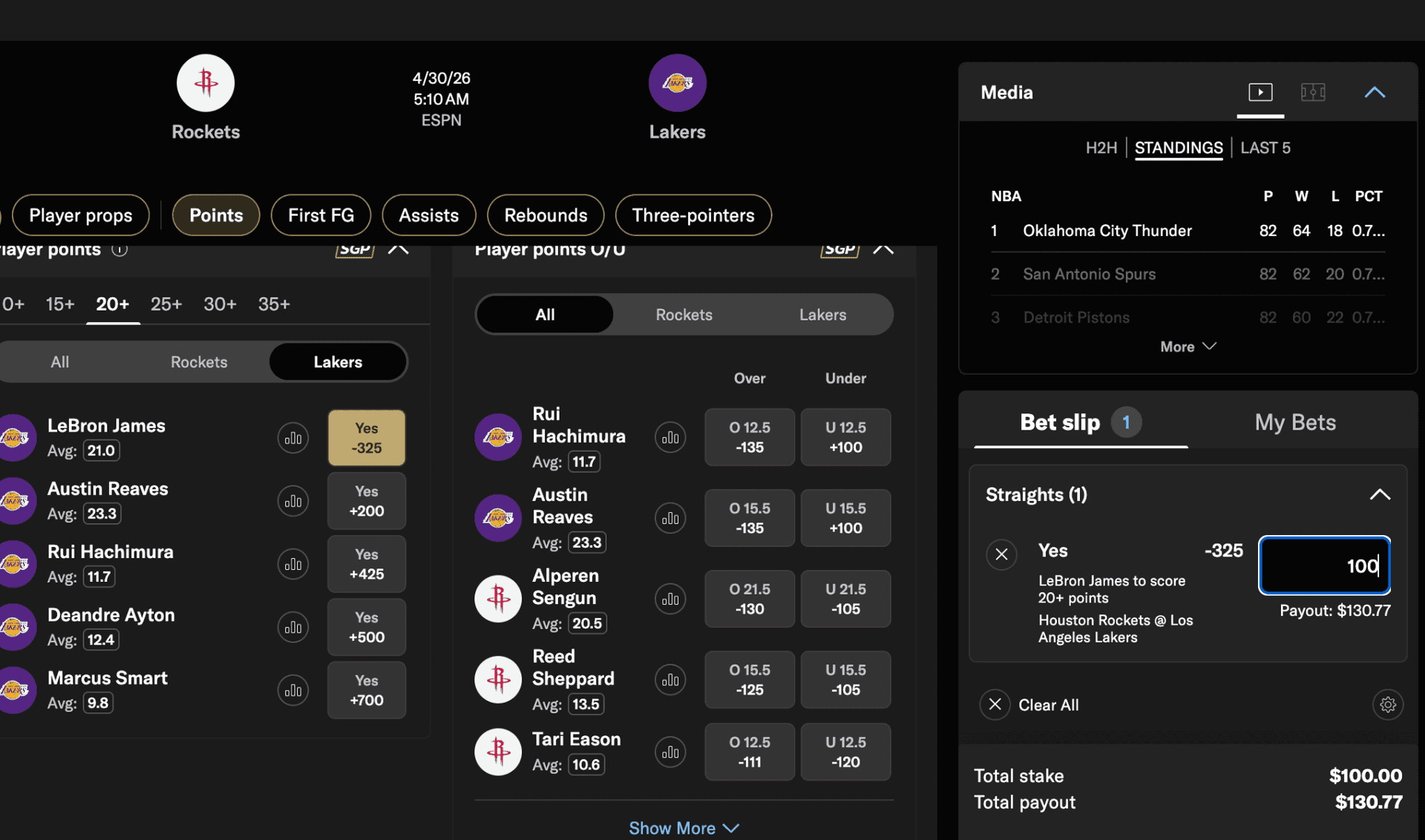
That means LeBron James at 41 years old is once again shouldering everything. He'd already delivered a 29-point, 13-rebound, six-assist, three-steal performance in Game 3, and with a chance to end the series in front of a home crowd, I expected him to show up again. So I put $100 on LeBron to score 20+ points at -325.
How to Bet on Player Stats
In this guide, I'll teach you how player props work, how licensed sportsbooks price them, where the real edges are, and the mistakes that bleed most bettors dry before they even realize it.
What Is Player Props Betting?
Player props betting is wagering on a specific player’s statistical outcome in a single game, instead of the final result. At NBA sportsbooks and NFL bookmakers, these bets focus on measurable performance outcomes., these bets focus on measurable performances like points, assists, rebounds, passing yards, or even specific events such as scoring first. Instead of picking which team wins, you’re predicting how an individual player performs within the game.
For example, you place a $50 bet on Nikola Jokić to score the first field goal against the Timberwolves at +500. If Jokić scores first, the bet wins irrespective if the Nuggets win the game.
The first mainstream player prop bet was on William “The Refrigerator” Perry scoring in Super Bowl XX (1986). Set at 20-1, he still got the touchdown, costing Caesars over $100,000 on a single bet.
How Player Props Betting Works
Player props are easy to wrap your head around because you’re simply wagering on a player to achieve something in a game, but how do you actually analyze bets?
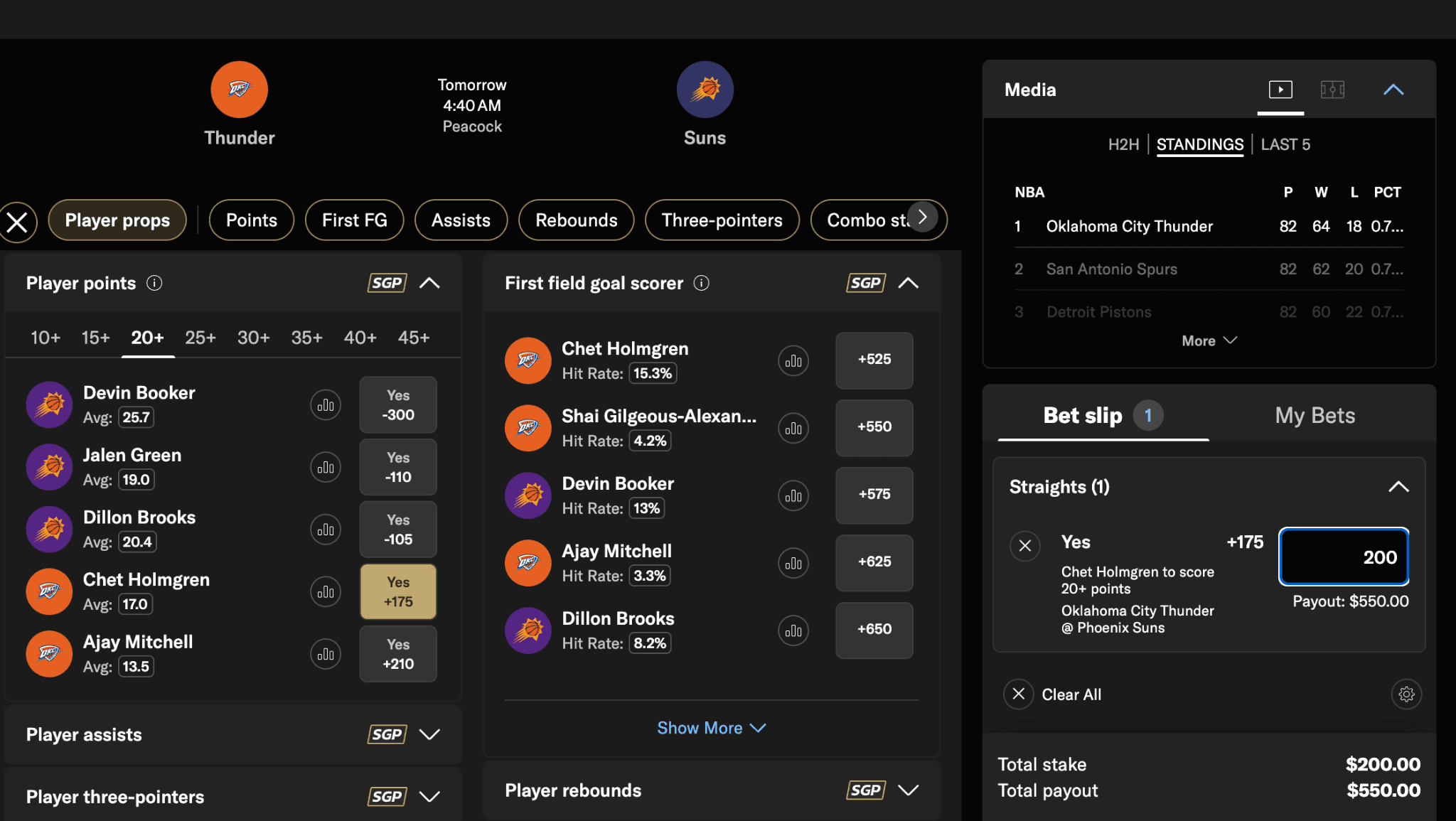
You start by selecting a market. I was looking at Chet Holmgren over 20 points against the Suns on April 27th at +175 on DraftKings. This is how I actually thought through the potential bet:
Holmgren is averaging 17.1 points this season. In his last 10 games, he'd scored 20+ points exactly twice. So I ran my own estimate: in roughly 20% to 25% of games, he crosses that threshold. Holmgren can disappear for stretches, especially in playoff settings where defensive schemes tighten significantly.
Now, this is the critical step most bettors skip. I converted +175 into implied probability using the standard formula: 100 ÷ (175 + 100) = 36.4%. That's the sportsbook's assessment of how likely Holmgren scores 20+.
My estimate is ~25%, and the book's estimate is 36.4%. The book was giving him substantially more credit than my analysis justified. So I ultimately passed on the bet.
How Player Props Betting Works
Before placing any prop, convert the odds to implied probability. This tells you what the book thinks the true probability of the outcome is and whether the price is worth paying.
The formula for negative odds is the absolute value of the odds divided by (the absolute value of the odds + 100). For positive odds: 100 divided by (the odds + 100).
Many prop bets use an over/under format. Leading NBA betting operators set a stat line, and you wager on whether the final number goes above or below it. Because both sides are tied to the same stat, the odds are often close, though they may shift slightly based on player usage, opponent tendencies, or game conditions.
Also if a player is ruled out before a game starts and never enters the game, the bet is usually voided. The wager is effectively canceled, and your stake is returned. Always check the injury report before props settle.
Drivers of Value in Player Props
Based on the latest betting insights and predictions and from tracking player props across an NBA and NFL season, these four situations consistently produce edges that standard pricing doesn't fully account for.
Injury Replacement Windows
When a starter is ruled out, sportsbooks move fast. The injured player's line is pulled, yet the flow-on effects across the rest of the lineup take longer to price in.
Minutes expand, shot volume climbs, and playmaking responsibilities shift. A backup projected for 18 bench minutes can suddenly be thrust into a 30+ minute role in a favorable matchup.
I've been exploiting this all series with the Lakers. With Luka out, Marcus Smart has been averaging 17+ points, and LeBron's usage has spiked to levels we haven't seen since his Cleveland days.
Mean vs. Median Confusion
Most bettors look at a player's season average and compare it to the line. However, sportsbooks price props closer to the median where outcomes split 50/50. A few big games can inflate the average above the median.
I got burned by this early in the season betting Holmgren overs. His average looked comfortably above the line, but four monster games were dragging that number up. His median game told a completely different story.
Low-Volume, High-Variance Markets
The heavily traded points market is priced much tighter than the lower-volume blocks and steals markets. This is a recurring pattern across sports, with low-volume and high-variance prop categories consistently offering better value.
I've had my best results on assists, steals, and blocks props, particularly in playoff games where the public money floods the points markets. Books simply don't sharpen those lines as aggressively.
Opponent Defensive Matchup Gaps
The Rockets, playing without Kevin Durant for much of this series, have been giving up easy drives to the paint. LeBron's points line barely budged between Games 2 and 3 despite Durant being out, giving clear value on the over for anyone running the defensive numbers. When a star defender is unavailable, most bettors don't notice the downstream effect on opponent prop lines.
Common Player Prop Mistakes
Don’t get caught on my simply betting only on players based on their averages or failing to ignore blowout risk and your favorite player getting benched!
Relying only on season averages
One of the biggest mistakes in betting NFL player props is people only relying on averages. So many bettors see that a player averages 51 receiving yards and his line is set at 48.5, so they automatically bet the over.
Averages are a decent place to start your research, but you need to go further. That player may have had one really big game that pulled up his average, while his other six games have all been around 40 yards. Dig into the median and the distribution.
Chasing long shot props
Long shot props like first touchdown scorer and player to record a triple-double usually carry massive vig. The implied probability is much lower than the real probability. Stick to two-way over/under markets where the pricing is tightest.
Betting into moved lines
Books move fast after big news. If you see a player's assists prop go from -110 to -135 in an hour, the value's probably gone. Get in early, or pass if the edge has disappeared. Prop markets run low limits, and a single sharp bet can shift a line several points within minutes.
Ignoring game context
When a team plays a defensively porous opponent at home and frequently builds an early lead, a star player's minutes can be managed aggressively in blowout situations.
A player's line is calculated based on competitive games where they play 35+ minutes and run the offense deep into the fourth quarter. If they get benched, their totals are going to nose-dive.
Conclusion
Player props are about pricing individual performances better than the sportsbook. Start by looking at a player’s median stats and then adjust based on recent results, game context, and other factors like injuries.
Then come up with your line and compare it with the sportsbooks. If your estimated probability is at least 5%+ higher, then you’ve found a player prop worth taking!
Player Props FAQ
What are player props?
Player props are wagers not tied to a game's outcome or season-long result. They focus on individual player milestones and specific statistical categories within a single game, like points scored, passing yards, and rebounds.
How do sportsbooks set prop lines?
Books start with a player's historical statistical distributions and adjust for matchup, pace, usage, and injury news.
Are player props profitable long-term?
Successful prop betting comes down to finding markets where you can analyze player statistics more effectively than the sportsbook.
Which sports have the best prop markets?
Basketball's high scoring and extensive statistics make it ideal for prop betting where you can wager on points, rebounds, assists, three-pointers, steals, blocks, turnovers, and combined stats. NFL props are the most popular, especially passing and rushing yards.
What affects player prop outcomes the most?
Player prop outcomes are often influenced by usage and matchup conditions like minutes played and the opposing team's defensive rating at the relevant position. Injuries to teammates are the single biggest repricing event, particularly for assists and shot volume markets.

Chad Nagel is a passionate sports fanatic who has worked in the sports and betting industry for over a decade. He spent most of his career as an editor-in-chief for Soccer Betting News, South Africa’s leading soccer betting newspaper, owned by Hollywoodbets. His articles have also featured in some of the most respected sports media platforms in the world, such as SPORTbible, Sports Illustrated, Combat Sports UK, and many others.
Comments
0 comments
No comments yet. Be the first to share your thoughts!
Related Resources to Betting Academy
- Buffett Warns Sports Betting Lets Governments Cash In on the Naïve
- The CFTC Takes 5 States To Court Over Prediction Markets & Betting
- Buenos Aires Blocks 251 Unlicensed Online Betting Platforms in Sweeping Regulatory Crackdown
- Responsible Gambling USA: Setting Limits on Betting Apps
- NFL Betting Guide: How to Enjoy the Playoffs & Super Bowl on a Budget
- Parlay Betting Explained: Hidden Vig, EV & Real Profit Math
- What does “Free Bet” Mean in Gambling Marketing?
- Teaser Betting Explained: Odds, Spreads & Strategy
- NFL Interim Coach Bump: What the Data Actually Says
- Here’s how a Hamstring Injury During an NFL Game Impacts Spread
- How Online Casino Games Can Keep NFL Bettors Engaged Between Games
- Best NFL-Themed Slots to Play When There's No Game On
- Future of Casino Loyalty Programs
- How to Build a 15-Leg NFL Parlay with $10
- How to Complete KYC Before NFL Sunday Kickoff
- Why $1 Crash Game Bets Are Popular with US Sports Bettors
- Kalshi’s Masters Trading Surge Shows Sports Becoming a Bigger Growth Engine
- States Are Cracking Down on the Entire Gambling Frontier
- Over/Under Betting: Everything You Need To Know
- Parlay Bets Explained: How They Work and Why They’re Risky