
Betting Academy
NFL Interim Coach Bump: What the Data Actually Says
Every time an NFL head coach gets fired mid-season, the same narrative ignites across sports media and betting forums: the team is about to get a "bump."

SportsBoom offers honest and impartial bookmaker reviews to help you make informed choices. While we may earn commissions through affiliate links, our content remains independent and free from promotional influence. For more information, see our Content Transparency and How We Review pages.
NFL Interim Coach Bump
Players rally behind new leadership, the locker room breathes again, and NFL bettors rush to back the emotionally recharged squad. But is this bump real? Let’s see what data has to say!
What the Numbers Actually Show
What the Numbers Actually Show
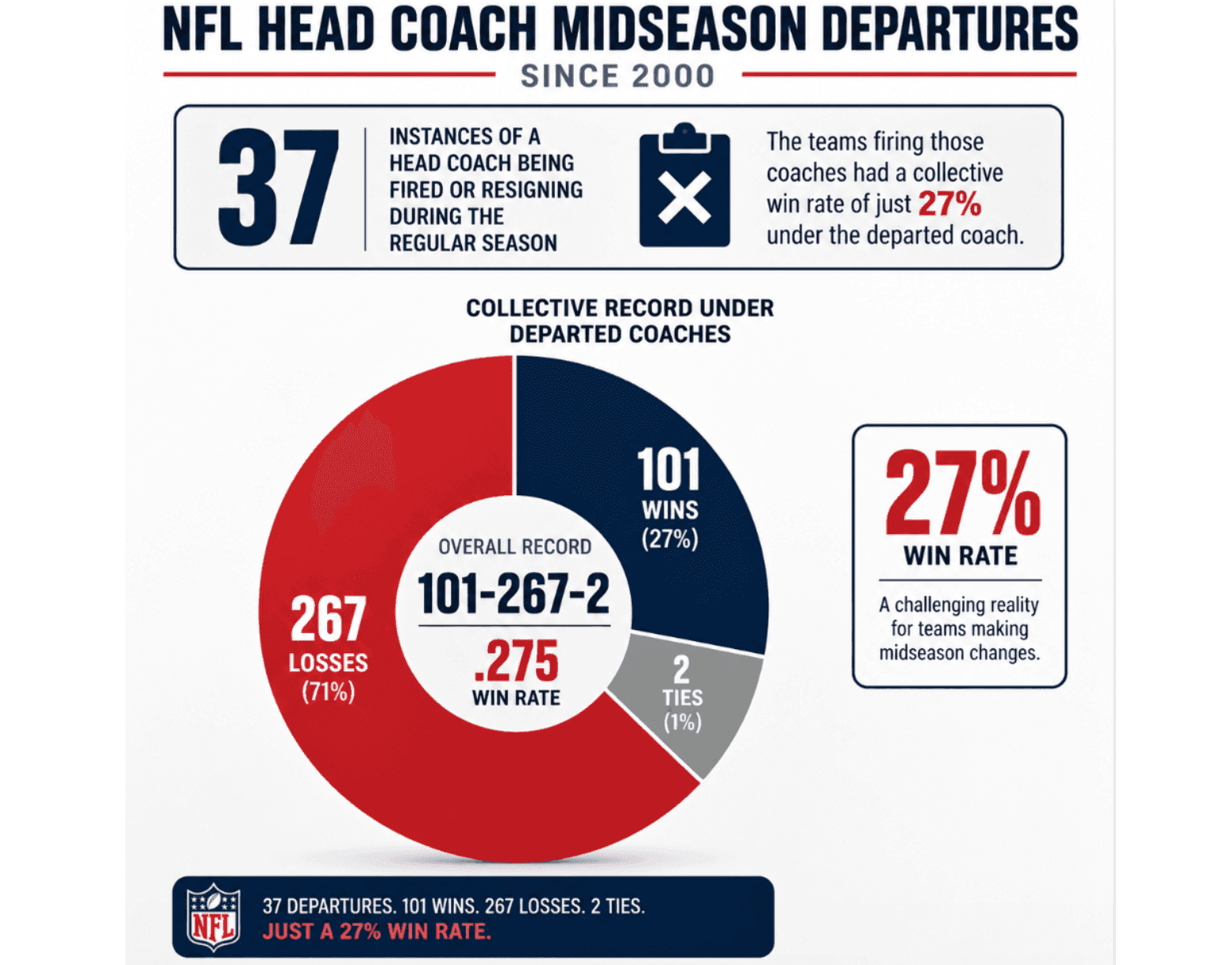
According to NFL research, since 2000 there have been 37 instances of a head coach being fired or resigning during the regular season. The teams firing those coaches had a collective win rate of just 27% under the departed coach (101-267-2 record).
Under interim successors, those same teams improved to a 39% win rate (88-140), a significant jump on the surface. In the debut game specifically, interim coaches are 20-30 straight up since 2000, a 40% win rate.
Since 2014, teams in their first game under an interim head coach have gone 15-4 ATS, covering the spread by 4.2 points per game on average and increasing their point differential by 16.3 points per game.
BetIQ data from 2010 onward shows interim coaches who take over by Week 6 win outright 62.5% of the time in debut games, while those inheriting a team in Week 13 or later win just 33.3% of the time straight up. So the bump is real, but why?
Regression to the Mean
The most statistically honest explanation for the interim coach bump is not the new coach at all. It is regression to the mean. This principle holds that when a team experiences an extreme negative stretch of results, a return toward average performance is statistically probable regardless of a new coach.
Coaches are fired precisely when teams hit rock bottom. Extreme losing streaks involve compounding bad luck: tight losses in one-score games, untimely turnovers, injury misfortune, and the kind of statistical variance that is unlikely to sustain itself indefinitely.
When researchers from Sportico examined this data, they found that under fired coaches, affected teams won just 27% of games and then improved to 39% under interims.
That 12-point swing looks like evidence of the "bump," but what it actually reflects, in large part, is that the extreme losing was always going to partially self-correct.
The Motivation Factor
Where the interim bump does appear to carry causal weight is through the motivation factor, the short-term emotional and psychological response players exhibit to a coaching change. The evidence is anecdotal but consistent enough to take into consideration.
When Antonio Pierce replaced Josh McDaniels in Las Vegas in November 2023, the Raiders responded with a 30-6 blowout of the New York Giants the following week, easily covering their -1.5 spread. Romeo Crennel's 2020 Houston Texans, inheriting a 0-4 team, immediately defeated Jacksonville 30-14 in his interim debut, with Crennel becoming the oldest head coach in NFL history at 73 to do so.
When a coach who has lost a locker room is removed, players experience relief, renewed purpose, and a desire to prove themselves to incoming leadership. Online betting sites acknowledge the phenomenon. However, this boost in motivation is typically only temporary.
The Duration Problem - When the Bump Vanishes
The most damning evidence against the interim coach bump as a sustained strategy is what happens after the debut. When coaches take over in Week 12 or earlier, interim teams cover the spread at a 73.3% rate in the first game.
By contrast, when looking at the full body of games played by interim coaches across a season, the overall win rate settles back toward 39-46%, barely above the baseline expected for teams of their caliber.
This pattern is a statistical anomaly masquerading as a trend. The first-game spike is real but unsustainable, driven by a combination of regression to the mean and emotional motivation.
The Sample Size Warning
The Sample Size Warning
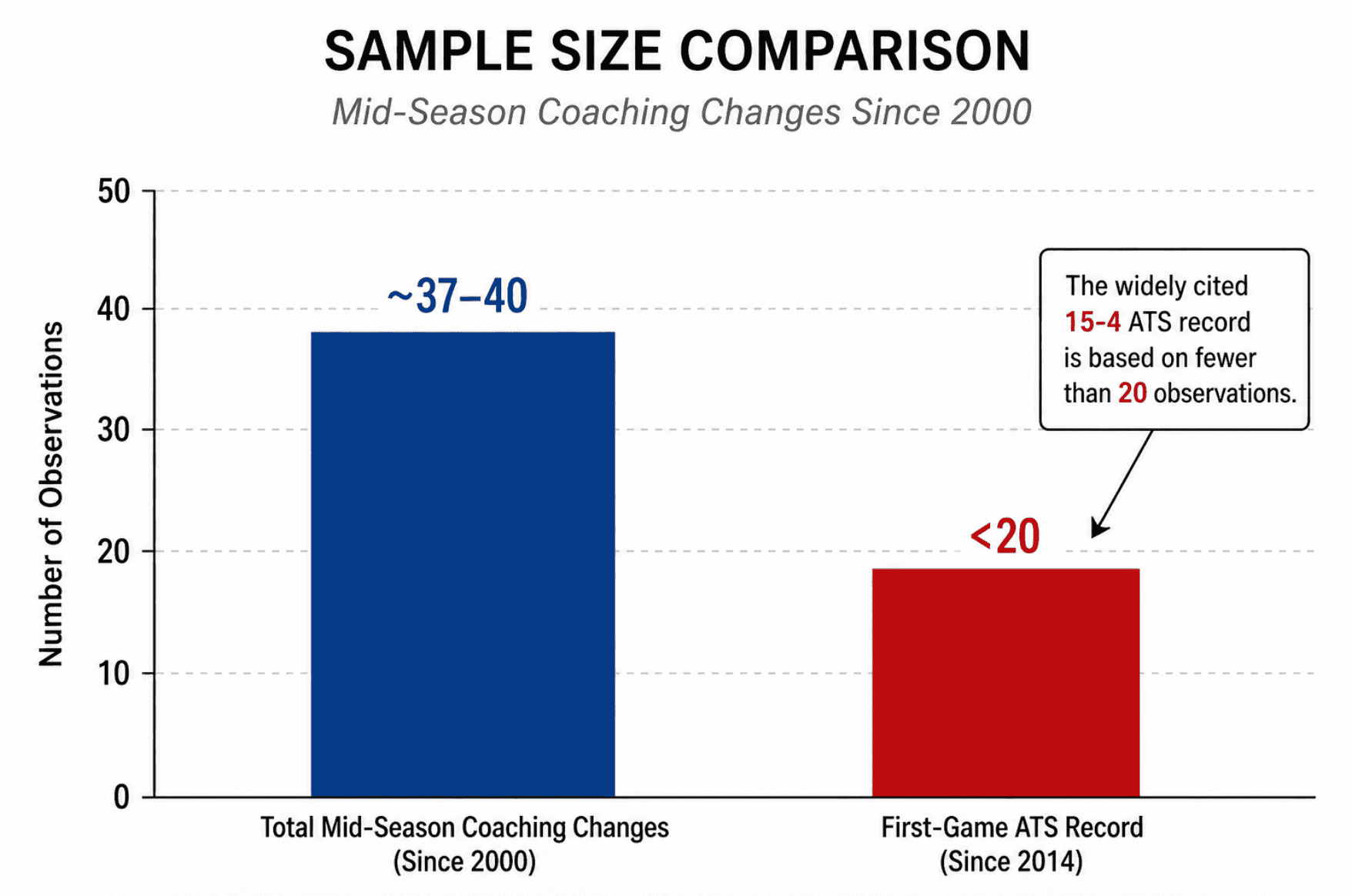
Any honest analytical framework must acknowledge the sample size problem at the heart of this debate. Since 2000, there have been roughly 37-40 mid-season coaching changes.
The first-game record of 15-4 ATS since 2014, the most cited "proof" of the bump, is derived from fewer than 20 observations. In statistical terms, that is insufficient to establish a reliable and repeatable pattern. A coin flipped 19 times can produce 15 heads without being a biased coin.

Chad Nagel is a passionate sports fanatic who has worked in the sports and betting industry for over a decade. He spent most of his career as an editor-in-chief for Soccer Betting News, South Africa’s leading soccer betting newspaper, owned by Hollywoodbets. His articles have also featured in some of the most respected sports media platforms in the world, such as SPORTbible, Sports Illustrated, Combat Sports UK, and many others.
Comments
0 comments
No comments yet. Be the first to share your thoughts!
Related Resources to Betting Academy
- Here’s how a Hamstring Injury During an NFL Game Impacts Spread
- How Online Casino Games Can Keep NFL Bettors Engaged Between Games
- Best NFL-Themed Slots to Play When There's No Game On
- Future of Casino Loyalty Programs
- How to Build a 15-Leg NFL Parlay with $10
- How to Complete KYC Before NFL Sunday Kickoff
- Why $1 Crash Game Bets Are Popular with US Sports Bettors
- Kalshi’s Masters Trading Surge Shows Sports Becoming a Bigger Growth Engine
- States Are Cracking Down on the Entire Gambling Frontier
- Over/Under Betting: Everything You Need To Know
- Round Robin Betting Guide: How It Works and Key Tips
- Parlay Bets Explained: How They Work and Why They’re Risky
- How Live Betting Affected the Sports Industry
- High Sportsbook Taxes Hurt Bettors Before They Hurt Operators
- How Contract Holdouts Can Help Predict NFL Trades
- Kalshi Notches Legal Win in New Jersey as Sports Prediction Court Battles Rage On
- Why the Future of Sports Prediction Markets Hangs in Balance
- How to Use a Bonus Bet to Hedge an NFL Trade Prediction
- Sports Betting Is Changing the Way Fans Watch the NFL and NBA
- Are All Sportsbook Sponsors in the NFL and NCAA Actually Legal?