
Betting Academy
Cash Out Betting: How It Works and When It’s Worth It
You've got $100 on the Magic covering +8.5 against the Pistons. Orlando leads by 12 heading into the fourth quarter, and your sportsbook is offering you $50 in profit. Is this offer worth it?

SportsBoom offers honest and impartial bookmaker reviews to help you make informed choices. While we may earn commissions through affiliate links, our content remains independent and free from promotional influence. For more information, see our Content Transparency and How We Review pages.
Cash Out Betting Explained
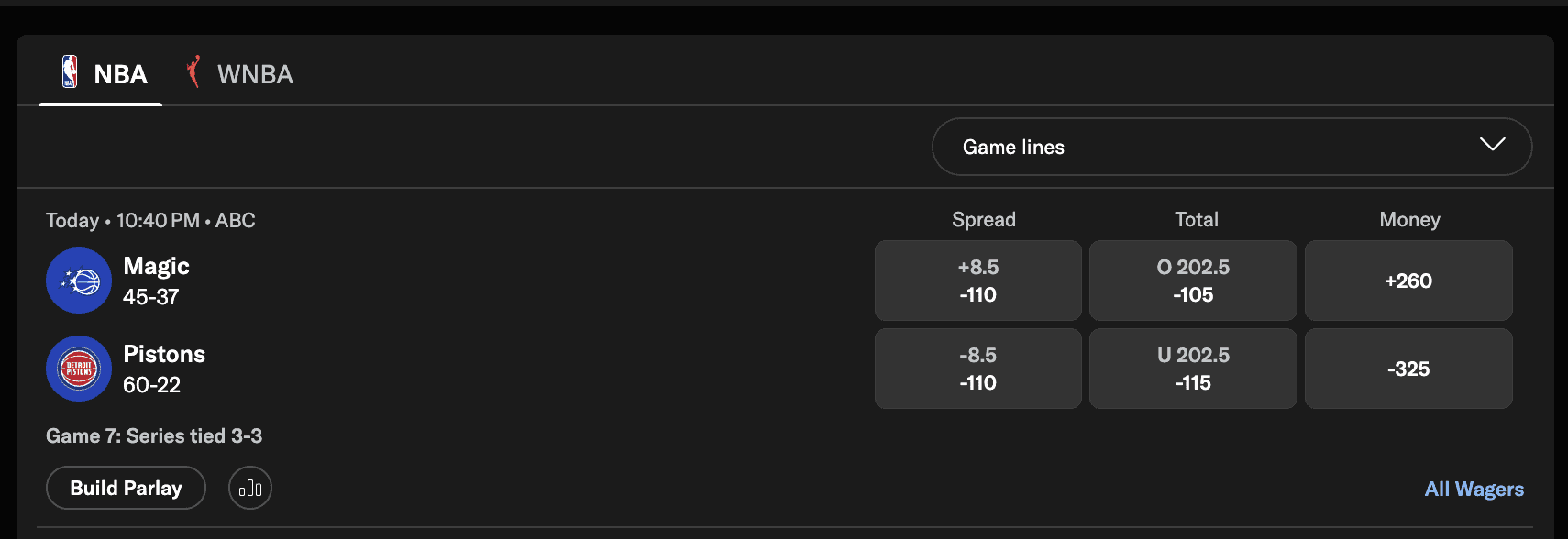
Credit: BetMGM Sportsbook – Screenshot captured by Felix Dubler on May 3
Keep reading as I show you how licensed sports betting platforms come up with cash out offers, why they’re often poor value, and how you can still lock in superior EV!
Remember cash out reflects reduced risk, not full value. You’re usually accepting less than true expected value.
What Is Cash Out Betting?
Cash out is a feature offered by the best NBA betting platforms that lets you settle a bet early, before the game or event ends, in exchange for a guaranteed payout [1]. That payout will be less than your full potential winnings if you let the bet run but more than zero if the bet eventually loses .[2]
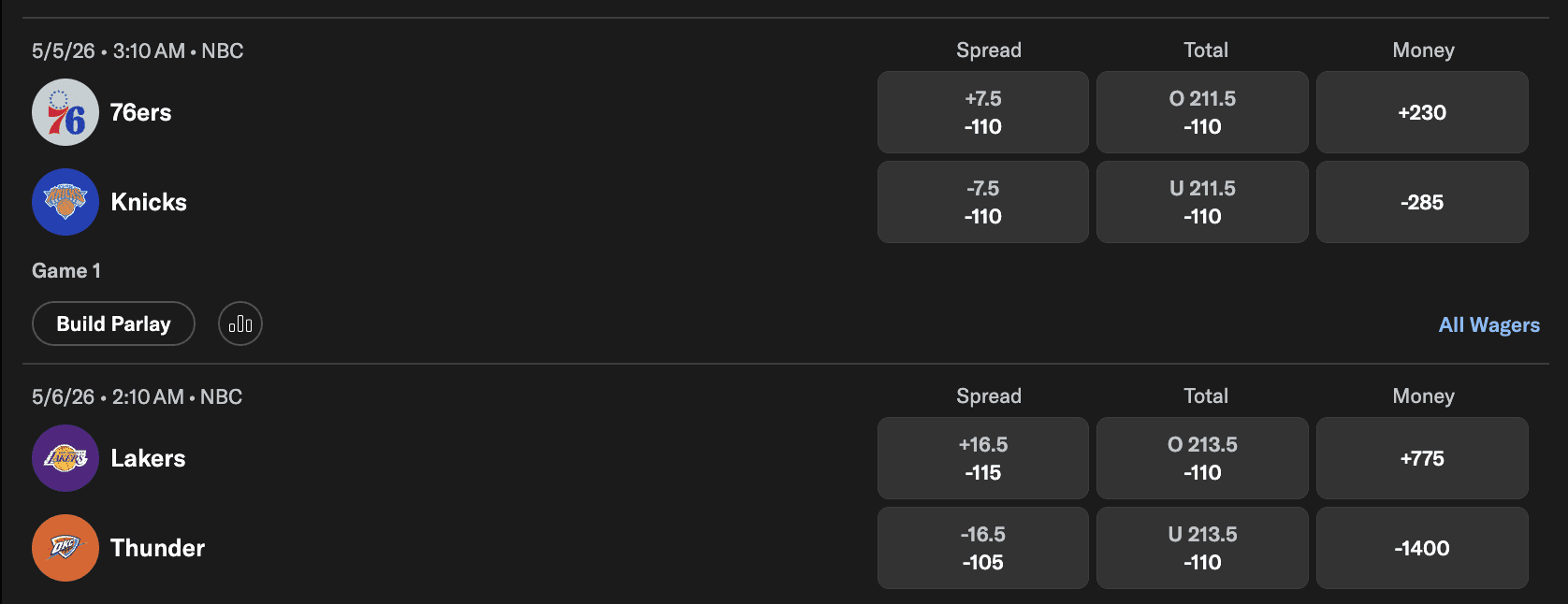
Credit: BetMGM Sportsbook – Screenshot captured by Felix Dubler on May 3
Let’s say you bet $110 on the 76ers/Knicks over 211.5 total points at -110. Both teams come out firing, and by halftime the score is 114-98, putting you way ahead of pace. Your sportsbook now offers you $180 to cash out, locking in a $70 profit right now.
How Cash Out Betting Works
Live NFL wagering platforms don't pull cash out figures out of thin air. There's a live calculation running behind the scenes, which constantly updates based on three main inputs [3].
Current implied probability
As the game moves, the book continuously re-prices the probability of your bet winning based on live odds. If you bet Orlando Magic +8.5 and they've stormed out to a 15-point lead, the book's model now assigns a high probability that the spread is covered. That shifts your cash out offer upward.
Time remaining
More time left in the game creates more variance. A 15-point lead in the first quarter is far more fragile than one with two minutes to go. The book factors in how much of the game remains, because longer time horizons introduce more ways your bet can unravel (or recover).
Original bet terms vs. current market
The formula most books use looks roughly like this: Cash Out Value = (Stake x Current Win Probability) ÷ Original Win Probability [4]. That gives you the fair value of your position before the book applies its margin on top.
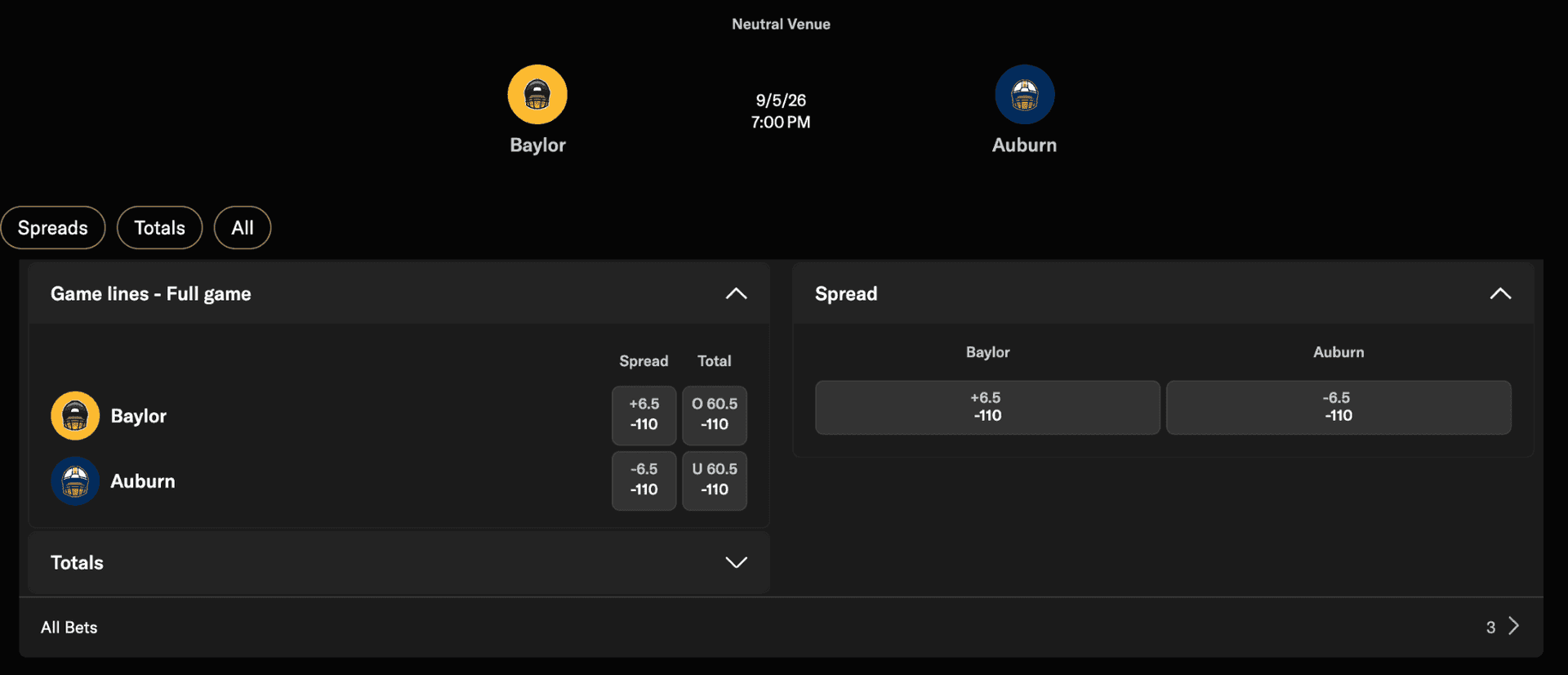
Credit: BetMGM Sportsbook – Screenshot captured by Felix Dubler on May 3
For example, you bet $110 to win $100 on Baylor +6.5 at -110. Baylor is up by a touchdown at halftime. The live market now prices Baylor covering at 78% probability. The fair value of your cash out would be approximately $110 x (0.78 ÷ 0.5) = $171.60. The sportsbook will then offer you 10% to 30% less.
Why Cash Out Prices Are Lower Than Fair Value
Sportsbooks use the cash out feature to generate even more revenue. The book already extracted their margin when you placed your original bet at -110 odds [5]. When you cash out, they apply another layer of margin on the settlement price.
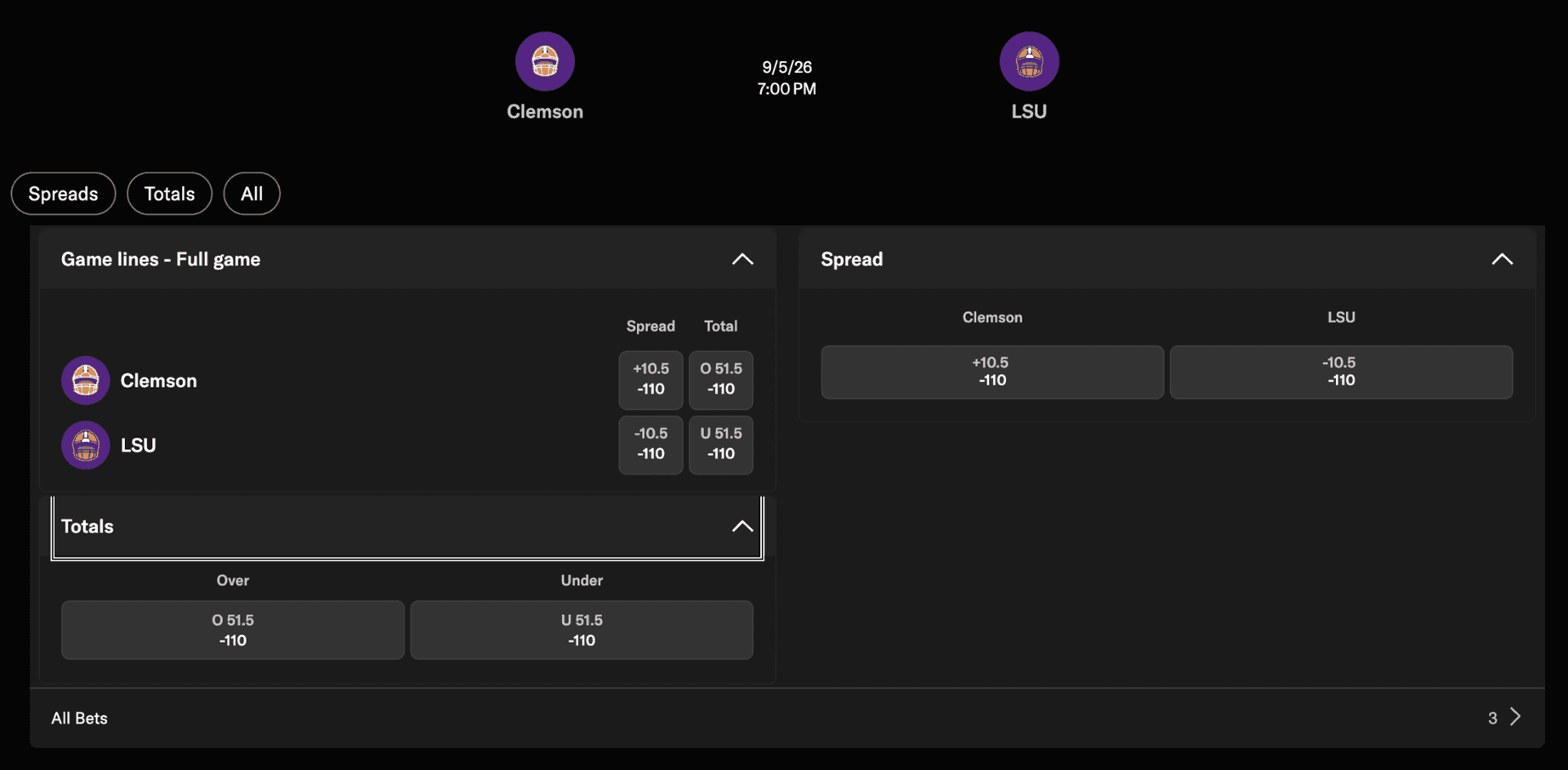
Credit: BetMGM Sportsbook – Screenshot captured by Felix Dubler on May 3
For example, if you bet $110 on the over 51.5 points for Clemson vs LSU at -110. Midway through the third quarter, the game is at 42 total points, with Clemson threatening to score. The true probability that the over hits might be around 72%.
Fair value of your position: $210 (your potential payout) x 0.72 = $151.20.
However, the sportsbook only offers $121, which is a 20% discount on fair value. That gap is the sportsbook’s profit. It’s common for sportsbooks to offer 10% to 30% below fair value.
Understanding Probability in Cash Out Decisions
This is how I evaluate every cash out offer before deciding what to do. I calculate my own expected value (EV) and compare it to the cash out number.
The formula is EV = (Win Probability x Potential Win Amount) – (Loss Probability x Stake)[6]
Say you bet $110 on the 76ers/Knicks over 211.5 points (-110), with a potential payout of $210 (stake + $100 profit). It's early in the fourth quarter, total points are at 198, and the book offers you $160 to cash out.
First, you figure out current win probability. The live market now has the over priced at -175, implying a win probability of 175 ÷ 275 = 63.6%.
Now run the EV: (0.636 x $210) – (0.364 x $110) = $133.56 – $40.04 = $93.52 expected profit.
But the cash out offers $160 total (your $110 stake back + $50 profit), resulting in a $50 profit.
Your EV from letting it ride ($93.52 profit) far exceeds the cash out offer ($50 profit). Taking the cash out here is a bad deal.
Based on the latest betting insights and predictions, my rule of thumb is that if the cash out offer is within 10-15% of my calculated EV, it's a reasonable deal. If it's more than 15% below fair value, I let it ride or hedge instead.
Cash Out vs Hedging
Both cash out and hedging let you lock in a return before the final whistle, but they are not equal. Cash out is the sportsbook's offer to buy back your bet on their terms. Hedging is you going to the market and setting your own terms [7].
Say you bet $100 on the Lakers +16.5 against the Thunder at -115, which gives you a potential total payout of $186.96. It's the fourth quarter, the Lakers are down by only 6, well inside that 16.5 cushion with four minutes left. They are now a near-lock to cover. The live market reflects that and prices the Lakers at +16.5 at -400, which implies an 80% win probability for your bet.
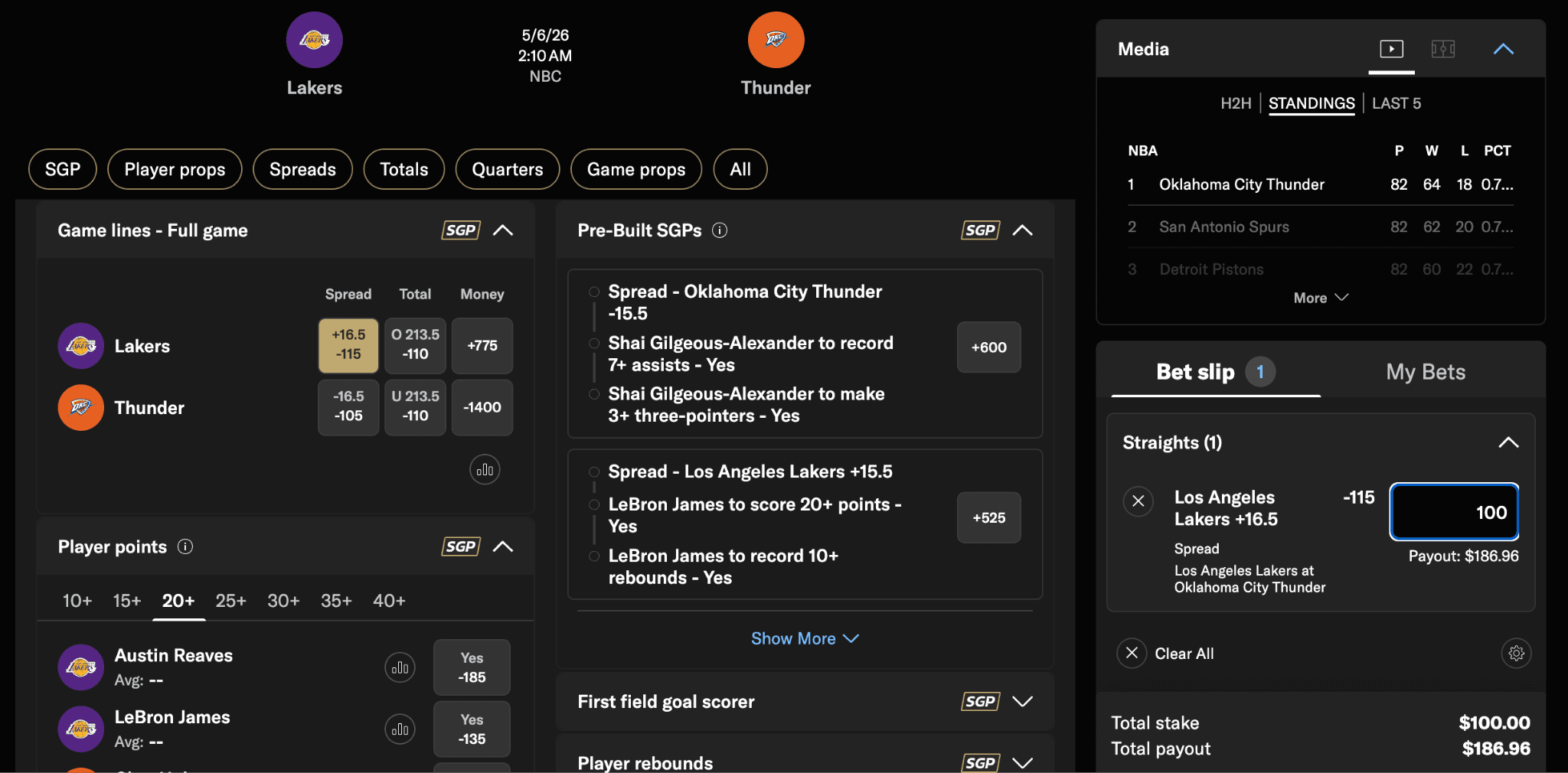
Credit: BetMGM Sportsbook – Screenshot captured by Felix Dubler on May 3
Fair value of your position: $186.96 x 0.80 = $149.57
The sportsbook's cash out offer comes in at $130, a $30 profit, and about 13% below fair value. Tempting, but let's see what hedging gets you.
You go live and find Thunder -16.5 (the opposing side) priced at +320 and bet $45.
If Lakers cover: +$86.96 – $45 = +$41.96. If Thunder cover: –$100.00 + $144 = +$44
You've locked in $42 guaranteed, regardless of what happens, which is 40% more than the sportsbook’s cash out for only a couple minutes of work.
Conclusion
I nearly always prefer hedging over cash out, because the math consistently shows a better expected outcome. When I can identify the right opposite bet at market odds, hedging gives me a guaranteed return that beats what the book would offer as a settlement price.
That said, cash out absolutely has its place. If your bankroll doesn't support placing an additional hedge bet or the market you'd need to hedge into is too complex, like a six-team parlay with multiple legs, then cash out makes sense. But only if the settlement price is within roughly 15% of fair value.
At the other end of the spectrum, if variance doesn't scare you and you are confident in your original read, letting the bet run is always the highest EV play [8].
FAQs
What is cash out betting?
Cash out betting lets you settle a wager before the game ends, accepting a guaranteed payout in exchange for giving up your full potential win. If you bet the Knicks moneyline and they are up late, you can cash out now for a sure profit instead of risking a fourth-quarter collapse.
How do sportsbooks calculate cash out?
Books calculate cash out using your original stake, your original win probability, and the current live win probability. The formula is roughly: (Stake x Current Win Probability) ÷ Original Win Probability = Fair Value. Then they subtract their margin (typically 5-15%) to set the offer.
Is cash out always worth it?
Rarely. Cash out almost always pays less than the mathematical expected value of your bet because the book builds in a margin. Compare the offer to your EV - if you have a 70% chance of winning a $210 total payout on a $110 bet, your EV is around $93 profit. If the cash out offers $45 profit, that's a bad deal.
Can cash out reduce losses?
Yes, that's one of its most legitimate uses. If you bet $110 on the 76ers/Knicks under 211.5 and the teams combine for 190 points by the third quarter, the book might offer $20 back. Taking that $20 instead of losing $110 is prudent risk management.
Should you cash out winning bets?
Usually not, unless the offer is close to fair value or you have a pressing bankroll reason. If you bet $110 on Clemson/LSU over 51.5 and the total is at 48 with eight minutes left, letting it run maintains your full expected value. Cashing out at that point will likely result in accepting a 10-20% discount.

Chad Nagel is a passionate sports fanatic who has worked in the sports and betting industry for over a decade. He spent most of his career as an editor-in-chief for Soccer Betting News, South Africa’s leading soccer betting newspaper, owned by Hollywoodbets. His articles have also featured in some of the most respected sports media platforms in the world, such as SPORTbible, Sports Illustrated, Combat Sports UK, and many others.
Comments
0 comments
No comments yet. Be the first to share your thoughts!
References
- 1.[1] - This source verifies the article's core claim that cash out lets bettors settle wagers early for a guaranteed payout. Accessed May 4, 2026.
- 2.[2] - This source verifies the article's claim that sportsbooks offer only a percentage of fair value on cash outs. Accessed May 4, 2026.
- 3.[3] - This source verifies the article's cash out formula. Accessed May 4, 2026
- 4.[4] - This source verifies the article's claim that cash out prices are driven by an algorithm. Accessed May 4, 2026
- 5.[5] - This source verifies the article's claim that books already extract their margin when a bet is placed at -110 odds. Accessed May 4, 2026.
- 6.[6] - This source verifies the article's EV formula. Accessed May 4, 2026.
- 7.[7] - This source verifies the article's distinction between cash out and hedging. Accessed May 4, 2026.
- 8.[8] - This source verifies the article's recommendation to let a bet ride. Accessed May 4, 2026.
Related Resources to Betting Academy
- How Weather Changes NFL Betting Odds and Game Outcomes
- Cash-Out Strategy: When to Lock In Profit or Let Your NFL Parlay Run
- Player Props Betting Explained: Odds, Strategy & How It Works
- Buffett Warns Sports Betting Lets Governments Cash In on the Naïve
- The CFTC Takes 5 States To Court Over Prediction Markets & Betting
- Buenos Aires Blocks 251 Unlicensed Online Betting Platforms in Sweeping Regulatory Crackdown
- Responsible Gambling USA: Setting Limits on Betting Apps
- NFL Betting Guide: How to Enjoy the Playoffs & Super Bowl on a Budget
- Parlay Betting Explained: Hidden Vig, EV & Real Profit Math
- What does “Free Bet” Mean in Gambling Marketing?
- Teaser Betting Explained: Odds, Spreads & Strategy
- NFL Interim Coach Bump: What the Data Actually Says
- Here’s how a Hamstring Injury During an NFL Game Impacts Spread
- How Online Casino Games Can Keep NFL Bettors Engaged Between Games
- Best NFL-Themed Slots to Play When There's No Game On
- Future of Casino Loyalty Programs
- How to Build a 15-Leg NFL Parlay with $10
- How to Complete KYC Before NFL Sunday Kickoff
- Why $1 Crash Game Bets Are Popular with US Sports Bettors
- Over/Under Betting: Everything You Need To Know