
Betting
Moneyline vs Spread vs Totals What’s the Difference
Moneyline, spread, and totals all have completely different risk profiles, vigs, and sets of situations where they give you the most value!

SportsBoom offers honest and impartial bookmaker reviews to help you make informed choices. While we may earn commissions through affiliate links, our content remains independent and free from promotional influence. For more information, see our Content Transparency and How We Review pages.
Moneyline vs Spread vs Totals What’s the Difference
Moneyline Simple Defintion
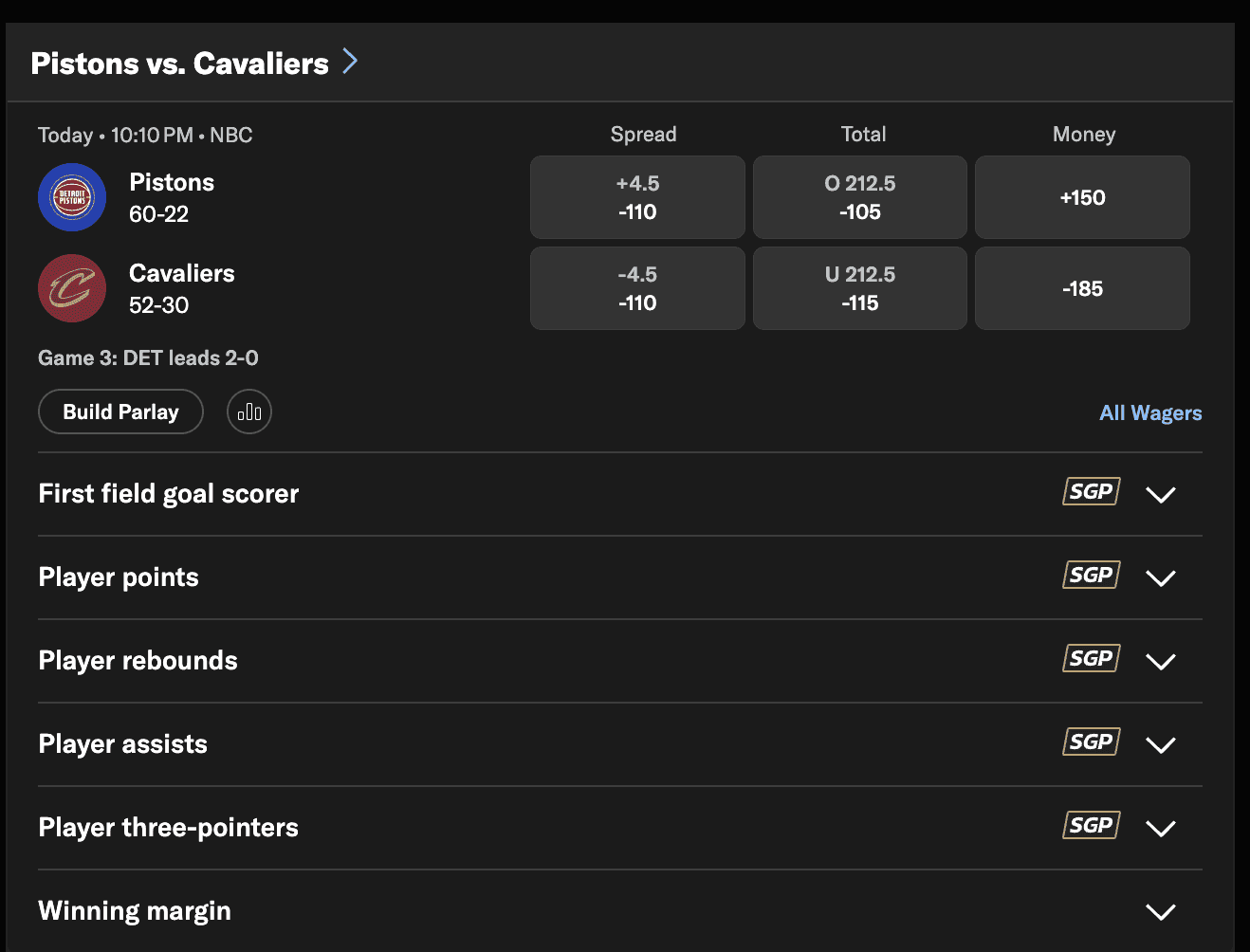
A moneyline bet is a wager on who will win. For example, Detroit Pistons (+150) vs. Cleveland Cavaliers (-185), NBA Playoffs Game 3.
Credit: BetMGM Sportsbook – Screenshot captured by Felix Dubler
The Cavs are the clear favorite at odds platforms at -185, so you'd need to risk $185 to profit $100.
The Pistons at +150 are the underdogs at BetMGM and a $100 slapped on Detroit wins you $150 in profit because the market only gives them about a 40% chance of winning.
Clear-Cut Spread Betting Definition
The point spread levels the playing field by giving the underdog a head start. Instead of betting on who wins outright, you're betting on whether a team covers the margin of victory set by the sportsbook.
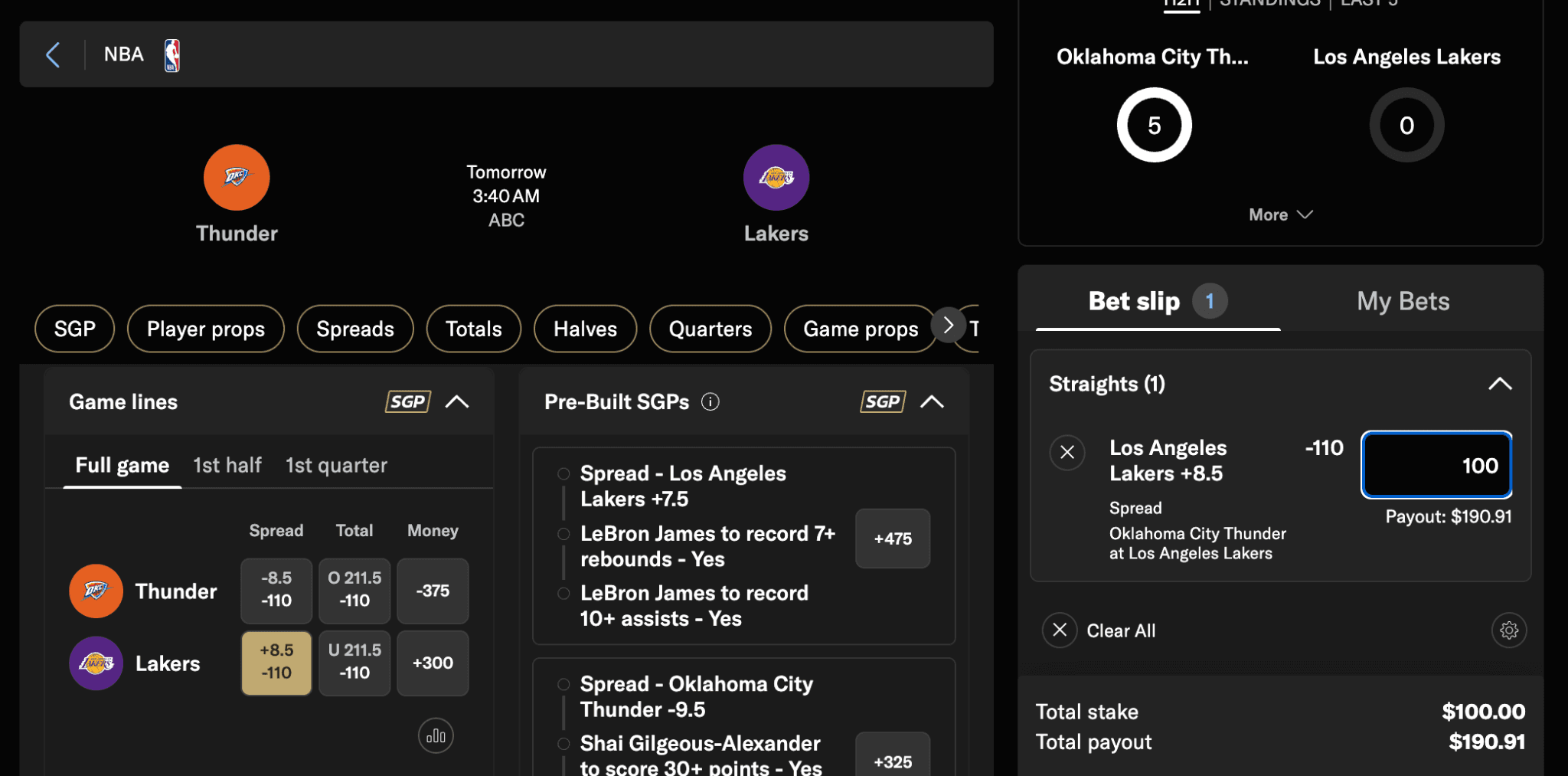
The favorite must win by more than the spread, and the underdog must lose by less than the spread or win the game. For example, Los Angeles Lakers +8.5 at -110.
Credit: BetMGM Sportsbook – Screenshot captured by Felix Dubler
After suffering back-to-back blowout losses, I'm backing the Lakers with the points. At +8.5, LA just needs to keep it within single digits (or win the game). I'm betting on reversion to the mean, as two 15+ point losses in a playoff series are statistically unusual, and LeBron historically elevates in elimination scenarios, and I think the Thunder won't replicate that same performance level.
My $100 at -110 wins $90.91 if LA covers. -110 is the standard spread pricing, and so for every $110 risked, you win $100. It also means you need to win 52.38% of your bets to break even.
Totals (Over/Under) Betting Explained For Newbies
A totals bet on an NBA, NFL or MLS wagering platform has nothing to do with who wins. You're wagering on the combined number of points (or runs or goals) scored by both teams. The sportsbook sets a line, and you bet whether the actual combined score will land above it (Over) or below it (Under).
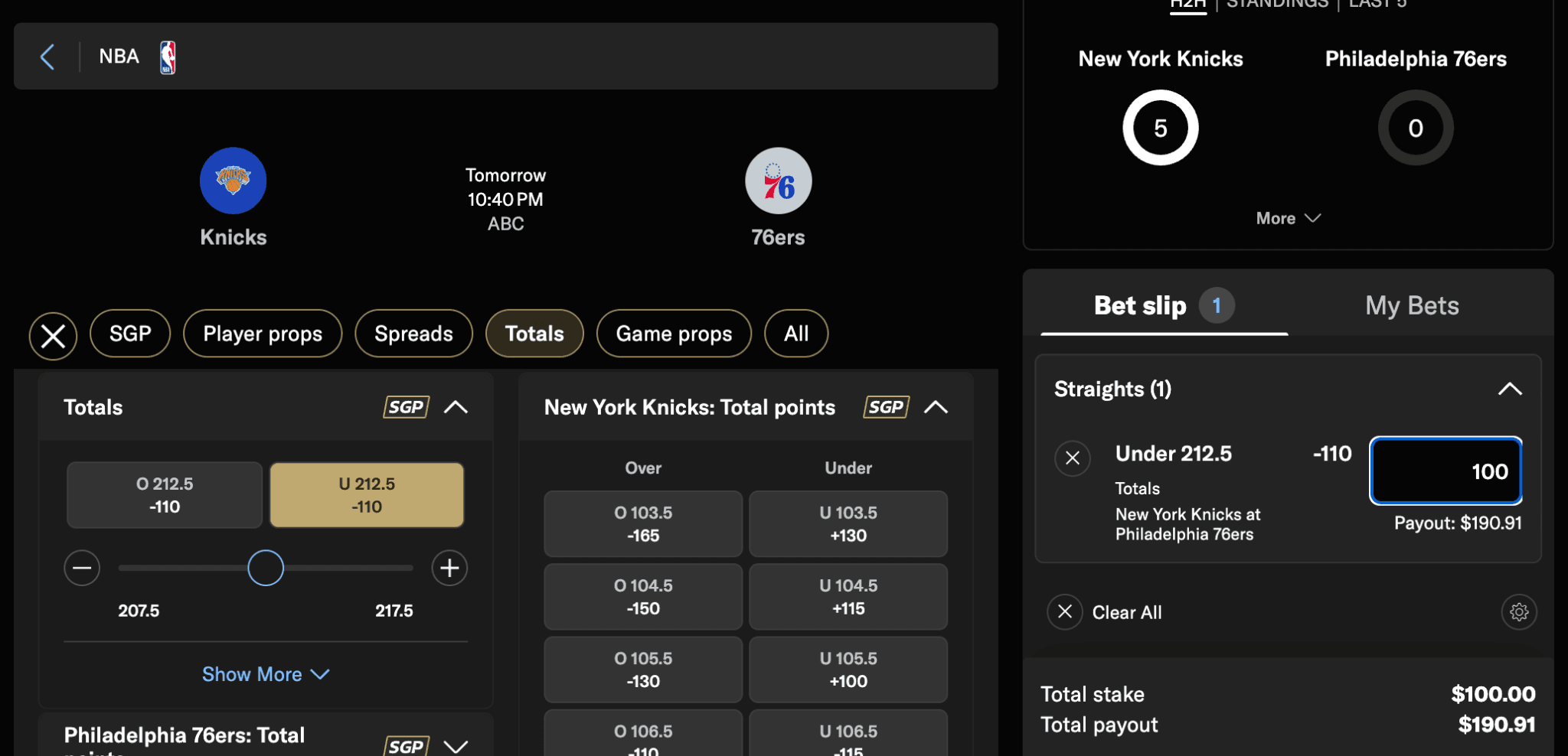
For example, I bet $100 on under 212.5 in New York Knicks vs. Philadelphia 76ers, Playoffs Game 3, at -110, which will pay out $190.91 if the combined score is 212 or less.
Credit: BetMGM Sportsbook – Screenshot captured by Felix Dubler
Game 2 finished with 210 total points, while Game 3 produced just 202 [1]. This is a physical, half-court, defensive playoff series where both coaches are willing to slow it down to gain an advantage.
I actually don't need either team to win as long as both offenses to stay in their established groove and not suddenly explode for 115 each my bet is good to go.
Books’ Secret Moneyline, Spread and Totals Pricing Technique
Sportsbooks, like DraftKings, FanDuel, and Caesars, run sophisticated quantitative models that ingest enormous data sets, including team offensive and defensive ratings, pace of play, home/away splits, rest days, injury reports, recent form, head-to-head history, and even weather for outdoor games. The models spit out a true implied probability for each outcome, and then the sportsbook adds its margin on top.
Check out the Cavs vs. Pistons moneyline to see the match in action. So at Cavs -185 the implied probability is 64.9% (185 ÷ (185 + 100). At the other end of the court the book’s are giving the Pistons a 40% chance of winning (100 ÷ (150 + 100) = 40.0%). You add those numbers up, deduct 100% and you’re left with the 4.9% which is the sportsbook's built-in edge.
If the book balanced all the money perfectly across both sides, it would collect $104.90 for every $100 it paid out [2].
You can run the same calculations for an NBA spread; Lakers (+8.5) and Thunder (-8.5), both at -110 on each side which comes out to a 104.76% total implied probability and 4.76% vig.
In comparison, player props carry a 5-8% vig, while futures and same-game parlays can carry 15-30% or more. Standard spread and totals markets are actually the most bettor-friendly markets at any sportsbook.
Once the opening line is posted, the sportsbook watches the money flow and adjusts. If 75% of the action hits the Lakers at +8.5, the line moves to +8 or +7.5 to pull money to the other side.
How I Approach Each Market
I've found is backing playoff underdogs in series where they've already won at least once to be a strong play. The market still overweights the favorite, but variance compresses in a 7-game series. The Warriors' upset of the Rockets during the 2025 NBA Playoffs is a perfect example of this [3].
When a spread moves significantly (say, from -3 to -5.5) in the 24 hours before kickoff on NFL odds platforms, it almost always reflects sharp money. If you see a line moving against public betting percentages, I say that's a signal worth tracking.
Before betting any totals, I check possessions per 48 minutes for both teams, injury reports, especially for primary ball-handlers and shot creators, whether either team played the previous night, and referee assignment, as certain crews call far more fouls, inflating totals through free throws.
In the NFL, wind speed above 15 mph is the single most reliable weather factor for suppressing totals, more reliable than rain or cold alone [4].
You can also use the spread to reverse-engineer moneyline value. If a team is a -7 favorite on the spread and -280 on the moneyline, there's likely more value in taking the spread at -110. Conversely, a team favored by only -2.5 might actually be a better moneyline bet if you believe they'll win cleanly.
Some Thoughts To Leave You With
Don’t spread yourself too thin by jumping between all three markets. Pick the one that fits how you watch sports. If you obsess over box scores, totals are a great choice. But If you care more about who wins than by how much, start with the moneyline.
FAQs
What is the difference between moneyline and spread betting?
Moneyline is just picking the winner, they can win by 1 point and you cash. A spread bet requires a team to win or lose within a specific margin. Cavs -185 moneyline is a bet on the Cavs to win, while Cavs -4.5 spread means Cleveland must win by 5+ points to cash your ticket.
Which market is most volatile: moneyline, spread, or totals?
Moneyline is most volatile because a heavy favorite at -400 loses occasionally, wiping out multiple wins in one result. Spread and totals carry less variance because both sides start near 50/50. For example, a Lakers at +8.5 spread bet survives a loss by 8, but a Lakers moneyline at -250 is worthless the moment the final buzzer sounds.
Why are spreads usually priced at -110?
At -110 on both sides, sportsbooks collect $110 for every $100 paid out. The extra $10 per $100 won is the sportsbook's guaranteed profit, regardless of outcome.
How do sportsbooks calculate totals lines?
Sportsbooks build scoring models using both teams' offensive and defensive ratings, pace of play (possessions per game in NBA, plays per game in NFL), injury reports, rest days, and head-to-head history. They convert the projected combined score into a line and add vig on each side to create their margin.
Can a team win but fail to cover the spread?
Yes, let’s say the Cavaliers are -7.5 favorites and win 108-104, Cleveland won the game but didn’t cover. Bettors on Cleveland -7.5 lost, and bettors on the opponent +7.5 won.

Chad Nagel is a passionate sports fanatic who has worked in the sports and betting industry for over a decade. He spent most of his career as an editor-in-chief for Soccer Betting News, South Africa’s leading soccer betting newspaper, owned by Hollywoodbets. His articles have also featured in some of the most respected sports media platforms in the world, such as SPORTbible, Sports Illustrated, Combat Sports UK, and many others.
Comments
0 comments
No comments yet. Be the first to share your thoughts!
References
- 1.Knicks vs 76ers - ESPN. Accessed May 10, 2026
- 2.How to Calculate Vig from Odds - Sports Betting Odds Calculator. Accessed May 10, 2026
- 3.NBA_playoffs - Wikipedia. Accessed May 10, 2026
- 4.NFL playoffs Weather Effects Offense Wind Snow - Jake Ciely- Ny Times. Accessed May 10, 2026