
Betting Academy
How Point Spread Betting Works: Odds, Line Movement & Strategy
Over the last two NFL seasons, teams receiving more than 60% of public bets in the first four weeks covered the spread at just 32%. The money was in taking the opposite position of the crowd! (source: NXT bets) This guide is here to help you avoid getting sucked into the losing herd mentality. I’ll show you real spread betting case studies, how to find soft lines at licensed sportsbooks, and how to avoid losers! This content is intended for adults aged 21 and over in states where sports betting is legally permitted. Spread betting involves financial risk. Never bet more than you can afford to lose.

SportsBoom offers honest and impartial bookmaker reviews to help you make informed choices. While we may earn commissions through affiliate links, our content remains independent and free from promotional influence. For more information, see our Content Transparency and How We Review pages.
Point Spread Betting Playbook
How the Spread Works
In point spread betting, the sportsbook sets a line to handicap the matchup, and you’re betting on whether a team performs above or below that number.

How the Spread Works
For example, I bet $50 on the Denver Nuggets -15.5 against the Philadelphia 76ers on March 17 at -112. That means Denver needed to win by 16 or more for the bet to cash. If they won by 15 or less or lost, the bet loses. I used FanDuel, a credible NBA betting operator, to place the wager.
The key is deciding whether the spread accurately reflects the true gap between teams. In this case, the numbers pointed one way. Denver was leading the league in scoring at around 120 points per game, with a top-tier offensive rating and efficient half-court execution.
Philly, on the other hand, sat 17th in defensive efficiency, allowing above-average points per possession, which is a bad matchup against a high-output offense.
Recent form made it stronger. The 76ers had just lost to Detroit by 22 points. Now they were facing the best offense in the league, on the road, in a worse spot.
At -112, the implied probability was 52.8%. I believed Denver cleared that number comfortably, given the offensive gap, Philly’s defensive ranking, and the recent 22-point loss. I kept the stake at $50. The edge was in the mismatch between Denver’s scoring power and Philly’s inability to contain it.
Spread Market
Case Study of Spread Market
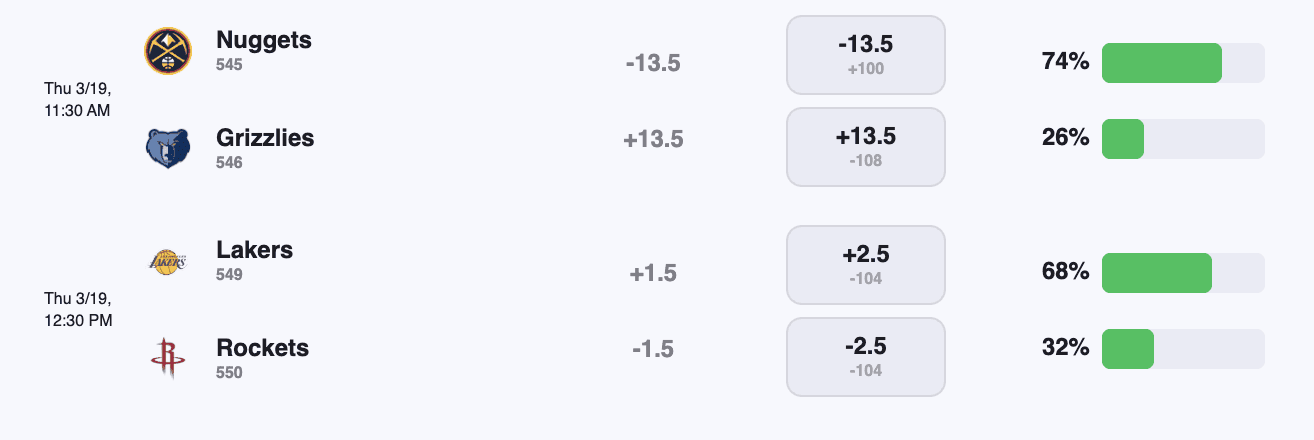
I bet $100 on the Lakers + 2.5 at -110 against the Rockets on March 17. At -110 odds, the implied probability is 52.4%, meaning I need the Lakers to cover more than 52 times out of 100 for the bet to have value. I had this closer to 60%, which created a clear edge.

Case Study of Spread Market
Houston’s top-3 defense was legitimate, but form mattered more. The Lakers came in on a six-game winning streak, taking nine of their last 10.
The biggest factor was Luka Dončić. Over his last five games, he averaged 36.6 points, 9.2 rebounds, and 8.2 assists. That level of production forces defensive adjustments most teams can’t sustain. Even elite defenses struggle to contain that volume and versatility without specific schemes and personnel, and Houston hadn’t shown either.
The Lakers’ road profile reinforced it. At 20-13 away, they were well above average in hostile environments, which reduced the usual home-court advantage. On the other side, Houston were just 5-5 in their last 10, suggesting their recent form didn’t match the strength implied by the line.
Putting it together, I made the spread closer to Lakers +1.5. Getting +2.5 gave me an extra point of value in a game where margins are tight. With the form edge, Luka’s output, and a solid road record, the number looked inflated, so I threw $100 on LA for a potential return of $190.90. The public seems to agree with me, but that’s not always an indicator of expert betting tips and predictions!
The 4 Drivers of Real Spread Value
Most casual bettors look at a spread and ask, “Who’s going to win?” Trust me, that’s not how you beat the market. The better question is: “Is this number off?" Pay attention to these patterns to spot soft lines:
- 1
Injury Impact — Key Role Players Rather Than Stars
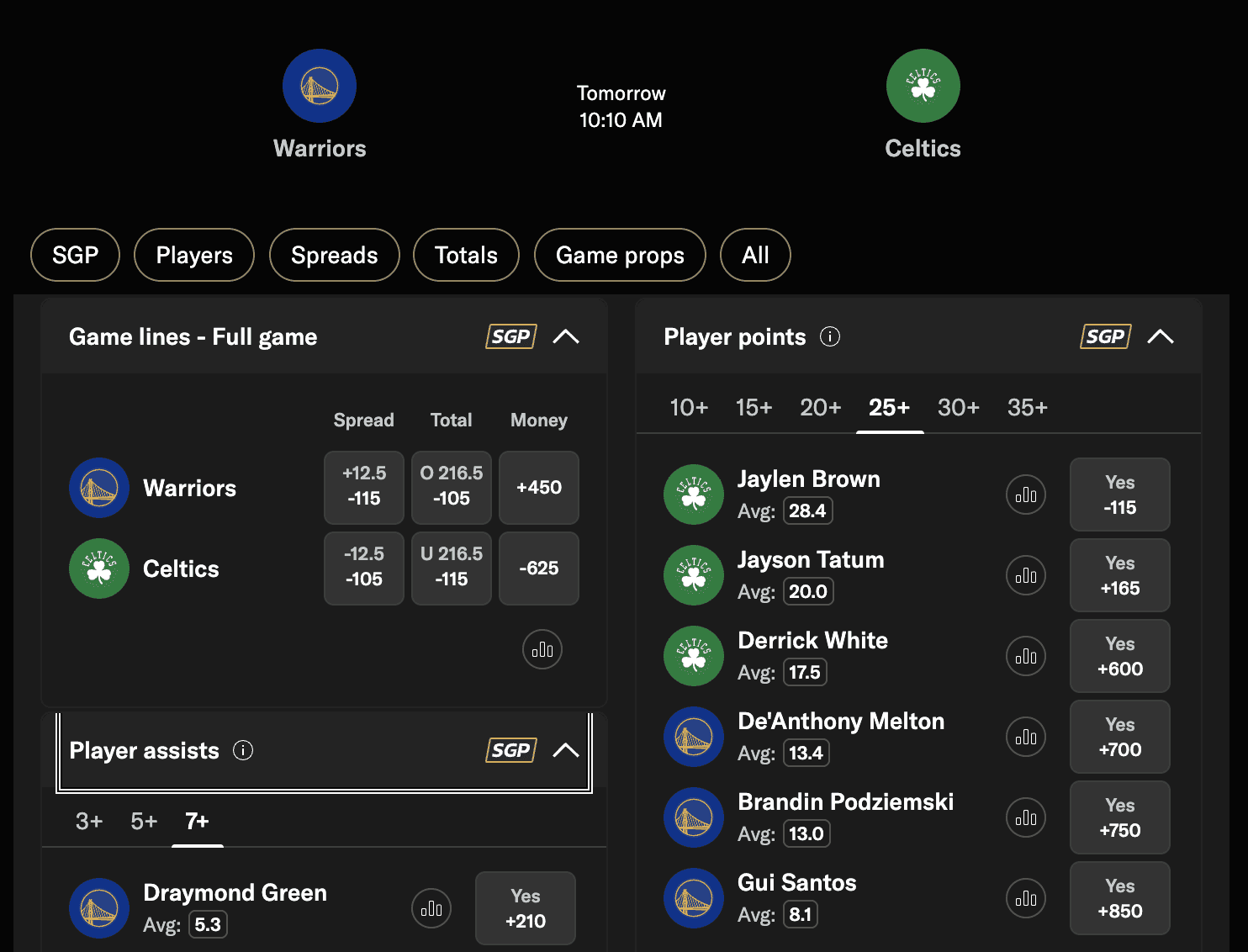
Star injuries are priced quickly and efficiently. If Steph Curry is ruled out like he was against the Celtics on March 18, a spread might move 3-4 points and totals drop 2-4, leaving little edge. The real opportunity comes from cluster injuries.
Injury Impact
Multiple absences, like two offensive linemen or key NBA defenders, create compounding effects that models don’t fully adjust for. Late injury reports, especially 15-30 minutes before tip-off, often trigger the final and most exploitable moves. - 2
Situational Spots — Schedule Creates Hidden Edges
Situational angles are widely known but poorly applied. NBA teams play around 14.9 back-to-backs per season, and road teams on zero rest typically decline by 1-3 points in performance.
However, based on my experience, blindly fading these teams isn’t profitable since most still cover around 50%. The edge comes when disadvantages stack, such as travel, fatigue, and a strong opponent. In the NFL, similar value appears in letdown spots, where teams underperform after emotional wins. - 3
Closing Line Value (CLV) — The Only Metric That Matters
Closing Line Value measures whether you beat the market. It’s the difference between your number and the closing spread. In the NFL, getting -2.5 instead of -3.5 at a trusted NFL betting site is critical due to key margins. In the NBA, a 1+ point spread move or 3+ point total shift usually reflects sharp action. If you consistently beat the closing line on over 55% of bets, you’re identifying real value.
- 4
Sharp Money & Reverse Line Movement
Sharp money drives line movement. When over 70% of bets are on one side but the line moves the other way, that’s pro big bettors driving the action. The gap between ticket percentage and money percentage highlights this. For example, if 80% of bets are on one team but only 50% of the money is, larger wagers are hitting the other side.
When I Avoid Spread Bets
Knowing when not to bet is just as valuable as knowing when to pull the trigger. I pass on more spread bets in a week than I place, especially when these situations arise:
When the Line Has Already Moved Against Me
If I miss the number, the bet is gone. A +3.5 is not the same as +2.5. In the NFL, crossing key numbers like 3 and 7 removes most of the edge. The same in the NBA, if -14.5 becomes -16, the value has shifted - I either reassess or move on.
When the Public Loves the Same Side
When the Public Loves the Same Side
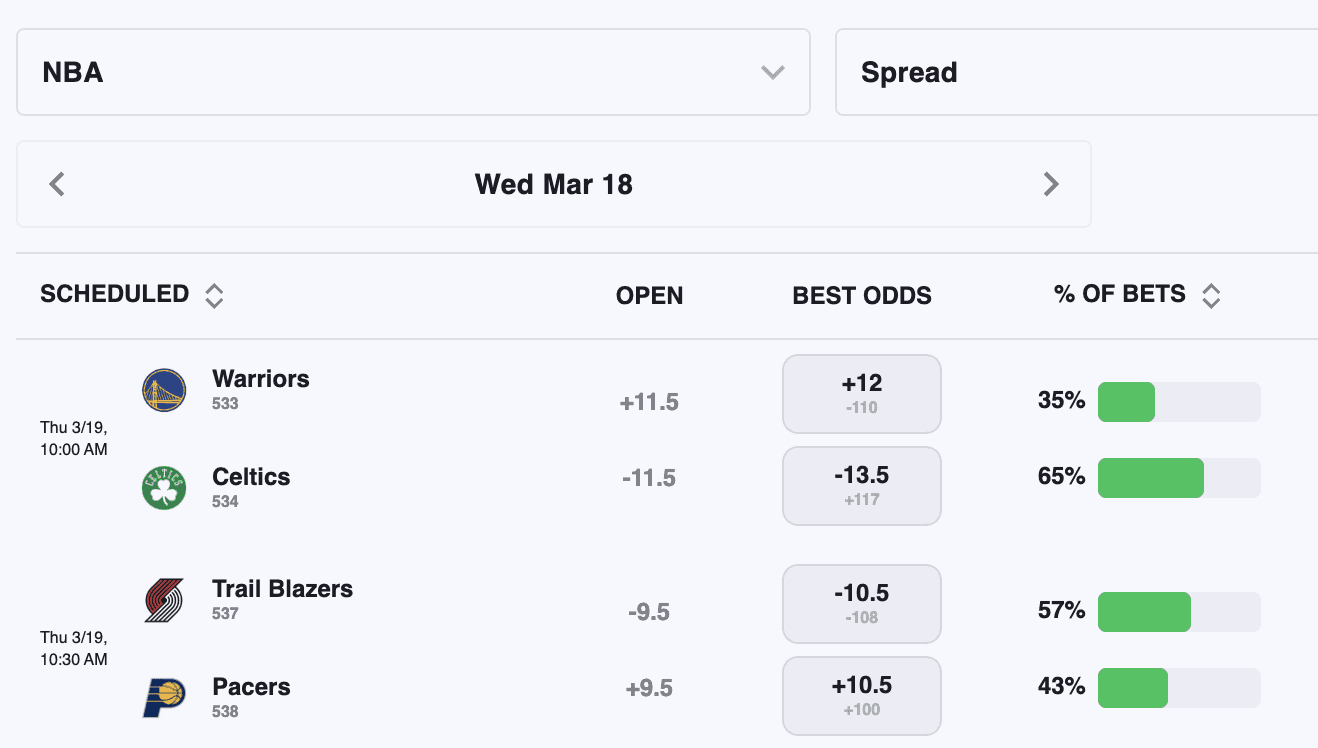
If 75%+ of tickets are on my side, I pause. That doesn’t make the bet wrong, but it usually indicates the price is inflated. For example, the Kansas City Chiefs often drew 65-75% of tickets, and backing them involves paying a premium.
When It’s a Trap Line
Trap lines look too good for a reason. A strong team priced shorter than expected usually signals something the market has already accounted for. In the NFL, this often happens after emotional wins. If a line feels obvious or generous, that’s when I question it most.
When There’s No Clear Edge
Liking a team isn’t a strategy. If I can’t explain why the number is wrong by using injuries, matchups, or market signals, I don’t bet. Without a clear edge, it’s just guessing, and that won’t hold long-term.
When Key Information Isn’t Confirmed
I avoid betting when injuries or weather are still unclear. One late update can move a spread 1-2 points instantly. If a key player is questionable with no practice, I wait.
When It’s a Large Spread Without Justification
Big spreads need strong reasoning. NFL favorites of 10+ points have covered just 49.3% since 1989, which isn’t enough to beat the vig. I only play large numbers when multiple factors align.
My Spread Bet Evaluation Checklist
I don't place a spread bet until I've run through this list. It takes two minutes and has saved me from more bad bets than any amount of research.
- Is the line moving in my direction since the opener?
- Is the gap between ticket percentage and money percentage greater than 20% in my favor?
- Does my side have a rest advantage over the opponent?
- Is the opponent in a letdown, look-ahead, or trap game spot?
- Are there cluster injuries on the opposing side not yet fully priced into the number?
- Has the opponent shown a recent structural collapse, like a 20+ point loss that suggests real vulnerability?
- Can I explain specifically why the spread is wrong?
Final Thoughts
The goal of spread betting is to identify mispriced lines that are overly generous in a particular direction. The easiest way to do that is to follow the games closely, take note of key stats like recent form, lineups, and scoring/defending metrics, and then compare your predicted probability to the sportsbook’s implied probability.
Remember to track your close line value from day one. This will tell you whether you’re actually handicapping spreads more accurately than the sportsbook.
FAQs
Why do spreads move before games?
Lines move because of sharp money early and public money later. If a number shifts quickly early in the week on low volume, that’s usually pros attacking value. Late movement is more crowd-driven.
How fast do spreads react to injury news?
Almost instantly. Books use automated systems, so once news is confirmed, the line adjusts within seconds. By the time you see it, the value’s gone. The only real edge is acting on strong rumors or reading between the lines before official announcements.
Are public betting trends reliable indicators?
Public data is useful when it conflicts with line movement. If most bets are on one side but the line moves the other way, that’s sharp money disagreeing.
Should I bet early or wait for line movement?
It depends on your angle. If you’re betting matchups or soft openers, go early before the market adjusts. If your edge depends on injuries or conditions, wait.
Why do some spreads reverse close to kickoff?
Pros often bet big just before kickoff when limits are higher, but sometimes the public piles in late and pushes the line back.

Bruce Douglas has more than a decade of experience in sports and news media, working across print and digital platforms.
Comments
0 comments
No comments yet. Be the first to share your thoughts!
Related Resources to Betting Academy
- Round Robin Betting Guide: How It Works and Key Tips
- Parlay Bets Explained: How They Work and Why They’re Risky
- How Live Betting Affected the Sports Industry
- High Sportsbook Taxes Hurt Bettors Before They Hurt Operators
- How Contract Holdouts Can Help Predict NFL Trades
- Kalshi Notches Legal Win in New Jersey as Sports Prediction Court Battles Rage On
- Why the Future of Sports Prediction Markets Hangs in Balance
- How to Use a Bonus Bet to Hedge an NFL Trade Prediction
- Sports Betting Is Changing the Way Fans Watch the NFL and NBA
- The Best NFL Offseason Markets to Bet On Before the Draft
- Do NFL Trade Rumors Affect the Odds Before the Deal is Officially Confirmed?
- Are All Sportsbook Sponsors in the NFL and NCAA Actually Legal?
- How to Bet NFL Trades & Free Agency Before Odds Move?
- How Draft Betting Markets Work: Odds, EV & Insider Signals
- Same Game Parlays Explained
- Best Bets for College Basketball – Thursday, March 12
- Best Bets for NCAA Men’s Basketball – Monday, March 9
- Best Bets for NCAA Men’s Basketball – Friday, March 6
- Best Bets for NCAA Men’s Basketball – Thursday, March 5
- Why Every Betting System is Garbage