
Betting Academy
Prop Betting Explained: Odds, Strategy & Real Examples 2026
Most prop bettors are doing the same thing - they find a player they like, check their season average against the line, and place the bet, and then wonder why they lose money. In this guide, I’ll tell you how licensed sportsbooks ahttps://www.sportsboom.us/bettingctually set prop lines, show real examples I evaluated in March, explain how to convert odds into implied probability, and explore the four key drivers I use to spot mispriced props. Prop betting carries high volatility. 21+ only.

SportsBoom offers honest and impartial bookmaker reviews to help you make informed choices. While we may earn commissions through affiliate links, our content remains independent and free from promotional influence. For more information, see our Content Transparency and How We Review pages.

Prop Betting Explained
What Are Prop Bets?
A prop bet is a wager on a specific player or team outcome within a game, independent of the final result. You can bet on everything from points to touchdowns to rebounds to field goals.

What Are Prop Bets
I put $50 on Shai Gilgeous-Alexander to score 30+ points against the Magic at -178 on March 17 at DraftKings, a verified NBA sportsbook. My thought process was that SGA is averaging just over 31 points per game this season, and the Magic are surrendering 114 points per game, one of the softer defensive outputs in the league.
Whether the Thunder won or lost was irrelevant to the bet, as I was wagering purely on one player's individual performance in a specific matchup. The same logic applies if you’re betting on football at trusted NFL betting sites. As long as your player scores X number of touchdowns, the game result doesn’t matter.
How I Calculate Implied Probability in Prop Bets
Before placing any prop, I convert the odds to implied probability. This tells me what the book thinks the true probability of the outcome is and whether the price is worth paying.
The formula:
- Positive odds: 100 ÷ (odds + 100)
- Negative odds: |odds| ÷ (|odds| + 100)
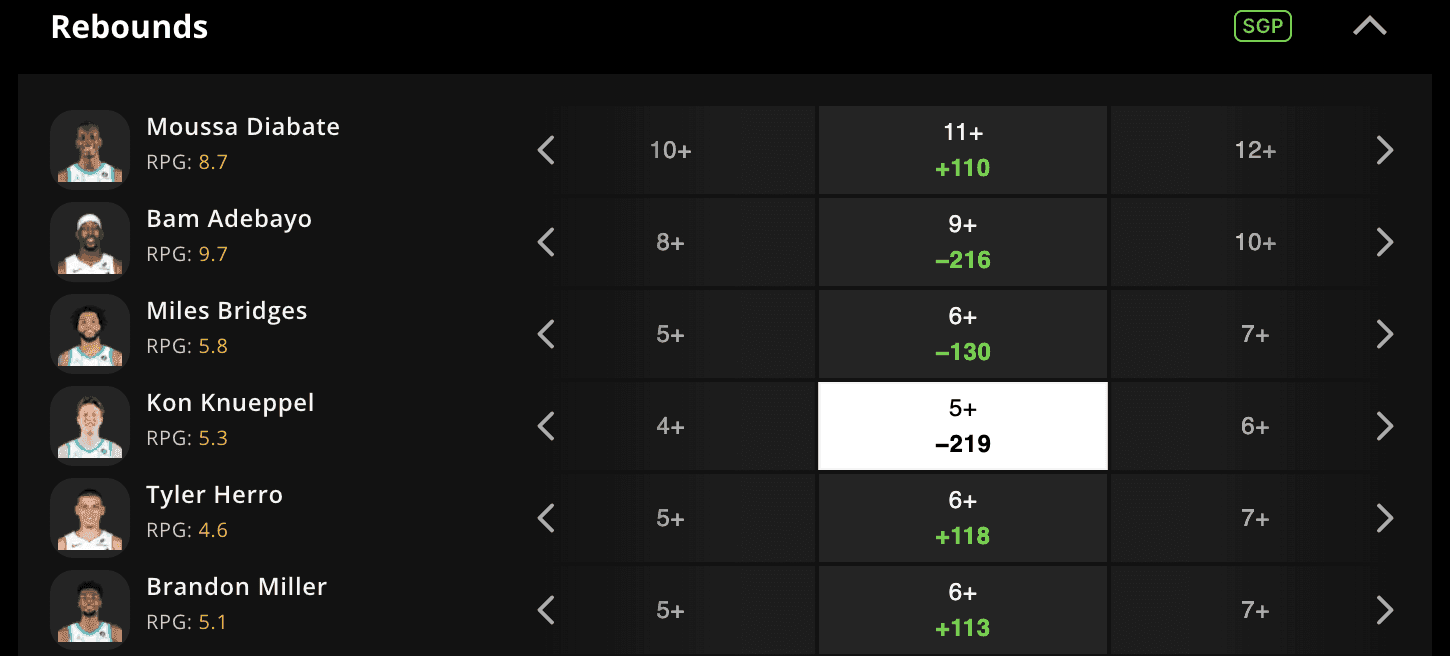
Take a prop I was looking at: Kon Kneueppel 5+ rebounds against the Heat on March 17th, priced at -219.
How I Calculate Implied Probability in Prop Bets
Using the negative odds formula: 219 ÷ (219 + 100) = 68.7% implied probability.
So, the question I'm actually asking is, do I believe Kneueppel grabs 5+ rebounds against the Heat more than 68.7% of the time?
Seeing as Kneueppel’s averaging 5.3 rebounds this season, 6 in his last 10 games, and only 4.3 against the Heat historically, I decided to pass on this prop bet.
The 4 Drivers of Real Props Value
These are the four areas I’ve found to produce the most reliable value when it comes to betting on team and player props:
The Mean vs. Median Trap the Book Is Exploiting Against You
This is the most misunderstood concept in prop betting. Most bettors look at a player’s season average (mean) and compare it to the line. However, based on the latest betting tips, sportsbooks price props closer to the median where outcomes split 50/50.
A few big games can inflate the average above the median. If a player averages 31.1 and the line is 30.5, you haven’t actually found soft odds. The sportsbook has already adjusted for skew. I’ve been burnt before by blindly betting overs by just focusing on a player's season average.
Secondary Player Props After a Rotation Change
When a starter is ruled out, sportsbooks move fast. The injured player’s line is pulled, yet the flow-on effects across the rest of the lineup take longer to price in.
That delay is where the edge sits, as usage doesn’t disappear. Minutes expand, shot volume climbs, and playmaking responsibilities shift. A backup projected for 18 bench minutes can suddenly be thrust into a 30+ minute role in a favorable matchup, effectively becoming a different player than the one the odds were originally built around.
Defensive Matchup Context Books Underweight
Most prop lines are driven by season averages and recent form. What’s often underweighted is the specific defensive context.
Team-level stats only tell part of the story, and your task is to find positional mismatches. A defense might rank mid-table overall but struggle badly against a specific position or play style.
When a player’s strengths align directly with a defense's structural weakness, the impact is often greater than the line reflects.
Cross-Book Line Discrepancies on the Same Prop
Prop limits are low compared to sides and totals, so markets correct more slowly. Different books also run different models, which leads to real pricing gaps.
It’s not uncommon to see the same prop posted at 48.5 on one book and 51.5 on another. What I like to do is use Pinnacle as the true probability and then look for major discrepancies on soft books like DraftKings, BetMGM, and FanDuel.
Case Study - Overvalued Prop Bet
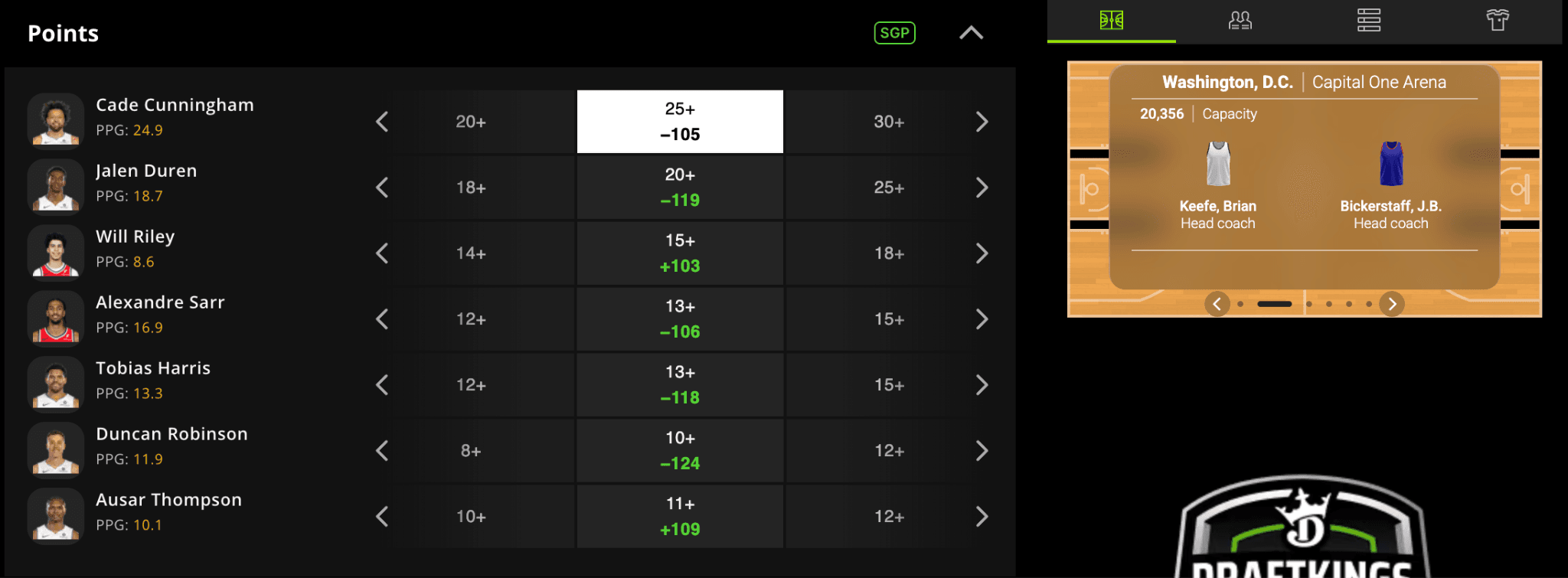
On March 17th, I was looking at Cade Cunningham to score 25+ points against the Wizards, priced at -105 on DraftKings.
Overvalued Prop Bet
On the surface, it looks reasonable. Cunningham is averaging 24.9 points per game this season, and the line is set almost exactly at his season average, implying the sportsbook sees this as a near 50/50 proposition. Converting -105: 105 ÷ 205 = 51.2% implied probability.
However, the Wizards are giving up 123.7 points per game, the second-worst defensive output in the league. That sounds like it helps Cunningham, but it actually creates the specific game environment that hurts him most: a blowout. When Detroit plays a defensively porous team at home, the Pistons frequently build an early lead and coast. Coach Bickerstaff manages Cunningham's minutes aggressively in those situations.
The data backs this up. Over Cunningham's last three blowout wins, he averaged just 28 minutes and 15 points per game. His season average of 24.9 is built on competitive games where he plays 35+ minutes and runs the offense deep into the fourth quarter. If you remove those minutes, the statistical output drops sharply.
So the book is pricing this at 51.2% using season-long averages. I'm looking at a high-probability blowout scenario where his most comparable recent performances produced 15 points in 28 minutes. The true probability of hitting 25+ in that game environment is materially below 51.2%, so I passed.
When I Avoid Prop Bets
Props are the softest market on the board, but soft doesn't mean undefended. These are the situations where I've learned to close the tab regardless of how good the number looks.
When the Line Has Already Moved Against Me
If I've identified a prop I like and come back an hour later to find it's moved a point or more in the wrong direction, I don't chase it. Sharp money got there first, and the number I built my case around no longer exists.
When the Injury Report Is Incomplete
If a key player on either side of the matchup is listed as questionable and hasn't been confirmed for game time, I don't place props around them until the status is resolved. The Knueppel 5+ rebounds prop against the Heat tonight is a good example. A late scratch to a rotation player on either team changes rebounding distribution in ways that invalidate the entire analysis I've built around that line.
When I'm Betting a Star Player in a Nationally Televised Game
Books pour more resources into pricing marquee matchups. A Luka points prop on Christmas Day, or a LeBron assists line in a nationally broadcast primetime game, has seen far more sharp attention than a secondary player prop in a midweek afternoon tip-off. The lines are tighter, and the margin for finding the overlay is much smaller.
When the Prop Is Based on a Streak
"SGA has scored 30+ in seven straight" is a narrative the sportsbook has already priced in. Streaks attract public money, public money inflates lines, and inflated lines on streak-driven props are consistently among the worst value on the board. The underlying matchup and usage data is what really matters.
My Prop Bets Evaluation Checklist
Most of my mistakes have come from skipping steps in my props betting process rather than being wrong about the underlying analysis. These are the questions I ask before every bet:
- Do I believe the true probability exceeds the book's implied probability?
- Is my conviction based on data (matchup stats, usage rates, recent form)?
- Have I checked the player's performance in comparable matchups, not just their season average?
- Have I checked the same prop across at least two other books for a better number?
- Am I betting on a line that has moved against me, or am I still ahead of the market?
- Have I sized the stake relative to my actual confidence level?
Final Thoughts
Prop markets are the most exploitable on the board, but not for the reasons most bettors think. You need to understand how sportsbooks set lines, where their models lag, and how quickly that window closes once sharp money arrives.
I focus on medians rather than averages, secondary players over stars, and model different game scenarios in a bid to predict likely totals. Then I use Pinnacle's lines as the true probability and look for discrepancies between their odds and softer sportsbooks like BetMGM and FanDuel to ensure I’m locking in value.
FAQs
Why do prop odds move pre-game?
Prop lines move due to sharp money and news. When a respected bettor hits a mispriced prop or a key player is out, sportsbooks adjust immediately. Unlike spreads, prop markets run low limits, so it takes less money to move them. A single sharp bet can shift a line several points within minutes.
How fast do they react to injury or lineup news?
Sportsbooks react within minutes of a lineup change. The window to exploit an unadjusted secondary player's prop after a starter is ruled out is super narrow, often under five minutes before books reprice the entire slate around that team.
Are public betting trends reliable for props?
No. Public bettors consistently skew toward overs and star players, which distorts prop lines without improving their accuracy. Sportsbooks know this and shade lines accordingly. Following public betting percentages on props tells you where recreational money is flowing, not where the value is.
Should I bet early or wait for line movement?
Depends on your edge. If you've identified a mispriced prop before the market catches up, especially early in the week on NFL, bet early before sharp money tightens it. If you're reading line movement to confirm a thesis, you're almost always getting a worse number than the sharps already captured.
Why do some props reverse or stabilize at the last minute?
The main causes are sharp buyback and liability management. When a line moves too far in one direction after early sharp action, those same bettors sometimes take the other side at the inflated number; this creates reverse line movement. Sportsbooks also stabilize lines manually when exposure on one side becomes too concentrated close to game time.

Bruce Douglas has more than a decade of experience in sports and news media, working across print and digital platforms.
Comments
0 comments
No comments yet. Be the first to share your thoughts!
Related Resources to Betting Academy
- Round Robin Betting Guide: How It Works and Key Tips
- Parlay Bets Explained: How They Work and Why They’re Risky
- How Live Betting Affected the Sports Industry
- High Sportsbook Taxes Hurt Bettors Before They Hurt Operators
- How Contract Holdouts Can Help Predict NFL Trades
- Kalshi Notches Legal Win in New Jersey as Sports Prediction Court Battles Rage On
- Why the Future of Sports Prediction Markets Hangs in Balance
- How to Use a Bonus Bet to Hedge an NFL Trade Prediction
- Sports Betting Is Changing the Way Fans Watch the NFL and NBA
- The Best NFL Offseason Markets to Bet On Before the Draft
- Do NFL Trade Rumors Affect the Odds Before the Deal is Officially Confirmed?
- Are All Sportsbook Sponsors in the NFL and NCAA Actually Legal?
- How to Bet NFL Trades & Free Agency Before Odds Move?
- How Draft Betting Markets Work: Odds, EV & Insider Signals
- Same Game Parlays Explained
- Best Bets for College Basketball – Thursday, March 12
- Best Bets for NCAA Men’s Basketball – Monday, March 9
- Best Bets for NCAA Men’s Basketball – Friday, March 6
- Best Bets for NCAA Men’s Basketball – Thursday, March 5
- Why Every Betting System is Garbage