
Betting Academy
Are All Sportsbook Sponsors in the NFL and NCAA Actually Legal?
The NFL collects close to $1 billion each year from sportsbook partnerships while prohibiting its players from earning a single dollar from those same brands. Meanwhile the NCAA allows gambling logos at its championship venues whilst quietly selling betting data.

SportsBoom offers honest and impartial bookmaker reviews to help you make informed choices. While we may earn commissions through affiliate links, our content remains independent and free from promotional influence. For more information, see our Content Transparency and How We Review pages.
areallsportsbooksponser
How We Got Here: The Supreme Court Changed Everything
How We Got Here
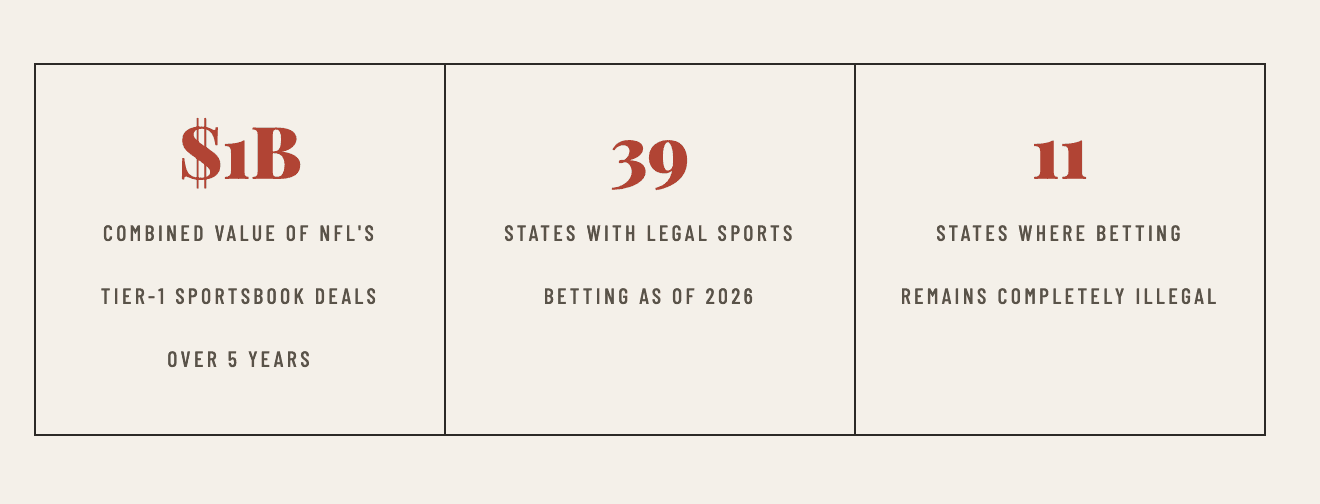
For 26 years, the Professional and Amateur Sports Protection Act of 1992 (PASPA) banned states from legalizing sports betting outside Nevada, Delaware, Montana, and Oregon. The NFL, NBA, NHL, MLB, and NCAA were all plaintiffs fighting to keep it in place, taking New Jersey all the way to the Supreme Court. They lost.
On May 14, 2018, the Court ruled 7-2 in Murphy v. National Collegiate Athletic Association that PASPA violated the Tenth Amendment's anti-commandeering doctrine. State gaming regulators were now free to offer sports betting entirely on their terms.
The same leagues that spent years in court fighting legalization pivoted within months to negotiating sponsorship deals.
The NFL's Sportsbook Empire
The NFL's Sportsbook Empire
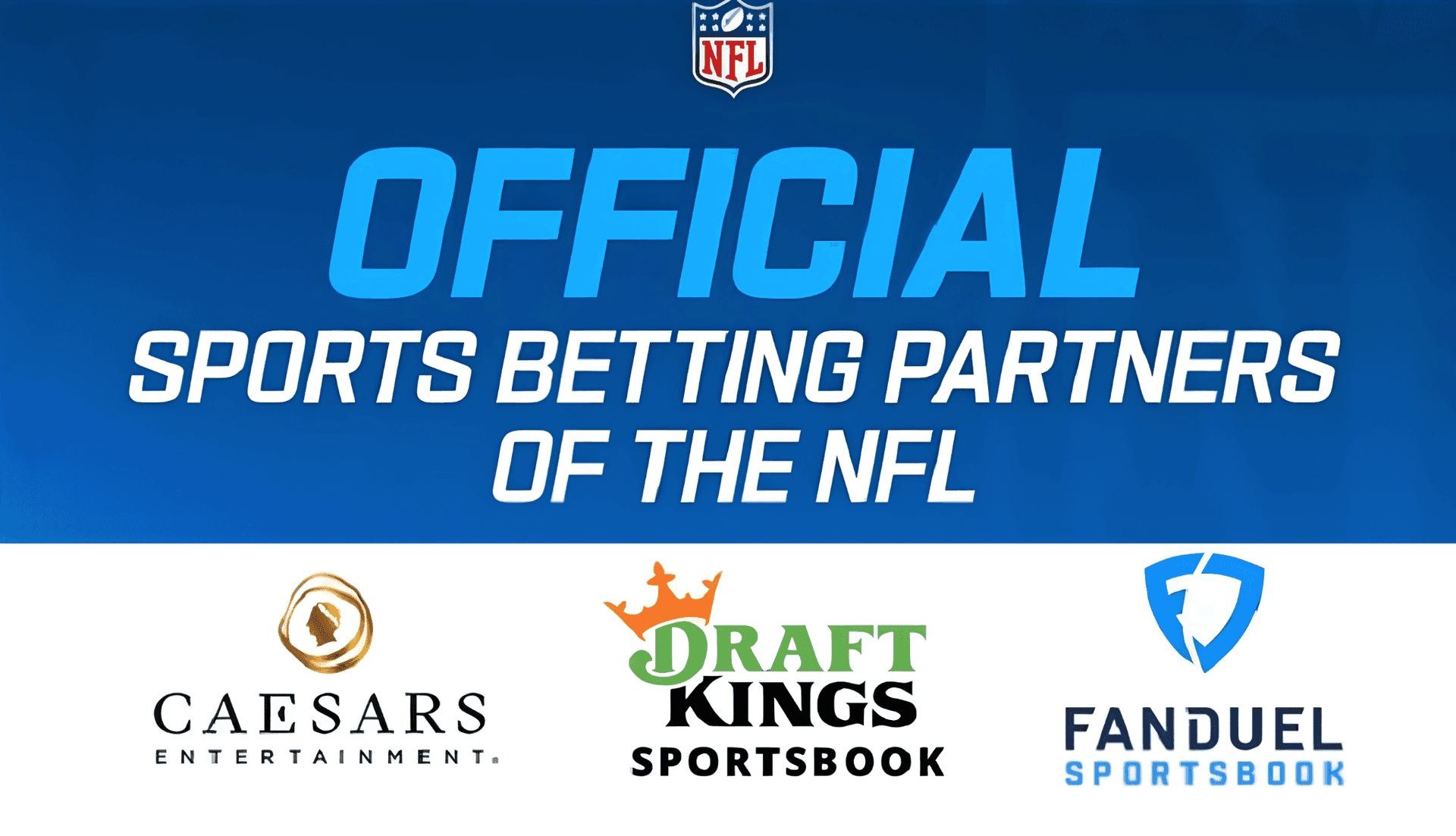
In April 2021, the NFL signed what it called its first-ever US sportsbook partnerships. Caesars Entertainment, DraftKings, and FanDuel became official sports betting partners of the NFL through five-year multi-year agreements reported to be worth just shy of $1 billion combined, according to sources familiar with the terms cited by Sportico and CNBC.
These Tier-1 deals give the three operators exclusive rights to leverage NFL marks within the sports betting category, integrate betting content directly into NFL.com and the NFL app, and use NFL highlights and Next Gen Stats data to set betting lines.
Below that sat a second tier: BetMGM, WynnBET, FOX Bet, and PointsBet were designated Approved Sportsbook Operators (ASOs), permitted to purchase premium NFL advertising inventory during games and ancillary programming. No other sportsbooks can buy this inventory.
Separately and significantly, the NFL signed a data rights deal with Genius Sports, the exclusive distributor of official NFL statistics to licensed sportsbooks. The NFL received equity in Genius Sports worth approximately $400 million at signing and now holds a roughly 9% stake.
The Team-Level Picture
In addition to league-level arrangements, NFL teams are permitted to negotiate their own sportsbook deals. As of 2025, more than 22 of 32 franchises have at least one such partnership in place.
Bet365 leads with approximately 12 team agreements, FanDuel is second. Six teams, including Denver, Detroit, Las Vegas, the NY Jets, Philadelphia, and Pittsburgh, each have agreements with three separate sportsbooks. NFL team sponsorship revenue hit a record $2.49 billion in the 2024 season.
Where the Legality Gets Complicated
State-by-state legality varies. As of April 2026, sports betting remains completely illegal in Alabama, Alaska, California, Georgia, Hawaii, Idaho, Minnesota, Oklahoma, South Carolina, Texas, and Utah. Yet sportsbook sponsorships continue to produce advertising beamed into those states during NFL broadcasts.
The Houston Texans are the only NFL team with sportsbook sponsorships in a state where sports wagering is entirely illegal. Texas has no licensed betting market, has repeatedly failed to pass enabling legislation, and has no expected launch date before 2027 at the earliest.
Owner Equity Stakes: The Undisclosed Conflict
The NFL confirmed to NBC Sports in February 2024 that team owners may hold equity stakes of up to 5% in companies that generate revenue from sports betting operations, provided the owner has no management role.
As of 2018, Robert Kraft (New England Patriots) and Jerry Jones (Dallas Cowboys) both held sub-5% stakes in DraftKings through various investment entities. DraftKings' current market capitalization runs to tens of billions of dollars. The NFL has refused to disclose which owners currently hold stakes in which sportsbook companies, which surprisingly isn’t a condition under the Bank Secrecy Act (BSA).
The Player Prohibition: A Double Standard With No Principled Basis
While the NFL collects close to $1 billion from sportsbook partnerships and permits its owners to hold equity in those same companies, NFL players are prohibited from endorsing sports betting brands with their name or likeness.
The NCAA's Stricter Line And Its Own Cracks
The NCAA's Stricter Line And Its Own Cracks
The NCAA draws a harder boundary. It has never signed an official sportsbook partnership. When it held the men's basketball Final Four at Caesars Superdome in New Orleans in 2022, it covered all Caesars gambling signage in the building. Gambling advertising and sponsorships at NCAA championship events remain prohibited.
However, in April 2025, the NCAA signed a deal with Genius Sports, the same company powering the NFL betting market for distribution of real-time NCAA statistics to licensed sportsbooks. The NCAA stated this was "not an endorsement of legal sports betting" and earmarked revenue for problem gambling education and athlete harassment monitoring. The distinction between selling data to sportsbooks and sponsoring them is real but increasingly thin.
Individual colleges briefly entered direct sportsbook partnerships between 2020 and 2023, including Colorado/PointsBet, Michigan State/Caesars, and LSU/Caesars. All faced swift public and political backlash and have largely been unwound. The full prohibition on all forms of gambling on NCAA championship sports remains in place across all three divisions.
The Verdict
The NFL's core sportsbook partnerships with licensed operators in legal states are technically lawful. But the arrangements contain structural conflicts such as undisclosed owner equity stakes in sportsbooks, a league owning equity in a data company that powers global betting on its games, and advertising flowing freely into states where the advertised product is illegal.
The NCAA maintains a more defensible position with no official sportsbook sponsorships or championship advertising. However, it has entered the data monetization economy through Genius Sports and is watching its member institutions absorb a wave of athlete gambling scandals.

Bruce Douglas has more than a decade of experience in sports and news media, working across print and digital platforms.
Comments
0 comments
No comments yet. Be the first to share your thoughts!
Related Resources to Betting Academy
- Kalshi’s Masters Trading Surge Shows Sports Becoming a Bigger Growth Engine
- Round Robin Betting Guide: How It Works and Key Tips
- Parlay Bets Explained: How They Work and Why They’re Risky
- How Live Betting Affected the Sports Industry
- High Sportsbook Taxes Hurt Bettors Before They Hurt Operators
- How Contract Holdouts Can Help Predict NFL Trades
- Kalshi Notches Legal Win in New Jersey as Sports Prediction Court Battles Rage On
- Why the Future of Sports Prediction Markets Hangs in Balance
- How to Use a Bonus Bet to Hedge an NFL Trade Prediction
- Sports Betting Is Changing the Way Fans Watch the NFL and NBA
- The Best NFL Offseason Markets to Bet On Before the Draft
- Do NFL Trade Rumors Affect the Odds Before the Deal is Officially Confirmed?
- How to Bet NFL Trades & Free Agency Before Odds Move?
- How Draft Betting Markets Work: Odds, EV & Insider Signals
- Same Game Parlays Explained
- Best Bets for College Basketball – Thursday, March 12
- Best Bets for NCAA Men’s Basketball – Monday, March 9
- Best Bets for NCAA Men’s Basketball – Friday, March 6
- Best Bets for NCAA Men’s Basketball – Thursday, March 5
- Why Every Betting System is Garbage