
Betting Academy
Why the Future of Sports Prediction Markets Hangs in Balance
The day Kalshi launched Combos, its parlay equivalent, DraftKings stock fell more than 12% in a single session, erasing roughly $2.5 billion in market value. Flutter Entertainment, FanDuel's parent, shed over 10% simultaneously. What began as a niche tool for political forecasters has evolved into a $44 billion industry in just 18 months!

SportsBoom offers honest and impartial bookmaker reviews to help you make informed choices. While we may earn commissions through affiliate links, our content remains independent and free from promotional influence. For more information, see our Content Transparency and How We Review pages.

Why the Future of Sports Prediction Markets Hangs in Balance
Two Radically Different Business Models
Traditional US online betting operators like FanDuel, DraftKings, and BetMGM operate as the house. They set the lines, accept your wager, and profit from the built-in margin embedded in every price. For simple match-winner bets, the vig runs around 5%, so bookmakers expect to retain $5 from every $100 wagered before costs. On parlays, that margin climbs as high as 20%.
At prediction markets like Kalshi and Polymarket, instead of betting against the house, users trade binary sports event contracts with each other through an order book. When one participant buys a Yes contract, another is selling it. The platform earns revenue through transaction fees instead of taking directional exposure to outcomes.
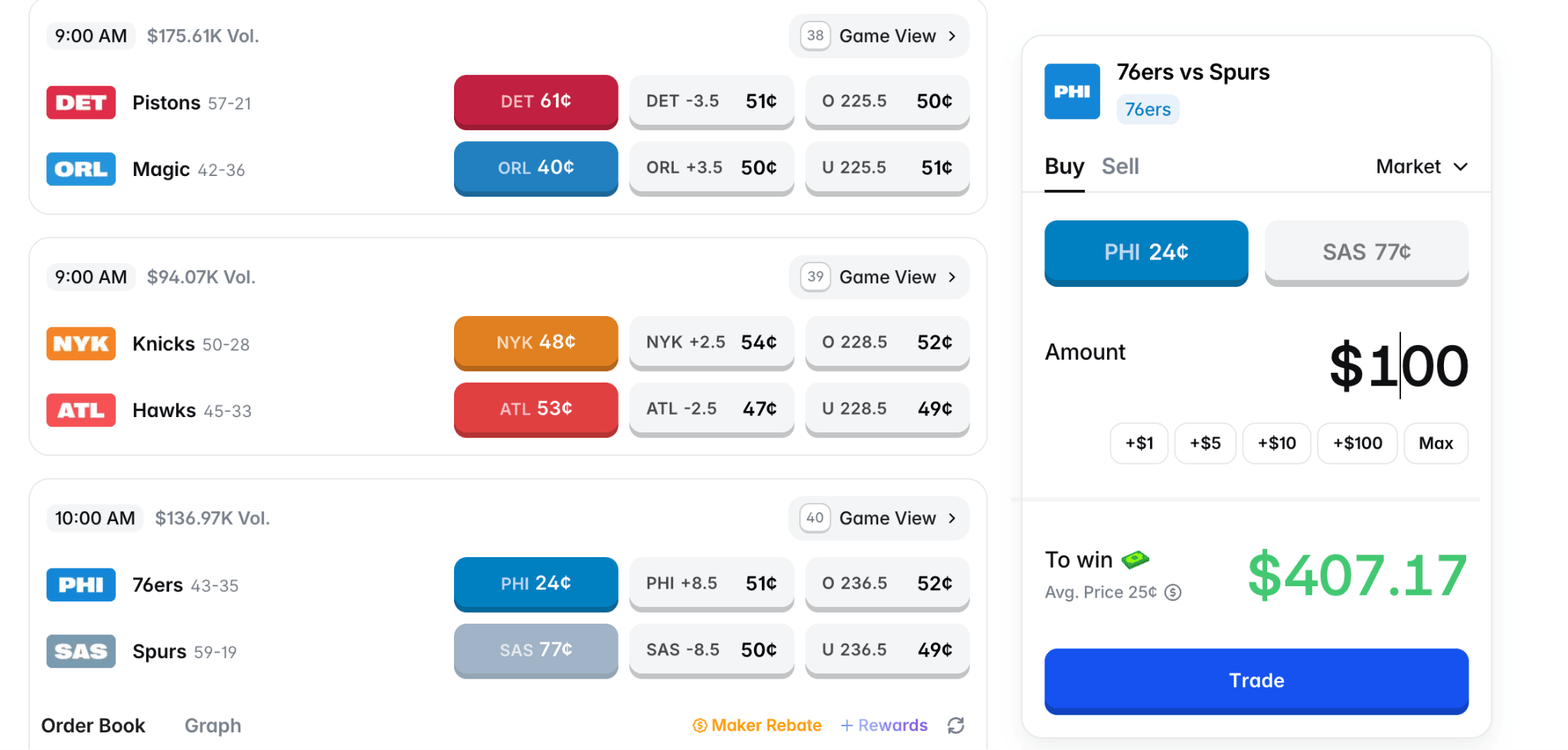
A contract priced at 62 cents reflects 62% implied probability. If you settle correctly, you receive a dollar, but if you get it wrong, you lose your stake. There is no embedded margin baked into the price.
The odds are often better at prediction markets. For example, backing a 76ers win against the Spurs on April 6 was paying +275 at BetMGM, while you could lock in the same bet at Polymarket at 24 cents, which equals +307, that’s an 8.23% better line.
Two Radically Different Business Models
The Geographic Wildcard That Changes Everything
DraftKings and FanDuel cannot accept bets from residents of California, Texas, Florida, and several other large states, representing roughly 40% of the US adult population. Kalshi faces no such restriction, giving it access to a massive untapped audience.
That is because Kalshi operates not as a sportsbook subject to state gambling law but as a federally regulated derivatives exchange under the Commodity Futures Trading Commission. In states where sports betting remains banned, Kalshi is completely legal. During the 2025 NCAA Tournament, it was the only platform Californians and Texans could use.
The Geographic Wildcard That Changes Everything
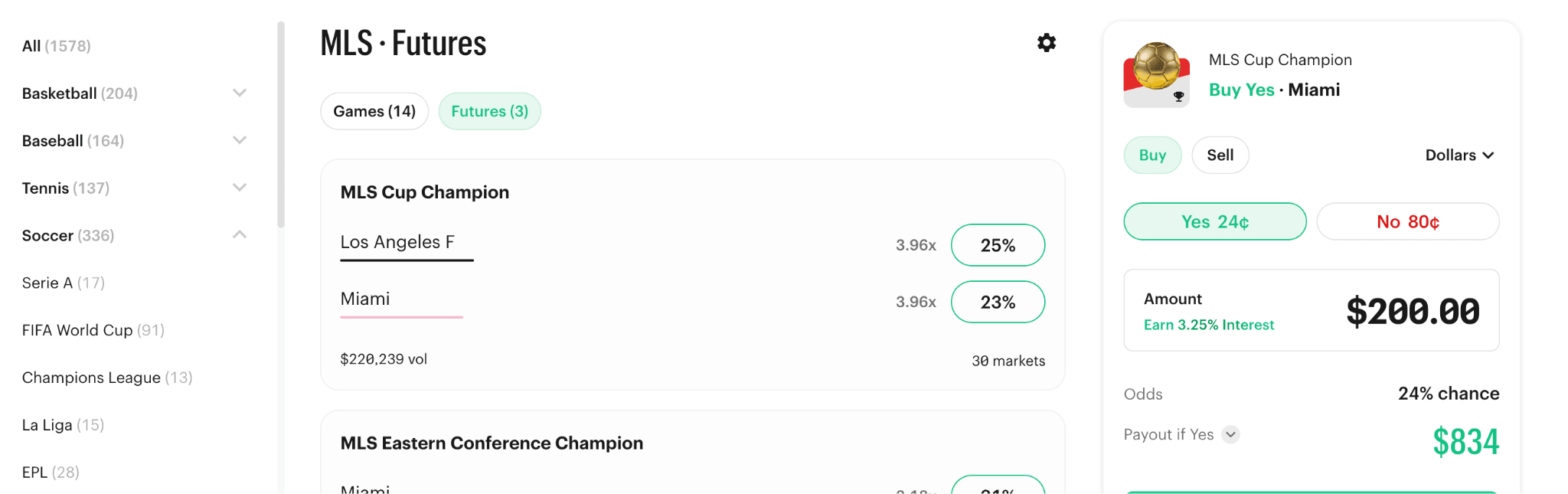
Due to this availability, monthly trading volume across prediction markets climbed from under $100 million in early 2024 to more than $13 billion by the end of 2025, with Polymarket processing $21.5 billion in annual volume and Kalshi $17.1 billion. Sports contracts accounted for 85% of Kalshi's notional volume.
The Legal War Threatening Everything
The legal landscape surrounding sport prediction markets is one of the most complex in US regulatory history, and it is currently unresolved.
Since Kalshi launched sports-event contracts in January 2025, a wave of state litigation has followed, with Nevada, New Jersey, Maryland, Massachusetts, Illinois, Connecticut, and Arizona all initiating enforcement actions or lawsuits arguing Kalshi is operating as an unlicensed sportsbook.
In January 2026, a Suffolk County judge ruled that Kalshi's sports contracts were subject to Massachusetts gaming law. Courts in Nevada and New Jersey reached the opposite conclusion, ruling federal law preempts state authority. The circuit split is widening toward the Supreme Court.
The federal government has now entered the fray on Kalshi's side. The Trump administration filed lawsuits against Illinois, Connecticut, and Arizona, arguing that prediction markets should be solely regulated by the federal government, not state gambling commissions.
The Sportsbook Response: If You Can't Beat Them
Rather than waiting to be displaced, the major operators are building their own. FanDuel Predicts, DraftKings Predictions, and Fanatics Markets all launched in December 2025, offering event contract trading in states where traditional sports betting remains restricted.
DraftKings acquired CFTC-licensed exchange Railbird to power its entry into the space. The line between sportsbook and prediction market is being deliberately blurred.
Prediction markets offer sharper odds, broader geographic reach, and a fee-based model that is lower than traditional vig. In contrast, sportsbooks offer deep liquidity, established brand trust, and generous promotional offers.
The Verdict
Prediction markets aren’t going to replace sportsbooks. The combined trading volume of Kalshi and Polymarket remains a fraction of the $147.91 billion handled by licensed US betting operators in 2024 alone. But they do not need to replace sportsbooks in order to be transformative.
They need only continue to attract the margin-sensitive bettor, the state-restricted user, and the trader who wants to express a view on an NFL game the same way they express one on interest rate policy.
Industry analysts now project prediction market trading could reach $1.3 trillion annually if current growth continues, with Citizens Financial estimating the sector could generate more than $10 billion in annual revenue by 2030.
The outcome rests on a single question the federal courts have not yet definitively answered: is a binary event contract on an NFL game materially different from a sports bet? The answer will define whether prediction markets become a permanent fixture of the American financial system or are classified as unlicensed sports betting platforms.

Chad Nagel is a passionate sports fanatic who has worked in the sports and betting industry for over a decade. He spent most of his career as an editor-in-chief for Soccer Betting News, South Africa’s leading soccer betting newspaper, owned by Hollywoodbets. His articles have also featured in some of the most respected sports media platforms in the world, such as SPORTbible, Sports Illustrated, Combat Sports UK, and many others.
Comments
0 comments
No comments yet. Be the first to share your thoughts!
Related Resources to Betting Academy
- Kalshi’s Masters Trading Surge Shows Sports Becoming a Bigger Growth Engine
- Round Robin Betting Guide: How It Works and Key Tips
- Parlay Bets Explained: How They Work and Why They’re Risky
- How Live Betting Affected the Sports Industry
- High Sportsbook Taxes Hurt Bettors Before They Hurt Operators
- How Contract Holdouts Can Help Predict NFL Trades
- Kalshi Notches Legal Win in New Jersey as Sports Prediction Court Battles Rage On
- How to Use a Bonus Bet to Hedge an NFL Trade Prediction
- Sports Betting Is Changing the Way Fans Watch the NFL and NBA
- The Best NFL Offseason Markets to Bet On Before the Draft
- Do NFL Trade Rumors Affect the Odds Before the Deal is Officially Confirmed?
- Are All Sportsbook Sponsors in the NFL and NCAA Actually Legal?
- How to Bet NFL Trades & Free Agency Before Odds Move?
- How Draft Betting Markets Work: Odds, EV & Insider Signals
- Same Game Parlays Explained
- Best Bets for College Basketball – Thursday, March 12
- Best Bets for NCAA Men’s Basketball – Monday, March 9
- Best Bets for NCAA Men’s Basketball – Friday, March 6
- Best Bets for NCAA Men’s Basketball – Thursday, March 5
- Why Every Betting System is Garbage