
Betting Academy
How Draft Betting Markets Work: Odds, EV & Insider Signals
Bettors still have PTSD over being suckered into the Shedeur Sanders hype and betting on him at -140 to go number 1 only to watch him slip to the fifth round. To avoid falling into the media trap or overweighting mock drafts, check out my expert betting tips and predictions, where I show you how to analyze draft pick futures like a pro! Draft futures carry extreme information risk and rapid volatility. 21+ only.
SportsBoom offers honest and impartial bookmaker reviews to help you make informed choices. While we may earn commissions through affiliate links, our content remains independent and free from promotional influence. For more information, see our Content Transparency and How We Review pages.
How Draft Betting Markets Work
What Are Draft Pick Futures?
A draft pick future is a bet at NBA, NFL, or MLS sportsbooks on where a player will be selected in an upcoming draft. You can wager on the exact pick (like No. 1 overall), the round a player will be taken in (such as over/under 3.5 rounds), or which team will select a particular player.
What Are Draft Pick Futures
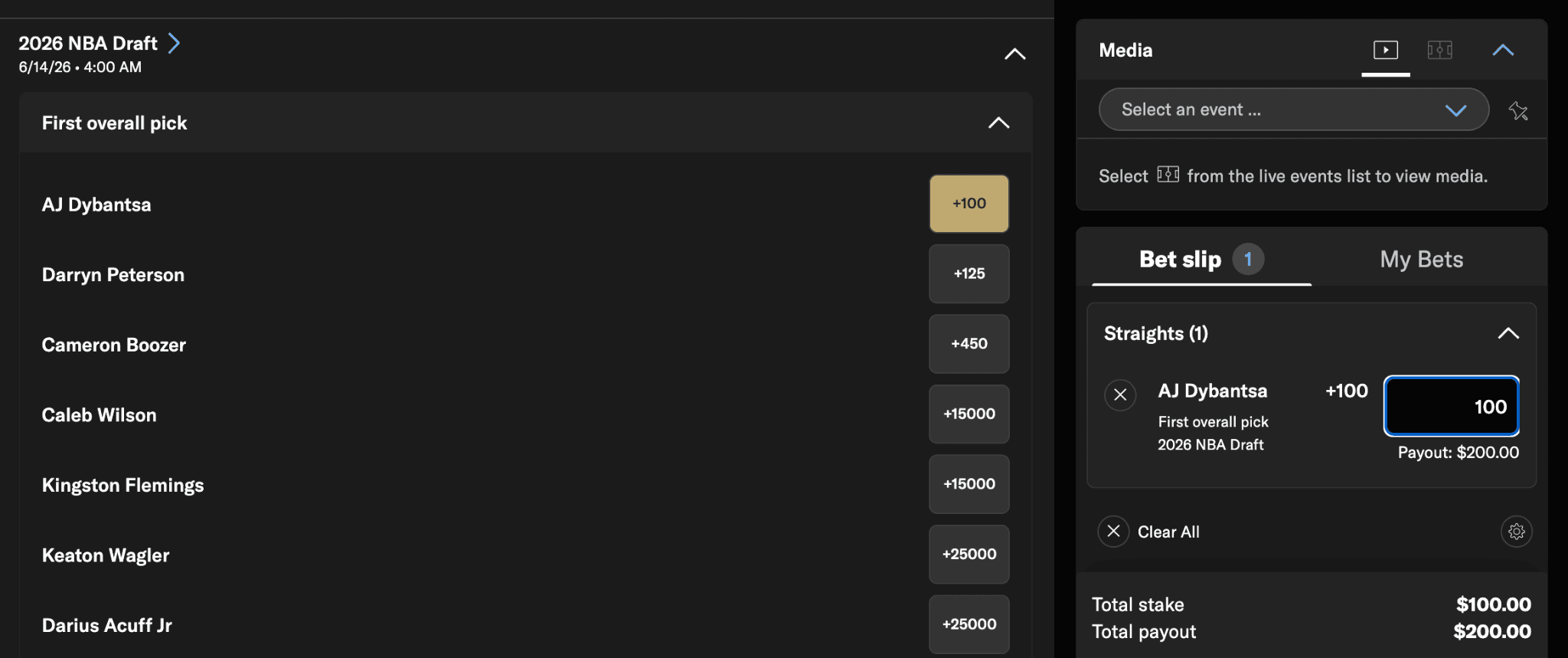
I've got $100 on AJ Dybantsa to go first overall in the 2026 NBA Draft at +100. The price seems short until you look at what he's doing at BYU. The 19-year-old is averaging 25.3 points, 6.7 rebounds, and 3.8 assists per game while shooting 51.3% from the field.
When an Eastern Conference executive told Brian Windhorst, "I think Dybantsa is the easy No. 1”, I decided to pull the trigger!
Market Overreaction & The Mock Draft Effect
Nothing moves draft betting markets faster than a high-profile mock draft. The cycle is predictable. Analysts like Mel Kiper Jr. and Todd McShay release mocks projecting surprise picks. Bettors treat them as inside information, pile in, and betting operators adjust quickly. A few weeks later, the market often reverses as new mocks emerge.
Market Overreaction & The Mock Draft Effect
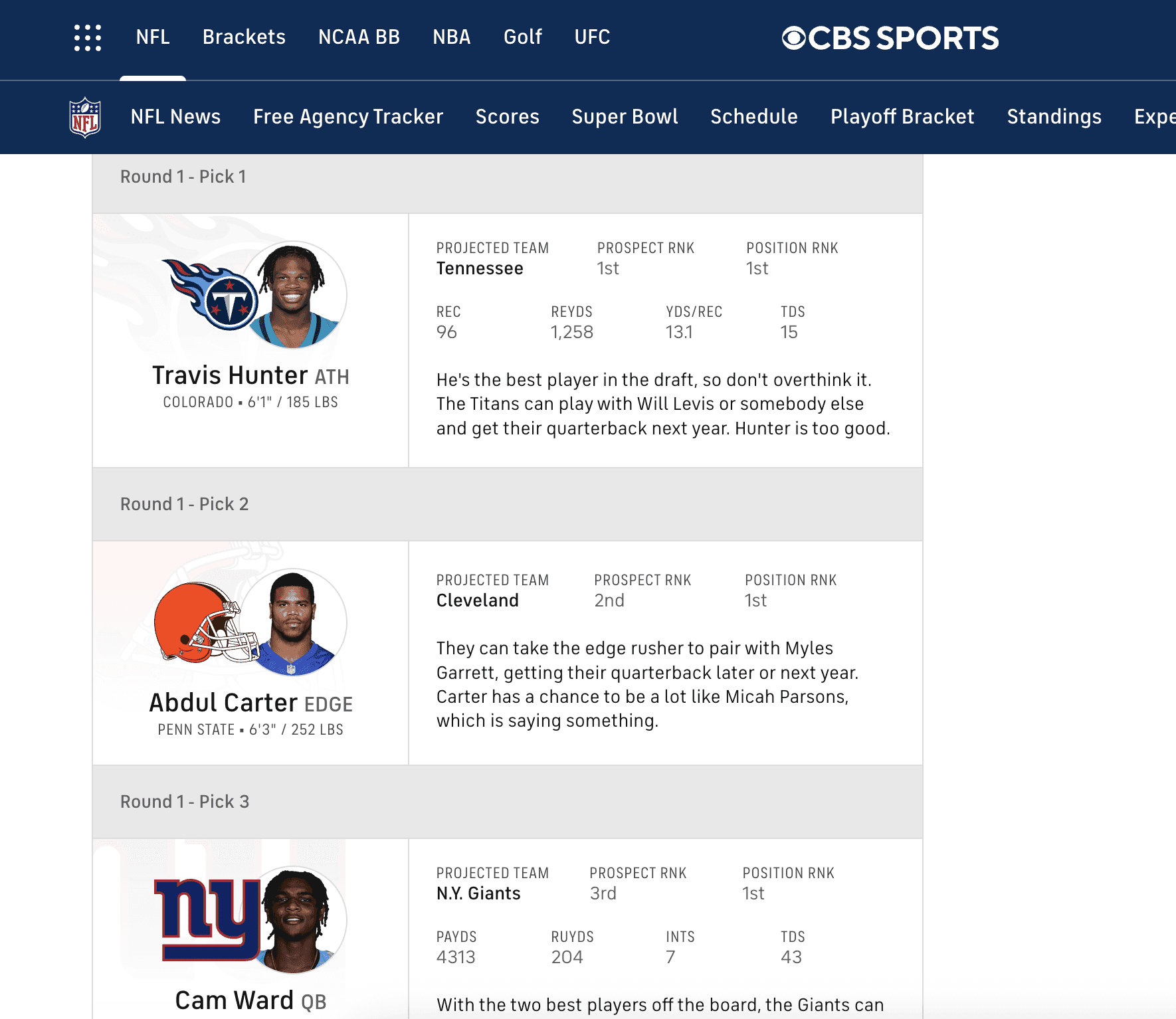
Travis Hunter in January 2025 illustrates this perfectly. Early mocks from CBS Sports and Sports Illustrated had Hunter going No. 1 overall to the Tennessee Titans, citing his rare two-way talent.
Media buzz and comments from Titans executives about not passing on a generational talent fueled heavy betting. His odds shortened from around +1500 to +150/+155 in some popular NFL sportsbooks, implying ~40% probability.
When the draft arrived, Tennessee picked Cam Ward first, and Hunter went No. 2 to the Jacksonville Jaguars. Mock-driven betting had created a surge disconnected from reality, and bettors who blindly followed the experts got punished.
How I Calculate Implied Probability in Draft Markets
The math is identical to any other American odds market, but the interpretation differs significantly.
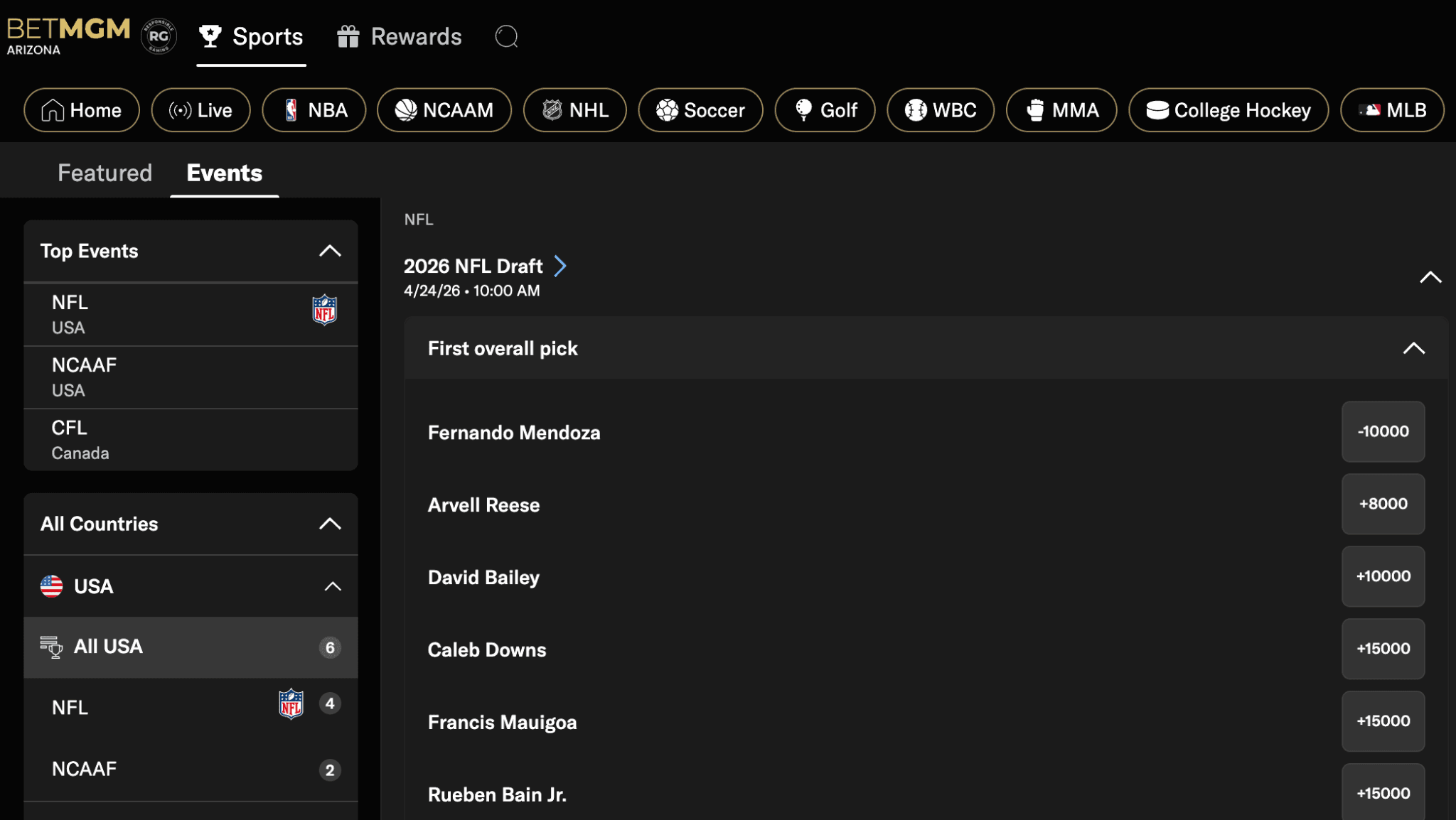
The math is identical to any other American odds market
I’ll be using the 2026 NFL Draft market as an example. Indiana QB Fernando Mendoza is currently paying -10000 at BetMGM to be the first overall pick. To convert that to implied probability:
For negative (−) odds: divide the odds by (odds + 100), ignoring the minus sign.
10000 ÷ (10000 + 100) = 10000 ÷ 10100 = 99%
Risking $200 to profit $1 is the sportsbook saying, "We'll take your money if you insist, but there's nothing here."
The more useful calculation is at the uncertain end of the market. Say a prospect is listed at +450 to go in the top 5:
For positive (+) odds: divide 100 by (odds + 100).
100 ÷ (450 + 100) = 100 ÷ 550 = 18.2% implied probability
Now the question becomes: do you really believe this player has better than an 18.2% chance of landing in the top 5? If, after researching combine grades, team needs, medical reports, and beat reporter sourcing, you estimate his true probability at 28%, you have an edge.
The 4 Drivers of Real Draft Market Value
Most bettors enter draft markets looking at the same things: prospect rankings, mock draft consensus, and recent performance. That's exactly why those inputs are already priced in. If you want to find an edge, pay attention to:
Medical information: Every NFL or NBA Combine prospect is examined by team doctors, but those evaluations are confidential. Betting markets often catch wind of key findings before reporters do. In 2025, Abdul Carter’s first-overall odds briefly lengthened after news of a stress fracture in his foot surfaced, well before most outlets reported it.
Team fit and actual need: Sportsbooks primarily price drafts based on public consensus about talent, not the specific needs of teams. In the NBA, a team that already has a defensive anchor may skip another top defender, while in the NFL, premium picks usually target clear roster holes.
Declaration timeline: NFL and NBA underclassmen can return to school, and announcements shift the market. Before the 2025 draft, Carson Beck’s decision to return compressed odds on all remaining top quarterbacks, creating real value for players like Cam Ward.
Positional scarcity: The depth and quality of the draft class shape individual odds. In the 2025 NBA Draft, Cooper Flagg dominated a weak class, making his -10000 odds at DraftKings, a leading NBA betting site, almost justified.
Case Study — A Draft Market That Overreacted
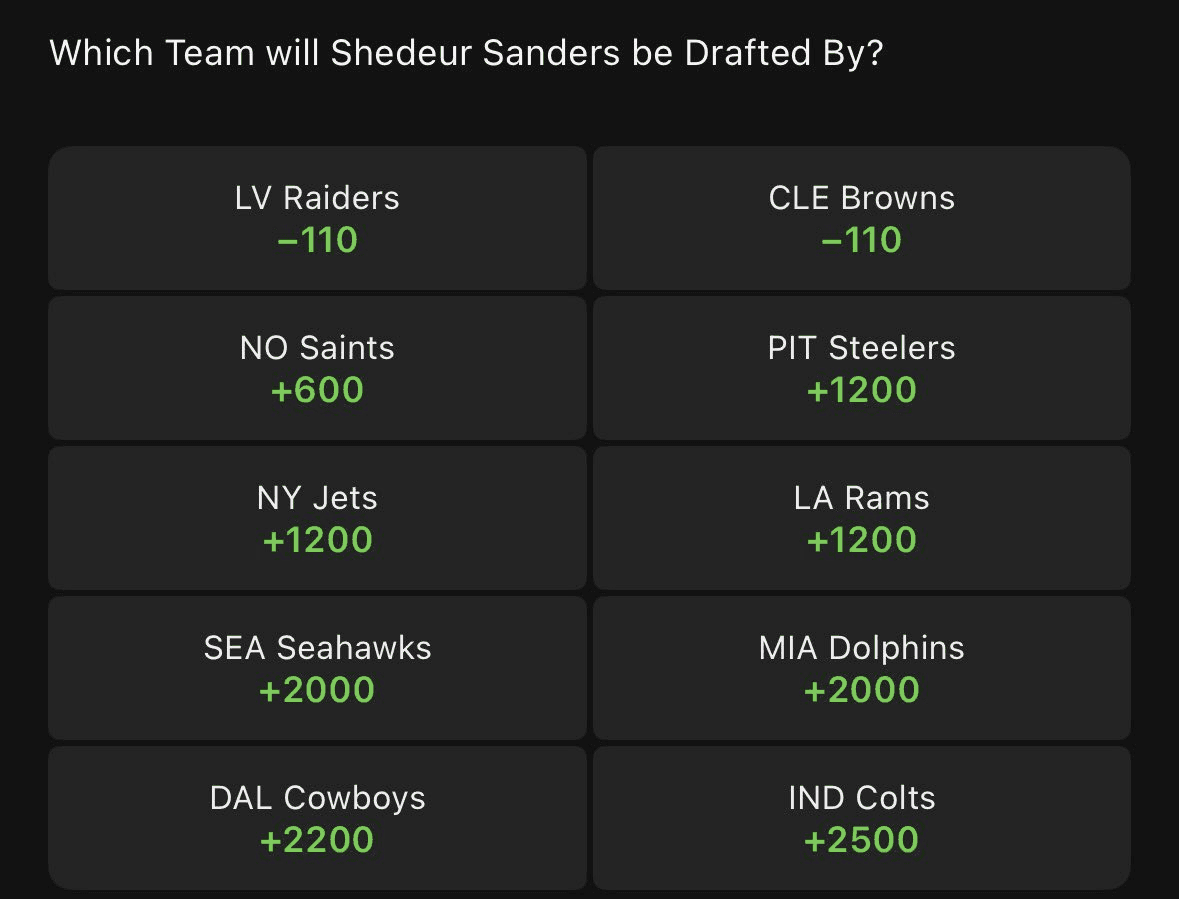
A Draft Market That Overreacted
No prospect in recent memory demonstrated the full anatomy of a draft market mispricing more clearly than Shedeur Sanders ahead of the 2025 NFL Draft.
Sanders opened in the summer of 2024 at +400 to go first overall. He played well through the college season. By December 17, 2024, he was -175, the outright betting favorite. That implies roughly a 63.6% probability of going #1. At that point, the Titans (holding the pick) needed a quarterback, Sanders was the consensus top QB in the class, and the market was pricing him as though the outcome was nearly certain.
Medical concerns about Sanders were circulating in NFL circles before they hit public reporting. And critically, Sanders had publicly refused to throw at the NFL Combine, a decision that played poorly with teams who wanted to see him perform under evaluation conditions.
By February 2025, Ward was -1200 at FanDuel, and Sanders had faded significantly. By mid-April, Sanders's over/under draft position had moved from 8.5 to 21.5. One week before the draft, his odds to go in the second round were -120 at ESPN Bet. He ultimately wasn't selected in the first round at all.
The bettor who backed Sanders at -175 in December locked in a 63.6% break-even requirement on a bet that resolved at approximately zero probability. But the market was wrong in both directions. Anyone who identified the disconnect between Sanders's true probability and his -175 price in December and bet against him at the right moment captured value.
The lesson is that draft markets in December are priced on narrative and public perception. The underlying information, including medicals, front office preferences, and combine results hadn't been processed yet. You need to wait for that information to arrive.
When I Avoid Draft Futures
Some market signals are actually traps. Over the years, I’ve learned to avoid situations where the information is shaky!
When the trigger is anonymous or unverifiable
The Will Levis situation in 2023 is a great example. A Reddit account created six days earlier posted that Levis was telling friends and family Carolina will take him.
His odds moved from 40-1 to 4-1 at DraftKings within an hour. DraftKings confirmed to ESPN they drastically cut the price based on this action. Levis went 33rd overall in round two. The books moved because liability management demands it. Your job is to not be the money they're managing against.When the only information is a vague executive quote
As the Travis Hunter situation demonstrated in January 2025, a single ambiguous line from a team executive, Titans President Chad Brinker, saying they "won't pass on a generational talent", crashed Hunter's first-overall odds from +850 to +140 in 48 hours.
Even though the market priced it as near-certain intelligence, Hunter went second to Jacksonville.When the market has already priced maximum certainty
Anything at -10,000 or shorter is not worth your time. Cooper Flagg reached -10,000 to go first overall in 2025 at FanDuel, Hard Rock Bet, and Caesars. Hard Rock Bet's SVP Neil Walsh described it as "as close to a certainty as our system can handle."
It's generally accepted that online sportsbooks charge around 20-40% on futures bets. At -10,000, you're not just paying vig, you're paying for the privilege of locking up capital for months on an outcome already priced at 99.99% probability.
My Draft Evaluation Checklist
To check my biases and make sure I’m betting with a clear head, I run through a quick checklist of questions before placing any draft future:
- Have I converted the book's implied probability and recorded my own estimate as a specific number?
- Has the line moved significantly without a corresponding public announcement?
- Have I calculated lottery probability and selection probability separately?
- Have I calculated my true break-even after adjusting for the full vig across the field?
- Have I line-shopped across at least three books?
Final Thoughts — Discipline in Information-Driven Markets
Draft futures are all about knowing the difference between what the public believes and what teams actually know. Mock drafts, executive quotes, and Reddit posts move markets, but they rarely move outcomes.
To analyze properly, start with team context: who holds the pick, what position they need, and their recent roster moves. Then, examine the prospect: talent, combine medicals, pro day attendance, and any red flags that might make teams hesitate. Finally, check the market: implied probability, unexplained line movement, and direction.
Your edge lives in the gap between narrative and reality, usually widest between the combine and pro day. Focus on position over/under bets, treat unexplained line shifts as intelligence, and size appropriately for the long horizon.
FAQs
Do draft odds always reflect insider information?
Not always. A quick shift typically signals real intelligence, like medicals, team workouts, and agent conversations. A move that partially reverses within days is usually public money reacting to a mock draft.
How fast do US draft markets move after a tweet?
Within minutes. When Rapoport or Schefter posts on a top prospect, books adjust before most bettors finish reading. By the time a move gets discussed on TV or a betting podcast, the value is already gone.
Are mock drafts reliable betting indicators?
As a standalone signal, no, because they reflect public consensus rather than team intentions. They're most useful as a contrarian indicator. When mock consensus is overwhelming in one direction, that outcome is likely overpriced, and the value sits on the other side.
Should I bet before the official draft day?
The combine-to-pro-day window is the sweet spot. Before the combine, too much information is missing. The final 72 hours before the draft, the market is at its most efficient, with line movement your only remaining edge.
Why do draft markets suspend so often?
Sportsbooks suspend when credible information, like leaked team intentions, medical flags, and agent signals, makes an outcome near-certain. Suspension means the window has closed. If you weren't positioned before it, the reopened price will already reflect what the books now know.
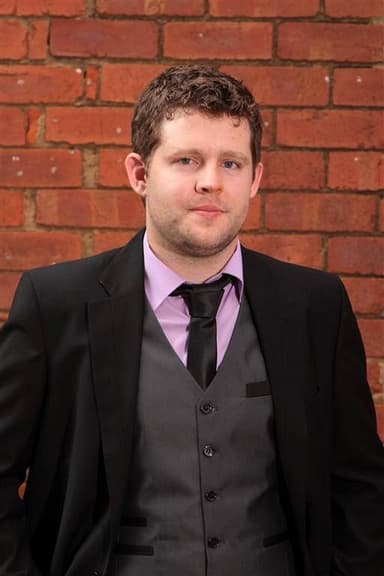
Bruce Douglas has more than a decade of experience in sports and news media, working across print and digital platforms.
Comments
0 comments
No comments yet. Be the first to share your thoughts!
Related Resources to Betting Academy
- Kalshi’s Masters Trading Surge Shows Sports Becoming a Bigger Growth Engine
- Round Robin Betting Guide: How It Works and Key Tips
- Parlay Bets Explained: How They Work and Why They’re Risky
- How Live Betting Affected the Sports Industry
- High Sportsbook Taxes Hurt Bettors Before They Hurt Operators
- How Contract Holdouts Can Help Predict NFL Trades
- Kalshi Notches Legal Win in New Jersey as Sports Prediction Court Battles Rage On
- Why the Future of Sports Prediction Markets Hangs in Balance
- How to Use a Bonus Bet to Hedge an NFL Trade Prediction
- Sports Betting Is Changing the Way Fans Watch the NFL and NBA
- The Best NFL Offseason Markets to Bet On Before the Draft
- Do NFL Trade Rumors Affect the Odds Before the Deal is Officially Confirmed?
- Are All Sportsbook Sponsors in the NFL and NCAA Actually Legal?
- How to Bet NFL Trades & Free Agency Before Odds Move?
- Same Game Parlays Explained
- Best Bets for College Basketball – Thursday, March 12
- Best Bets for NCAA Men’s Basketball – Monday, March 9
- Best Bets for NCAA Men’s Basketball – Friday, March 6
- Best Bets for NCAA Men’s Basketball – Thursday, March 5
- Why Every Betting System is Garbage