
Betting Academy
Same Game Parlays Explained: Maximize Value & Beat the Odds
SGPs are controversial due to their high vig, sportsbooks pushing pre-compiled bets with poor value, and the mystical correlation mechanic sites are using to compile odds. In this guide, I’ll break down how books actually price correlated outcomes, walk through real SGPs I evaluated on BetMGM in March, show you how to calculate whether a payout is fair before placing a ticket, and reveal my latest betting insights and predictions. Same Game Parlays carry high volatility and compounded risk. 21+ only.

SportsBoom offers honest and impartial bookmaker reviews to help you make informed choices. While we may earn commissions through affiliate links, our content remains independent and free from promotional influence. For more information, see our Content Transparency and How We Review pages.

Same Game Parlays Explained
What Are Same Game Parlays?
A Same Game Parlay is a single bet combining multiple legs from one game.
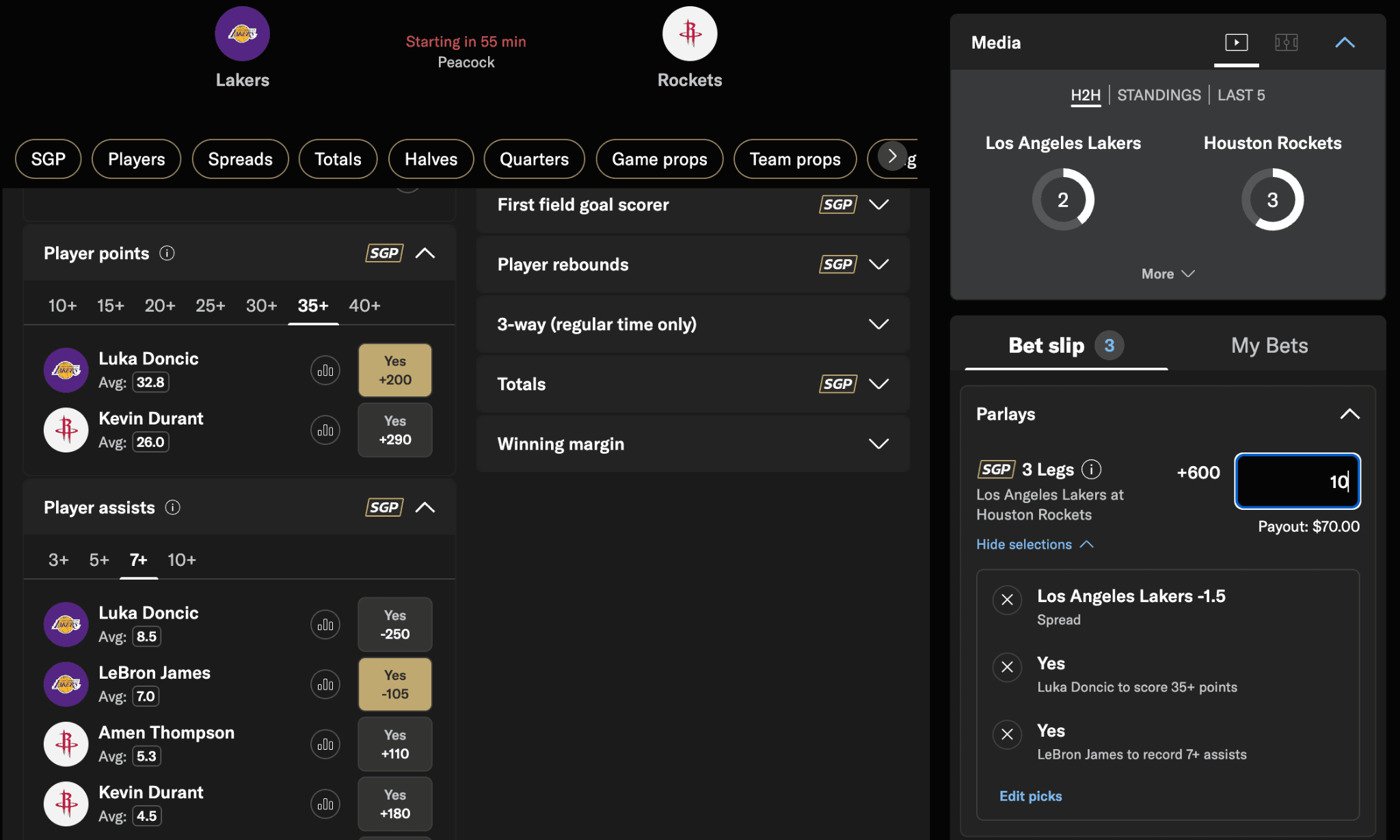
On March 16th, I put $10 on a Lakers vs Rockets SGP on DraftKings: Lakers -1.5, Doncic 35+ points, LeBron 10+ assists, priced at +600.
What Are Same Game Parlays.
Standard parlays combine independent events; for example, Chiefs vs Patriots at the top NFL betting platform and Celtics vs Warriors - neither game cares about the other. SGPs are different because the legs are causally linked.
In my parlay, I wagered on the Lakers to win by 1.5 points or more. If the Lakers are going to beat the Rockets, Doncic will need to score a lot of points, and LeBron will be running the offense. The spread leg and the player props are positively correlated, so if one hits, the others become more likely.
How Correlation Affects Same Game Parlay Odds
With a standard parlay, you convert each leg to decimal odds, multiply them together, and convert them back to American odds.
How Correlation Affects Same Game Parlay Odds
SGPs don't work that way. Because the legs are correlated, online bookmakers reduce the payout to account for the fact that your legs are more likely to land together than independent math would suggest.
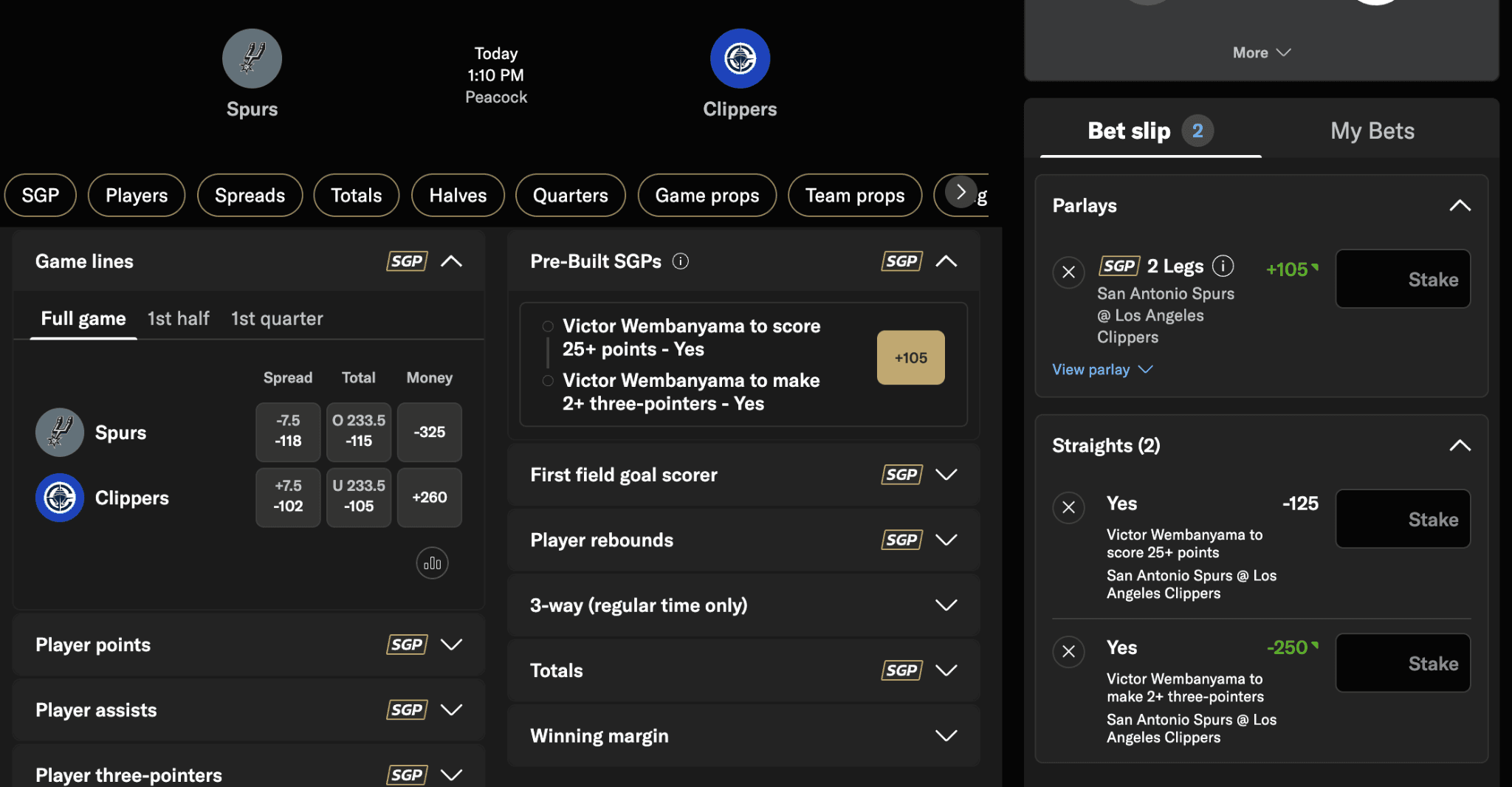
I pulled up a pre-built SGP for the March 16th Spurs vs Clippers game on BetMGM, one of the best NBA betting platforms, which featured Wembanyama with 25+ points and 2+ three-pointers. DraftKings had the SGP paying +105.
As singles, Wembanyama 25+ points was -125 and 2+ threes was -250. If you run the standard parlay math on those two lines, you get +152.The book cut 47 points off the payout because they know these legs aren't independent. To hit 25 points Wembanyama is going to take several three-point attempts. The sportsbook priced that correlation in and passed the cost directly to you.
How I Calculate Implied Probability in Same Game Parlays
Converting odds to implied probability is the first thing I do before evaluating any SGP. The formula is simple:
- Positive odds: 100 ÷ (odds + 100)
- Negative odds: |odds| ÷ (|odds| + 100)
Take an SGP I was looking at for the March 22nd Philadelphia Union vs Chicago Fire MLS game: Philly to win combined with Both Teams to Score, priced at +275. I started by converting each leg as a single:
Leg | Odds | Implied Probability |
Philadelphia to win | +110 | 47.6% |
BTTS Yes | -165 | 62.3% |
Then I multiplied them as if they were independent: 0.476 × 0.623 = 29.7% → fair independent odds of +237.
The sportsbook is offering +275, which implies a 26.7% probability, which is actually lower than my independent calculation, so the payout is higher than the independent math justifies. This is because these legs are negatively correlated. Philly winning cleanly often is likely the result of a shutout or a narrow defensive win, which works against BTTS landing.
The sportsbook has priced that negative correlation in and is giving you higher odds than a standard parlay.
The 4 Drivers of Real SGP Value
Sportsbooks’ SGP pricing models aren’t infallible. Look for these drivers when compiling your next Same Game Parlay:
Positive Correlation: The Sportsbook Has Underpriced
Sportsbooks price obvious correlations tightly. If a star scores more, the team is more likely to win, that relationship is already baked into the numbers. Where value appears is in second-order correlations.
For example, if an opposing team’s primary ball-handler is out, the home point guard’s assist line may quietly become tied to the spread. It’s not a simple star scores, team wins relationship. The injury can disrupt defensive schemes, forcing rotations that funnel more playmaking through one player.
Using Mispriced Props as the Anchor
Spread and total markets usually close efficiently because sharp money attacks them all week. Player props, especially for secondary players, often stay softer for longer. A third receiver’s target prop or a backup center's rebound line in a game where the starter risks foul trouble can still carry pricing gaps.
Game Script Clarity
Clear game scripts make correlation stronger. If a heavy home favorite faces a bottom-tier defense, the favorite often leads early and runs their normal offense through their star. When that script holds, player projections and correlated legs become more reliable.
Cross-Book Pricing Differences
Different sportsbooks model correlation differently, and the gaps on same-game parlays can be huge. I’ve priced identical three-leg SGPs across books and seen payout differences of 60-80 points. When one book offers a significantly higher number, it usually signals a softer correlation model.
Case Study — An Overpriced Same Game Parlay
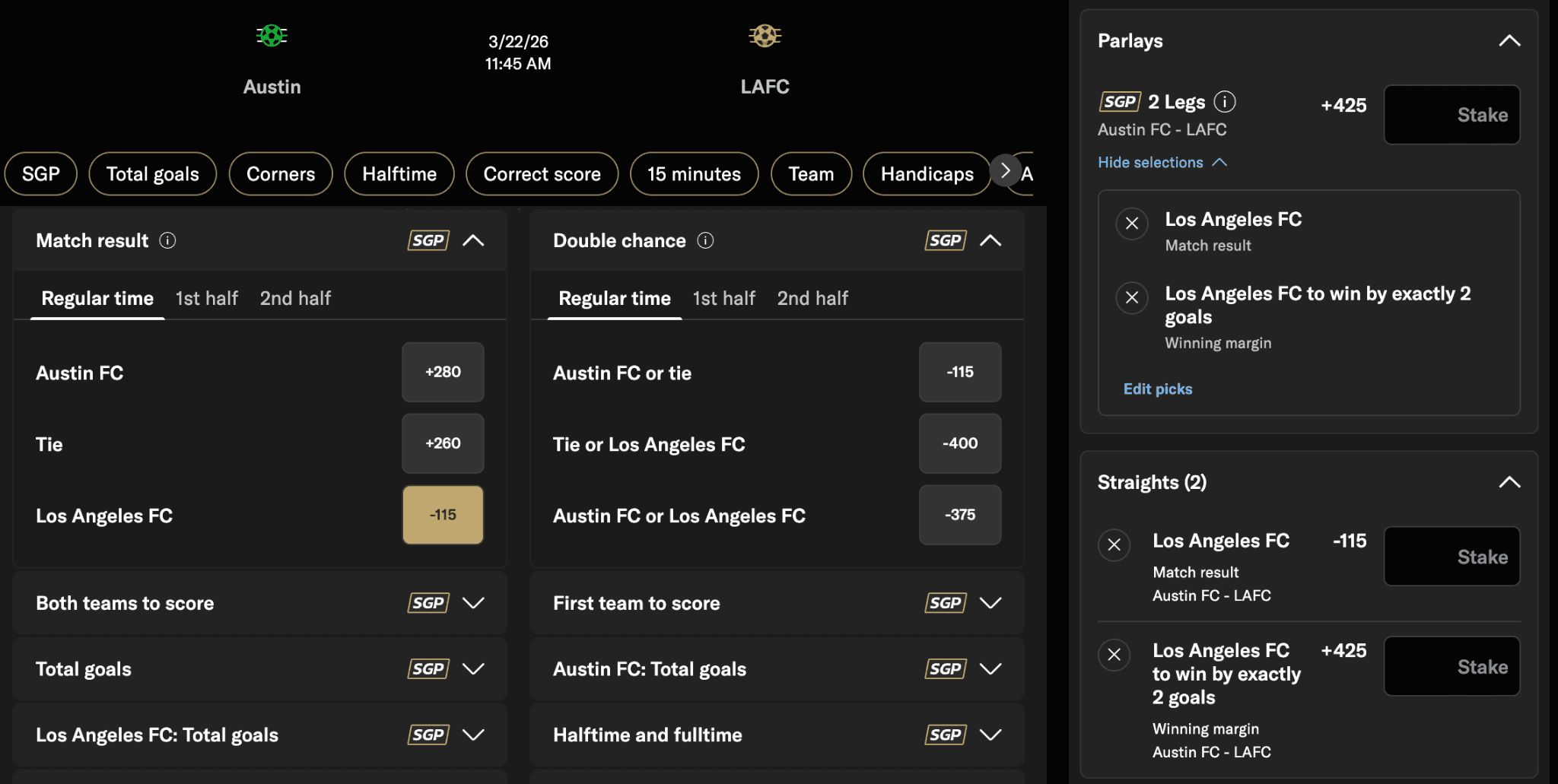
On March 22nd, I was looking at the Austin FC vs LAFC MLS game and pulled up a two-leg SGP on DraftKings: LAFC to win and LAFC to score first, priced at +110.
\An Overpriced Same Game Parlay
I decided to dig into this SGP and broke down the implied probability of each leg of the parlay:
Leg | Odds | Implied Probability |
LAFC to win | -115 | 53.5% |
LAFC to score first | -160 | 61.5% |
Independent combined probability: 0.535 × 0.615 = 32.9% → fair independent odds of +204.
The book is offering +110, which implies 47.6%. That's 14.7 percentage points above the independent baseline. BetMGM has priced this as if these two legs are far more likely to land together than the raw singles suggest.
And they're right that there's correlation here. If LAFC score first, they're more likely to win, as teams that open the scoring in MLS win roughly 69% of the time. The book has identified that relationship and priced it aggressively against the bettor.
However, the correlation adjustment has swung so hard that the +110 payout implies nearly a coin-flip probability on a two-leg parlay. You're being offered worse than evens on a bet with two legs, both of which individually sit below 62% probability.
The independent math says +204. The book says +110. That 94-point gap is the house capturing the correlation benefit entirely!
When I Avoid Same Game Parlays
Most games are not suitable for Same Game Parlays because they fall into these scenarios, which are ticket killers:
When I Avoid Same Game Parlays
When I'm Combining Totals Legs With Player Props
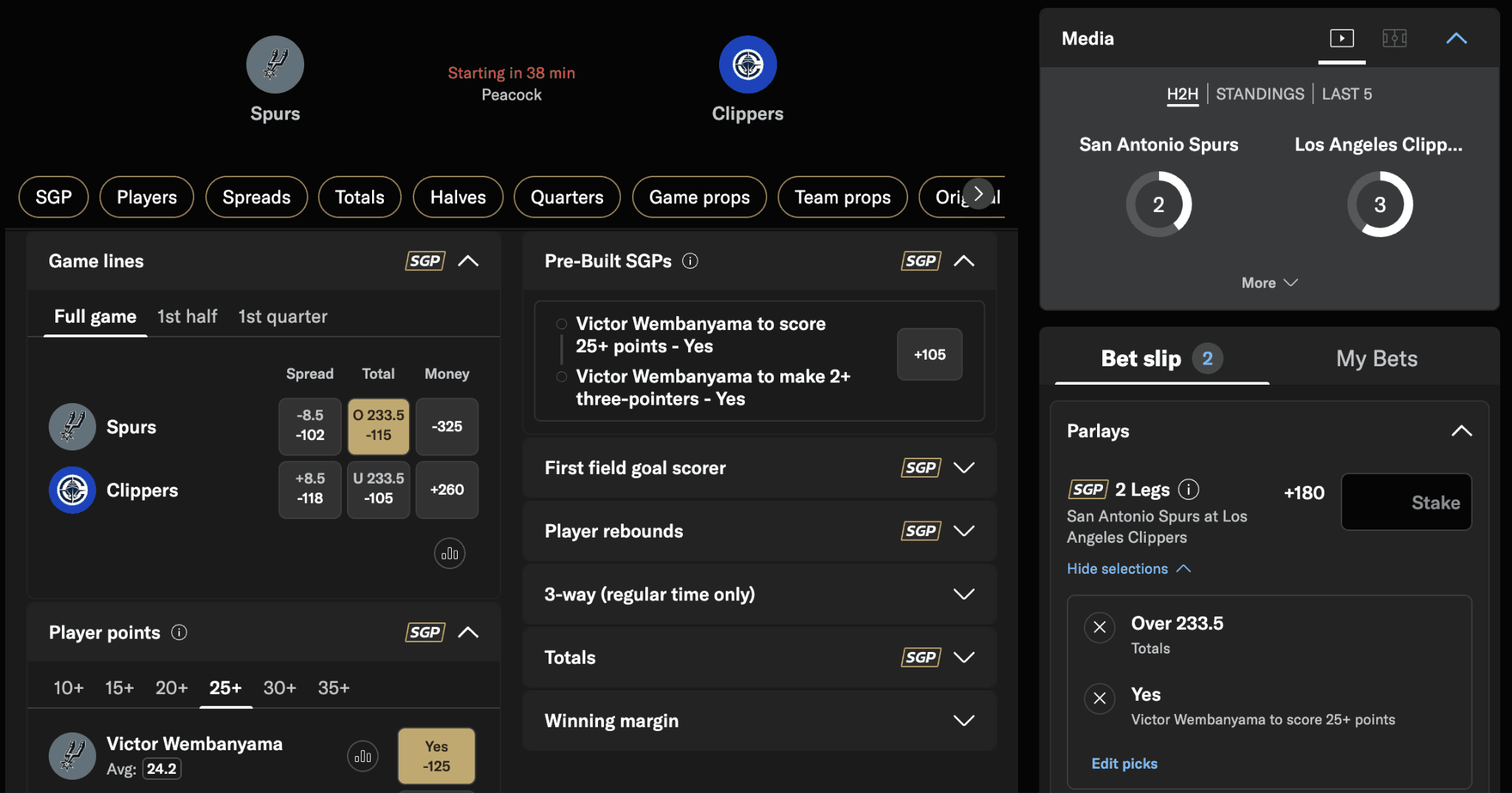
Over 224.5 combined with a team's leading scorer going Over 28.5 points sounds logical, but sportsbooks’ models price this pairing aggressively because it's one of the most common SGP constructions. I've consistently found the payout on this combination doesn't compensate for how tightly the book has modeled it.
When the Line Has Moved Significantly Before I Build
If the spread has moved two or more points since open, something sharp has already happened, such as a line move, an injury, a weather update, or a public fade. Any SGP I build off the current number is being constructed on information the market has already repriced around. The individual legs may now be misaligned with each other, even if each looks reasonable in isolation.
When the Prop Market Opens Late
For the NFL specifically, if key props like offensive line injury, confirmed starter, and snap count projection only surface close to kickoff, I don't build an SGP around them. There isn't enough time to properly model the downstream effects on correlated legs. Rushed SGPs are where I've lost the most money.
My Same Game Parlay Evaluation Checklist
Before I place any SGP, I run through a fixed set of questions. If I'm collecting more no's than yes's,the ticket doesn't get placed.
- Are my legs positively correlated?
- Have I converted every leg to implied probability and calculated the independent combined odds?
- Is the book's offered payout at or above that independent baseline?
- Am I anchoring around a single strong value prop rather than stacking likely outcomes?
- Do all my legs require the same game script to hit?
- Have I checked the same combination across at least two other books for a better price?
- Am I capping at four legs or fewer?
- Am I avoiding obvious correlations the book has almost certainly already priced in?
Final Thoughts — Discipline in Multi-Leg Betting
Same Game Parlays are the most marketed bet type in sports betting for a reason: because they're enormously profitable for sportsbooks. The correlation mechanic is what sportsbooks use to compress your payout below fair value.
When it comes to SGPs, I focus on props before spreads, mispriced correlations in softer markets rather than obvious ones like game winner and play point totals, and never stack more than four legs!
FAQs
Do Same Game Parlays offer fair odds?
Rarely. Sportsbooks price correlations against you, so the payout reduction typically exceeds the actual probability adjustment. Occasionally you'll find overlays, usually in player prop combinations on less-modeled markets, but typically SGP odds favor the house.
How do sportsbooks calculate correlated outcomes?
They use correlation models that estimate how likely legs are to land together and then reduce the payout accordingly. The models aren't perfect, particularly when it comes to player props, but on obvious correlations like a team winning and their star player posting big numbers, sportsbooks nail it.
Why are SGP payouts often lower than standard parlays?
For standard parlays you just multiply the decimal singles odds to determine your payout because the events are independent. However, because SGP legs are positively correlated, the sportsbooks reduce the payout to account for that.
Are Same Game Parlays profitable long-term?
For most bettors, no. The house margin on SGPs is higher than almost any other bet type and is often over 20%.
How many legs are too many?
Three to four is where I cap it. Every additional leg compounds the book's margin and introduces more game-script dependencies.

Bruce Douglas has more than a decade of experience in sports and news media, working across print and digital platforms.
Comments
0 comments
No comments yet. Be the first to share your thoughts!
Related Resources to Betting Academy
- Kalshi’s Masters Trading Surge Shows Sports Becoming a Bigger Growth Engine
- Round Robin Betting Guide: How It Works and Key Tips
- Parlay Bets Explained: How They Work and Why They’re Risky
- How Live Betting Affected the Sports Industry
- High Sportsbook Taxes Hurt Bettors Before They Hurt Operators
- How Contract Holdouts Can Help Predict NFL Trades
- Kalshi Notches Legal Win in New Jersey as Sports Prediction Court Battles Rage On
- Why the Future of Sports Prediction Markets Hangs in Balance
- How to Use a Bonus Bet to Hedge an NFL Trade Prediction
- Sports Betting Is Changing the Way Fans Watch the NFL and NBA
- The Best NFL Offseason Markets to Bet On Before the Draft
- Do NFL Trade Rumors Affect the Odds Before the Deal is Officially Confirmed?
- Are All Sportsbook Sponsors in the NFL and NCAA Actually Legal?
- How to Bet NFL Trades & Free Agency Before Odds Move?
- How Draft Betting Markets Work: Odds, EV & Insider Signals
- Best Bets for College Basketball – Thursday, March 12
- Best Bets for NCAA Men’s Basketball – Monday, March 9
- Best Bets for NCAA Men’s Basketball – Friday, March 6
- Best Bets for NCAA Men’s Basketball – Thursday, March 5
- Why Every Betting System is Garbage