
Betting
How Betting Odds Work: Decimal, Fractional and American
The first accumulator bet I ever placed seemed like it would be a good one. Five selections, all favourites, and the potential payout could be huge. I assumed the odds meant those outcomes were very likely. But, of course, that bet lost! That was the point I realised that odds are not predictions. They’re simply a way to express probability and price risk.

SportsBoom offers honest and impartial bookmaker reviews to help you make informed choices. While we may earn commissions through affiliate links, our content remains independent and free from promotional influence. For more information, see our Content Transparency and How We Review pages.
How Betting Odds Work
Over the years, watching matches and analysing odds across different sports betting platforms, I’ve learned that successful bettors don’t treat odds as signals. They treat them as probability tools.
In this guide, I’ll explain how betting odds work, what they mean in practice, and provide betting odds explained in simple terms – something I wish I understood when I started betting.
This guide is for educational purposes only. Gambling involves risk so it should always be done responsibly. You must be 18 or older and only wager money you can afford to lose.
What are Betting Odds?
Betting odds show two things: the price of a bet and the probability of an outcome. Many beginner bettors think odds are predictions, but they’re actually probability estimates set by the market.
For example, odds of 2.00 imply a 50% chance of winning. A R10 bet at these odds would return R20 in total – your original stake plus R10 profit.
Odds don’t guarantee results; they simply reflect how likely an outcome is considered to be.
How Do Betting Odds Work
When you look at betting odds, they describe betting odds probability and payout at the same time. Shorter prices usually indicate the favourite in the market. Higher odds usually appear when the outcome is seen as less likely.
Here’s an example for the South Africa vs Panama soccer clash:
- Home (South Africa): 1/5
- Draw: 1/1
- Visitor (Panama): 6/5
South Africa are the favourites, which is why their odds are so low at 1/5. Panama is less likely to win, so their odds are higher at 6/5. For example, a R10 bet on:
- South Africa at 1/5 would return R12 (R2 profit)
- A draw at 1/1 would return R20 (R10 profit)
- Panama at 6/5 would return R22 (R12 profit)
When I analyse a betting market, I’m not really asking “Who will win?” Instead, I’m asking whether the odds accurately reflect the probability of the outcome.
If a tennis player is priced at 1.40, the odds suggest they should win most of the time – roughly 7 matches out of 10. But injuries, form, or surface can still affect the outcome.
This is where betting odds explained through probability makes the market easier to read.
How Are Betting Odds Calculated?
Odds usually start with a simple probability estimate. Once that is done, the bookmakers then adjust the prices a little, to add their margin. This is why the odds you see never just reflect the pure probability.
| Odds Format | Odds | Sum |
| Decimal | 2.50 | 1 ÷ 2.50 = 0.40 (40%) |
| Fractional | 6/4 | 4 ÷ (6+4) = 0.40 (40%) |
| American | +150 | 100 ÷ (150+100) = 0.40 (40%) |


How Are Betting Odds Calculated!
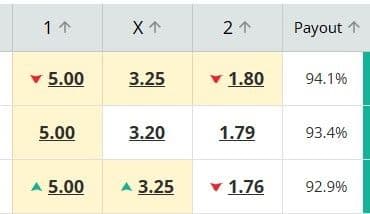
In the above image we see:
Orbit College FC – Odds 5.00 (20%)
Draw – Odds 3.20 (31.25%)
Kaizer Chiefs – Odds 1.77 (56.50%)
Total Implied Probability: 20% + 31.25% + 56.50% = 107.75% (The extra 7.75% is the bookmaker's margin).
How to Read Betting Odds
When I look through betting markets, I usually follow the same simple process.
- 1
Step 1: Identify the probability – I mentally estimate what probability the odds imply.
- 2
Step 2: Compare the reality - I then ask whether the price seems reasonable based on form, matchup, and historical performance.
- 3
Step 3: Ignore emotional bias – One mistake I made early was letting personal feelings influence how I read the odds.
Think about your favourite football team. If they’re priced at 1.70, the market expects them to win fairly often, but supporters don’t always look at it that objectively.
Fractional Odds
Although not often used in South Africa, fractional odds are widely used in the UK and Ireland, and you’ll see them often in sports like horse racing.
Take 5/1 as an example. The numbers simply show how much profit you win relative to your stake. In this case R5 profit for every R1 staked or R50 profit for every R10 staked.
Fractional Odds to Percentages
To convert fractional odds into probability, you can use a simple formula:
Probability = Denominator ÷ (Numerator + Denominator)
5/1
1 ÷ (5 + 1) = 16.7% probability
Converting Fractional Odds to Probability
When I think of fractional odds quickly, I see it as “chance out of total outcomes.”
Odds of 3/1 would suggest a 1-in-4 success rate (3 + 1), or about 25% probability (1 ÷ 4).
This is not perfect maths, but it works for quick estimates.
Decimal Odds
You’ll notice that most online bookmakers with competitive odds use the decimal odds format. They’re easier to read, mainly because the number already includes your stake. If we have odds 2.50, a R10 stake would give you R25 total return.
Decimal Odds to Percentages
Probability formula: Probability = 1 ÷ Decimal Odds
So, with the same odds of 2.50 we spoke about above, we say, 1 ÷ 2.50 = 40% probability.
Convert Decimal Odds to Probability
If I need to evaluate prices quickly, I often round off slightly.
If I see odds of 2.00, I know it is a 50% probability (1 ÷ 2), so odds of 1.50 would have a probability of about 67%, (1 ÷ 1.5).
For quick estimates, this approach usually saves me from having to grab a calculator.
Converting Betting Odds
How to Convert Decimal Odds to Fractional Odds
Formula: Decimal – 1 = Fractional
Example: 2.50 – 1 = 1.50 = 3/2 (1.50 is the same as 3 ÷ 2, which gives us 3/2)How to Convert Fractional Odds to Decimal Odds
If we take odds of 3/1, we use the formula, fractional odds × 100, in this case, 3/1 ×100 = +300. So fractional odds of 3/1 is equivalent to decimal odds +300.
Best Sports for Betting Odds
In my experience, some sports produce clearer betting markets than others. Football has enormous betting volume, which helps create efficient pricing. Many bettors choose to bet on soccer because the markets are widely available and heavily analysed.
Tennis is interesting because there are only two competitors. This makes working out the probability relatively straightforward.
Horse racing odds don’t usually stay still for long. A small update, such as a change in track conditions or a late withdrawal, can be enough to move the market.
Best Leagues for Betting Odds
Markets in the biggest competitions tend to be the most active. Events like the Premier Soccer League, the United Rugby Championship, and the SA20 attract large betting volume, so odds can shift regularly as money enters the market.
Why Understanding Betting Odds is Important
At the beginning, I spent most of my time trying to pick winners. Only later did I realise that understanding probability – the core of betting odds probability – is what really changes the way you analyse betting markets.
Understanding odds affects several things, including:
- Bankroll management
- Risk perception
- Long-term decision-making
Many bettors follow expert betting predictions. But the odds themselves still tell an important part of the story.
Common Mistakes When Reading Odds
When I just started out sports betting, I made a few common mistakes early on. Here are some of them:
Betting Favourites Blindly – Low odds don’t mean guaranteed wins.
Chasing long odds – High odds can seem great, but they don’t automatically represent good value.
Ignoring bookmaker margins – It’s important to remember that bookmakers build profit into their odds.
Staying in control, being disciplined, and responsible gambling are essential.
Tips for Using Betting Odds Effectively
Over time, I developed a few habits when analysing odds.
Think in probabilities, not predictions.
Avoid emotional betting decisions.
Compare odds across multiple bookmakers.
Keep records of past bets.
Odds should be used as risk indicators, not signals.
Odds Movement Explained
Odds change constantly, and this happens for many reasons.
- New information (injuries, weather
- Betting volume
- Professional bettors influencing markets
You’ll often see odds shift when a lot of bets come in on one team. As bets start coming in, bookmakers sometimes tweak the prices to manage their risk. That’s why the odds you see at kickoff can be very different from the opening market.
Odds Movement Explained!
Safer Gambling and Responsible Betting Notes
Sports betting should always be done responsibly. Guidelines I follow:
- Only bet money you can afford to lose
- Set limits on spending and time
- Avoid chasing losses
Gambling is strictly for 18+ audiences, and all betting should be done with licensed operators.
Conclusion
Understanding how betting odds work is about interpreting probability, not predicting winners. Once I started looking at odds this way, betting markets made a lot more sense. Odds are simply tools for measuring risk and potential return, not predicting what is going to happen.
When you start viewing odds through a probability mindset rather than using too much emotion, betting decisions become clearer and more disciplined. At least, that’s what experience over time has taught me.
Betting Odds FAQs
Do higher odds mean better value?
Not necessarily. Higher odds usually mean the outcome is less likely. Value depends on whether the probability behind the odds is accurate, not just how big the price looks.
Why do odds change after I place a bet?
Odds change for many reasons. Sometimes new information comes out, such as injuries or change in conditions. Other times the price shifts simply because a lot of money is coming in on one side of the market.
Are odds the same on all betting sites?
No, bookmakers price events differently. Because of that, you’ll see small variations in odds between betting sites.

Chad Nagel is a passionate sports fanatic who has worked in the sports and betting industry for over a decade. He spent most of his career as an editor-in-chief for Soccer Betting News, South Africa’s leading soccer betting newspaper, owned by Hollywoodbets. His articles have also featured in some of the most respected sports media platforms in the world, such as SPORTbible, Sports Illustrated, Combat Sports UK, and many others.
Related Resources to Betting Academy
- Round Robin Betting Guide: How It Works and Key Tips
- Parlay Bets Explained: How They Work and Why They’re Risky
- How Live Betting Affected the Sports Industry
- High Sportsbook Taxes Hurt Bettors Before They Hurt Operators
- How Contract Holdouts Can Help Predict NFL Trades
- Kalshi Notches Legal Win in New Jersey as Sports Prediction Court Battles Rage On
- Why the Future of Sports Prediction Markets Hangs in Balance
- How to Use a Bonus Bet to Hedge an NFL Trade Prediction
- Sports Betting Is Changing the Way Fans Watch the NFL and NBA
- The Best NFL Offseason Markets to Bet On Before the Draft
- Do NFL Trade Rumors Affect the Odds Before the Deal is Officially Confirmed?
- Are All Sportsbook Sponsors in the NFL and NCAA Actually Legal?
- How to Bet NFL Trades & Free Agency Before Odds Move?
- How Draft Betting Markets Work: Odds, EV & Insider Signals
- Same Game Parlays Explained
- Best Bets for College Basketball – Thursday, March 12
- Best Bets for NCAA Men’s Basketball – Monday, March 9
- Best Bets for NCAA Men’s Basketball – Friday, March 6
- Best Bets for NCAA Men’s Basketball – Thursday, March 5
- Why Every Betting System is Garbage