
Betting News
Which US States Have Banned Prediction Markets
Kalshi and Polymarket hold a federal licence, and the federal government is actively defending it in court. Twenty states disagree, and two federal appeals courts have now ruled on the same question and reached opposite answers.

SportsBoom offers honest and impartial bookmaker reviews to help you make informed choices. While we may earn commissions through affiliate links, our content remains independent and free from promotional influence. For more information, see our Content Transparency and How We Review pages.
Credit: Getty Images
A prediction market lets people buy and sell contracts on the outcome of a real-world event, a sports result, an election, a Federal Reserve decision, a company's earnings, rather than placing a wager with a bookmaker. Each contract typically settles at $1 if the event happens and $0 if it doesn't, and the price at which it trades between those two points reflects the market's running estimate of how likely the outcome is.
Platforms such as Kalshi and Polymarket make their money from a trading fee, not from setting odds against the customer the way a sportsbook does.
That structure is exactly why prediction markets have become so contested. Kalshi is registered with the Commodity Futures Trading Commission as a designated contract market, the same federal status held by exchanges trading oil, wheat or interest rate futures, and it argues that a contract on who wins a football game is no different in kind to a contract on where the price of corn ends up.
Federal securities and commodities law generally pre-empts state regulation of that kind of exchange. State gambling regulators see the same product and reach the opposite conclusion: a contract that pays out based on a sports score is a bet on a sports score, however it is dressed up, and taking that bet without a state gambling licence is exactly the activity their laws exist to control.
Election and political contracts add a separate layer of concern that shows up more in public debate than in the legal filings, prices on a prediction market get quoted in the press as though they were polling data, and critics argue that a liquid market where anyone can buy a position creates an incentive to try to influence the outcome itself, not just predict it. Sports contracts are where the money and the enforcement both concentrate, though.
Every state that has moved against the platforms already has a licensed sportsbook industry, a regulator, and a tax base built around it, and a federally licensed exchange offering an equivalent bet with none of the state licensing costs is the most direct competitive threat that industry has faced.
Both platforms operate under their federal licence regardless of what any individual state decides, and Washington has gone to unusual lengths to defend it, suing nine states directly to stop them from enforcing their own gambling law against the exchanges. That is not a normal regulatory dispute. It is a jurisdictional fight between the federal government and the states, being fought state by state and court by court, with no single outcome yet in sight.
The circuit split that sends this to the Supreme Court
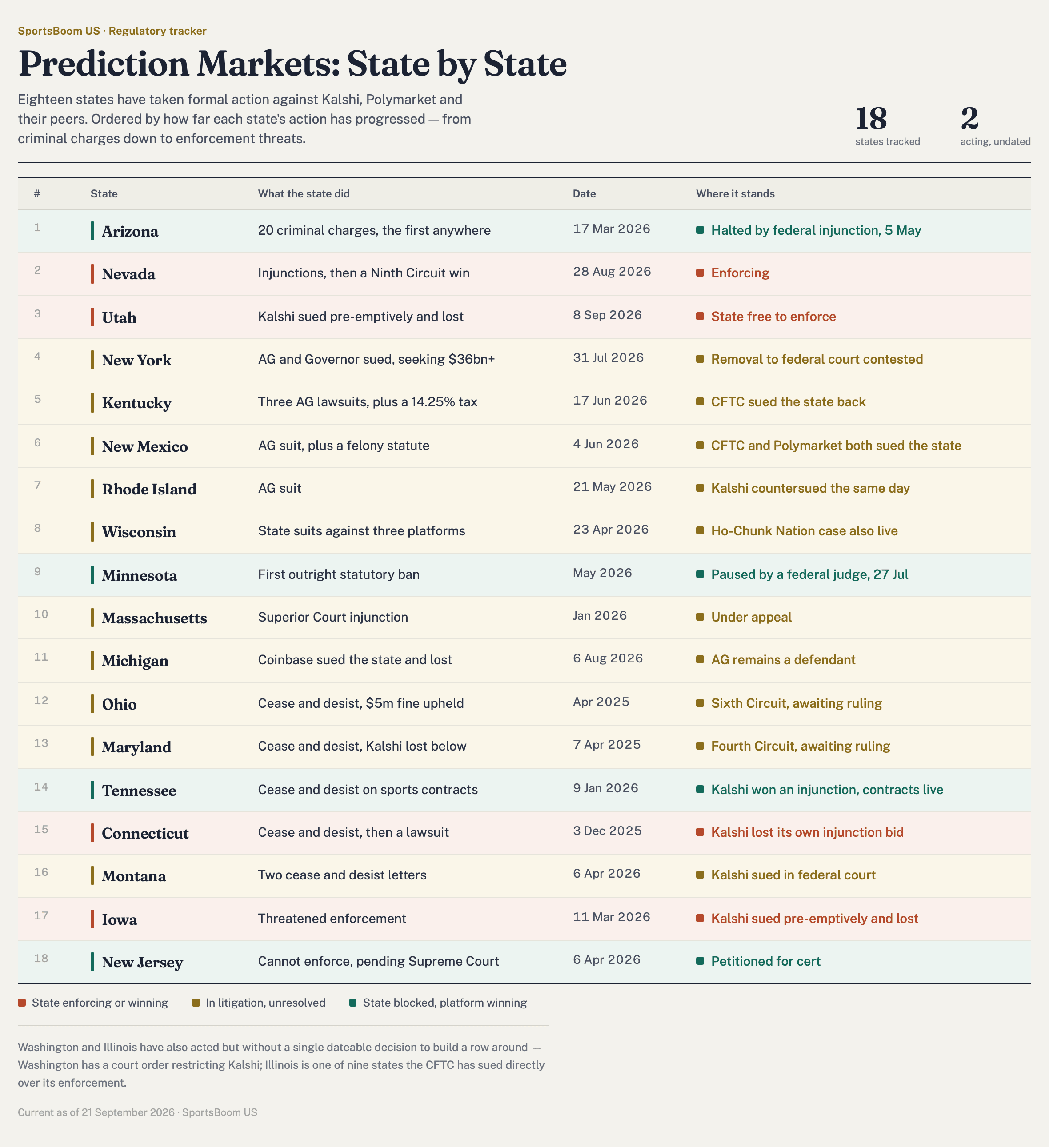
Two federal appeals courts have now ruled on the identical legal question, whether Kalshi's sports contracts qualify as swaps under exclusive CFTC jurisdiction, and reached opposite conclusions. On 6 April 2026 the Third Circuit ruled 2–1 that New Jersey cannot enforce its gambling law against Kalshi. On 28 August the Ninth Circuit ruled 3–0 the other way in Nevada's case, finding the contracts unlikely to qualify as swaps at all. Nevada has since started enforcing, and Kalshi has asked the Ninth Circuit for a rehearing before a full panel.
State by state
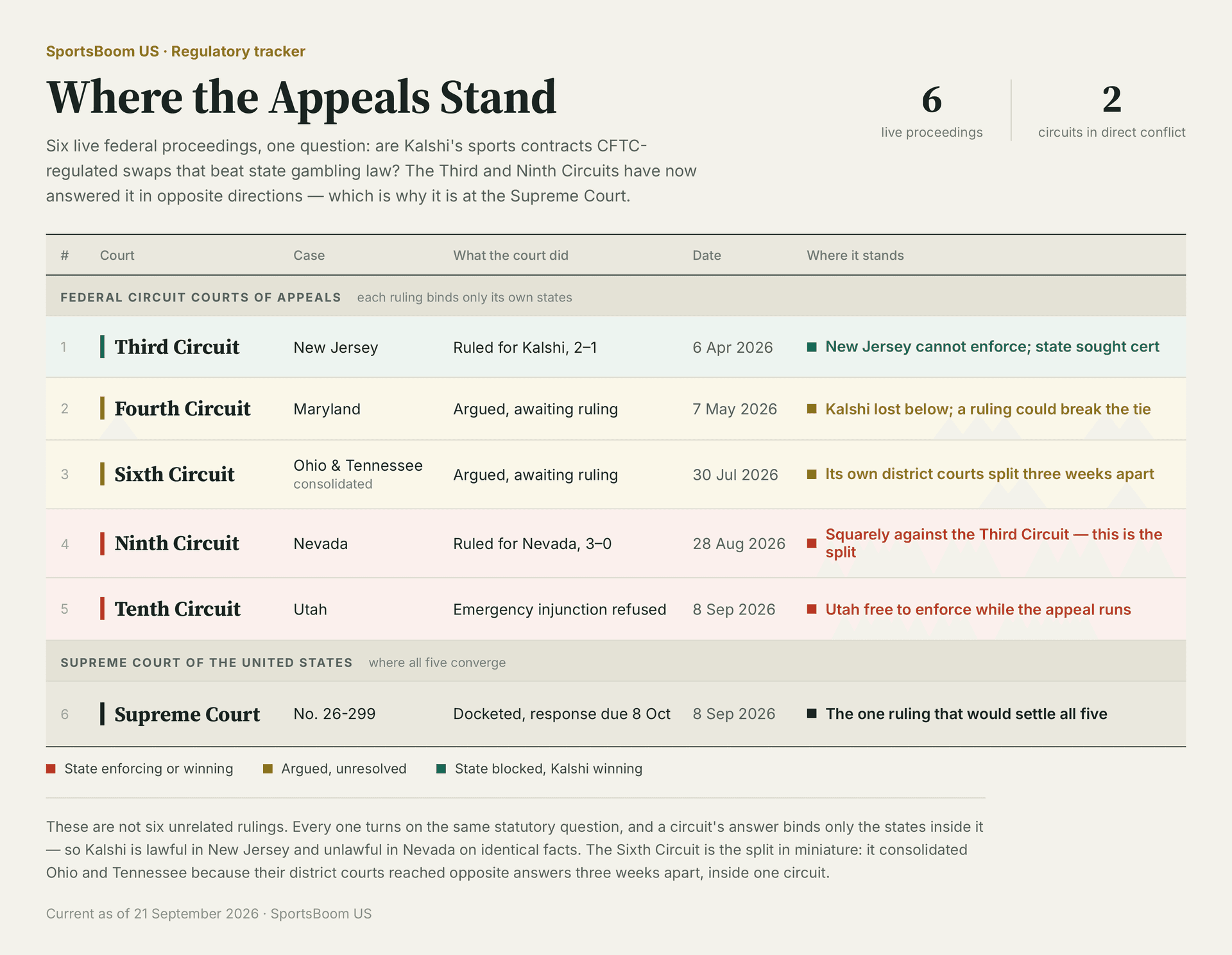
Sorted by how far each state has actually got, not alphabetically. A cease and desist letter and a criminal prosecution are very different things, even when both count as "action" in a headline. The state- and circuit-level detail below was compiled and cross-checked against research published by VIP-Grinders[1], which tracks prediction market restrictions on a rolling basis.
North Carolina went the other way
On 7 July 2026, North Carolina became the first state to legalise prediction markets rather than fight them. The law recognises the CFTC's exclusive federal authority over the product and applies a 6% tax on net trading fee revenue from state residents, with no separate licence required. The same bill raised the state's existing sports betting tax from 18% to 23%, which is a fairly direct signal of how lawmakers weighed the two industries against each other.
The contrast with Kentucky is the cleanest illustration of the two paths available to a state. Kentucky taxes the same product at 14.25% and is now defending itself in a federal lawsuit brought by the CFTC. North Carolina taxes it at 6% and is not.
The tribes have their own case
Three California tribes sued Kalshi and Robinhood in July 2025 under the Indian Gaming Regulatory Act, arguing that sports event contracts undercut exclusive gaming rights they had negotiated with the state. A federal judge denied their injunction, holding that the Act does not reach third party platforms, and the Ninth Circuit heard the appeal on 10 July 2026 without yet ruling. In Wisconsin, the Ho-Chunk Nation brought a similar claim and survived a motion to dismiss on 11 May, the first ruling anywhere to favour a tribe on this specific question.
What happens to a position when a state acts
An order lands on the platform, not directly on an account, and the practical effect varies by mechanism. Tennessee's cease-and-desist letters ordered both platforms to void open sports contracts and refund every deposit by 31 January 2026, the only instance anywhere of a regulator ordering money returned outright. It never happened: Kalshi sued the same day, and a federal judge's injunction in February stopped the refund order before it took effect, so the contracts stayed open and positions were never voided. That is worth remembering when weighing how enforceable any state order actually is once a platform decides to litigate rather than comply.

Meet Louis Hobbs, our resident sports guru with a knack for all things darts and snooker. His expertise goes beyond the ordinary, offering deep insights that set him apart. Louis also has a strong passion for US sports, particularly basketball and American football.
Comments
0 comments
No comments yet. Be the first to share your thoughts!
References
- 1.vip-grinders.com - Where Are Prediction Markets Banned? Polymarket and Kalshi Restrictions by Country
Related Resources to Betting News
- Prediction Markets' 16-Fold Volume Surge Shows Why Sportsbooks Should Be Worried
- DraftKings’ Four-State Prediction Push Reveals Its Bigger US Market Bet
- MLB’s Polymarket Exclusivity Tested as Five Teams Partner With Kalshi
- Which US States are Posting the Biggest Gambling Revenue Gains in 2026
- Colorado Introduces New Betting Protection Law: Which States Will Follow Next?
- New York's Sports Betting Tax Take Jumped $50M After World Cup Results Favoured the Books
- Prediction Markets Gain Sportsbook-Level Legitimacy as Genius Sports Strikes Polymarket and Kalshi Deals
- Could Real-Time Statistics Change How Americans Bet on Sports?
- U.S. Sportsbooks Are Likely to Break Their All-Time Hold Record This Summer
- Has Live Betting Become More Popular Than Pre-Match Betting?
- Why Fast Rewards Drive Online Gambling Growth
- The reason why U.S. Betting Operators are becoming Media Ecosystems
- Are Branded Slot Games Still Effective at Attracting New Players?
- Gamification in Online Casinos: Where Games and Gambling Converge
- Simplicity Over Value: Why Casual Bettors Accept Worse Odds
- Are Same-Game Parlays the Fast Food of American Sports Betting?
- Why Power Laws Rule the Sports Betting Industry
- Online Casinos Vs Sports Betting Market
- Have Sportsbooks Become Too Reliant on the NFL Calendar?
- Can Artificial Intelligence Make Bettors Smarter Than Sportsbooks?