
Betting News
Prediction Markets' 16-Fold Volume Surge Shows Why Sportsbooks Should Be Worried
Prediction markets are reshaping US sports betting, with Kalshi and Polymarket surging in volume. VIP-Grinders' João Mourato examines five key figures and what they mean for sportsbooks.

SportsBoom offers honest and impartial bookmaker reviews to help you make informed choices. While we may earn commissions through affiliate links, our content remains independent and free from promotional influence. For more information, see our Content Transparency and How We Review pages.

Credit: Getty Images
Sportsbooks spent much of 2026 treating prediction markets as a niche curiosity. The volume data says otherwise. Kalshi and Polymarket now dominate a corner of the betting market that barely existed eighteen months ago, and the question hanging over every regulated operator has shifted, no longer whether these platforms matter, but how much of the traditional book's business they're quietly taking, and whether that's a temporary World Cup effect or something structural.
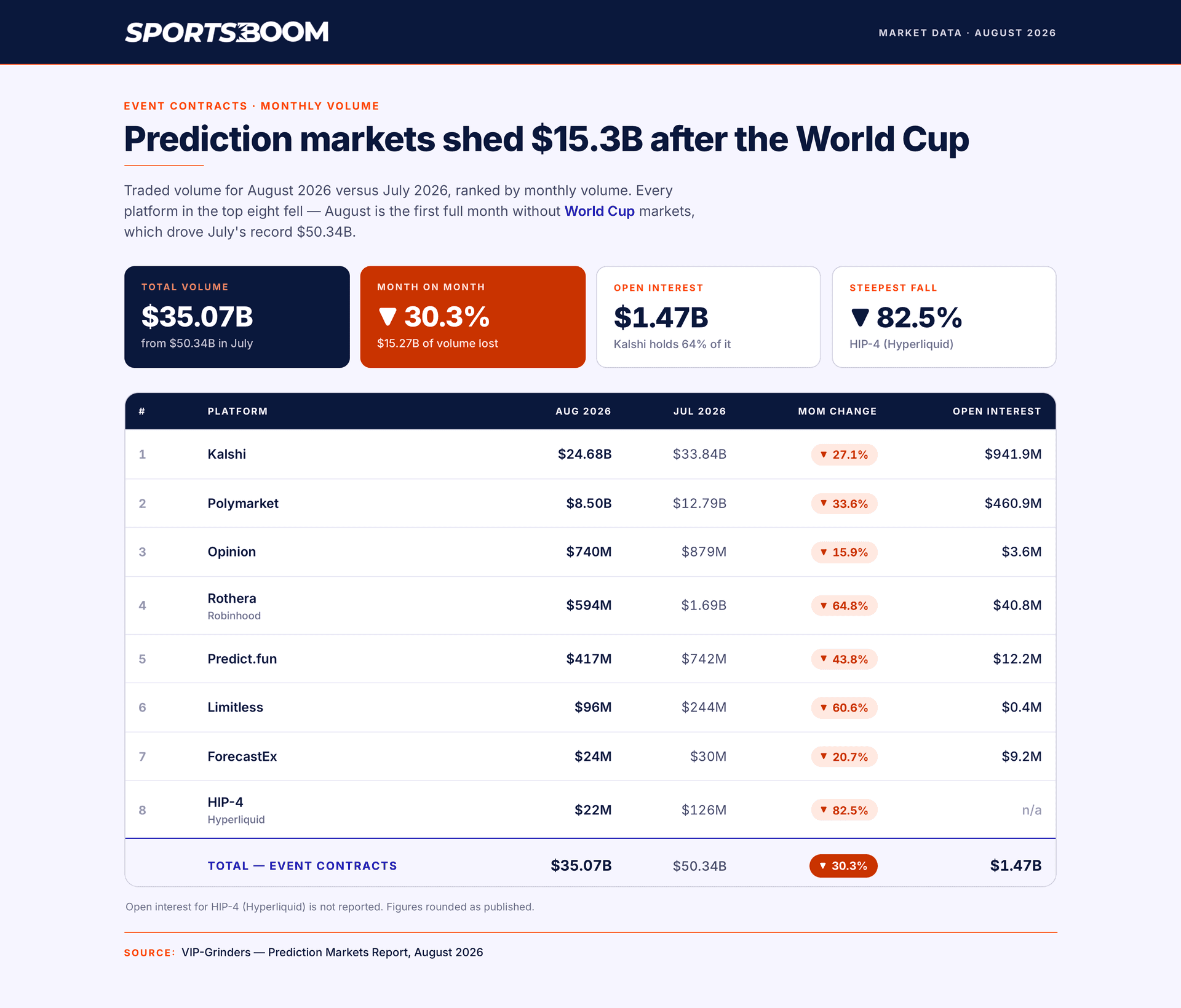
VIP-Grinders' August 2026 Prediction Markets Report put numbers on that question.[1]
SportsBoom sat down with João Mourato, Head of iGaming Product at VIP-Grinders, to go through the report line by line, starting with the headline stat and working through to the one regulators are watching most closely.
We picked five figures from the report that matter most to our readers, and asked Mourato to defend, qualify, or walk back each one. He didn't walk back much.
It's worth reading these supply-side numbers alongside the demand side too. Our recent article on prediction market awareness among NFL fans found a wide gap between bettors' stated intent to try these products and their actual legal access to them state by state.
27% of World Cup Betting Volume
H2 Gambling Capital's number is the one that's been quoted everywhere: prediction markets took roughly 27% of legal US sports betting volume during the World Cup, up from about 9% at the start of 2026.
The obvious question is whether that's a tournament spike or a permanent shift in where the money goes.
"Both, and the distinction matters," Mourato began.
"The 27% covers a tournament, and August volume falling 30.3% once the World Cup ended shows a good part of that was event-driven."
But he doesn't think the underlying number is noise.
"The underlying shift is real, and the cleanest way to see it is a like-for-like comparison. Kalshi and Polymarket took $1.98bn in August 2025 and $33.18bn in August 2026. Two non-tournament months, sixteen times the volume, no World Cup in either,” Mourato exclusively told SportsBoom.us.
His explanation runs through cost and platform design rather than the tournament itself.
"My read on why is that bettors have got sharper about cost. On a straight two-way market, a prediction market charges a fraction of what a sportsbook takes out of the price, and it's visible rather than buried in the odds."
"The bigger draw, speaking as someone who bet professionally, is that an exchange can't close a winning account. Betfair proved that model works twenty-six years ago. What's new is a federal licence and everything beyond sport.”
AGA Data Tells A Different Story
The AGA reported a year-on-year fall in sportsbook handle for May 2026, which read to some as the first hard evidence of prediction markets biting into the regulated market.
Mourato isn't convinced that single data point holds up.
"There was a drop, but a marginal one, and I wouldn't build much on a single month," he said.
"Sports betting revenue for January to May was up 8.5% year on year."
June, he argues, is the more instructive figure, and it points the other way.
"Handle rose 26% to $12.59bn while revenue fell 18.3%, because hold dropped from 12.5% to 8.1%. That's the same period prediction markets reportedly took 27% share. Handle went up, not down, and the revenue fall was bettors winning rather than bettors leaving."
He still won't rule out substitution entirely.
"Some absorption is almost certainly happening. It just isn't visible in the handle data yet, and the AGA isn't a neutral reader of its own numbers given it's lobbying for these contracts to be regulated as gambling."
Asked directly to put a dollar-for-dollar substitution rate on the record, he declined and explained why the number itself is close to unknowable.
"Nobody can compute it, because the two sides count different things. Handle counts a bet once when it's struck. Prediction market volume counts both sides of every matched trade, plus every trade in and out of the same position. Sports contracts turn over 9.17 times their open interest in an average week, so the same dollar shows up in the volume figure repeatedly,” Mourato added.
The Cost Of Trading
The cost argument is central to the whole prediction-markets pitch: Kalshi's effective fee runs at roughly a quarter of a standard sportsbook's two-way overround for someone who bets once and holds to the final whistle. But that comparison assumes a bettor who doesn't trade the position, and Mourato says most sports bettors do.
"It depends entirely on how the player behaves, and for anyone trading in-play the answer is no," he said.
"A betting exchange charges commission once, when the market resolves. A prediction market charges on every matched trade. So anyone actively trading through a match will very likely pay more in fees than they would have paid a sportsbook."
The trade-off, in his view, is optionality rather than cost.
"What they get in return is the ability to enter and exit repeatedly. At a sportsbook you're in for the whole match unless you take the cash-out, which from my years in the industry carries around a 10% penalty baked into the price."
The turnover figures back that up directly.
"Sports contracts turn over 9.17 times their open interest in an average week. Politics turns over 1.05 times. The low fee is real for someone who places one bet and waits, and it disappears for anyone who trades. The bettors most attracted by the low fee are the ones most likely to trade it away.”
The Parlay Problem
Prediction markets have marketed their combination contracts as a cheaper parlay. The blended numbers support that.
Gambling Insider's benchmarking put the blended loss on Kalshi combinations at 8 to 9 cents per dollar, against roughly 19 cents on a typical sportsbook parlay.
Mourato flags that comparison as misleading for the retail customer specifically.
"Their argument is that the blended number includes the professional firms taking the other side, and that the retail trader's real rate runs two to four times higher. That puts it somewhere between 16 and 36 cents per dollar. I'd treat it as a range rather than a number," he said.

"For context, Bloomberg found retail lost a net $294m on Kalshi combinations in 2026, at an average implied probability of 9%."
He's sceptical that the no-limits pitch changes the calculation for this customer segment.
"The thing worth understanding is who buys these. Parlay bettors are almost never value-driven. They're buying a lottery ticket, a small stake with the chance of a large return. Anyone genuinely hunting value wouldn't touch a parlay, because every added leg multiplies the operator's edge. That's true at a sportsbook and it's true on Kalshi."
"So the venue changed and the product didn't. Same bet, same customer, at a rate that may not be much better once you strip out the professionals on the other side."
On Kalshi's promise not to limit winning traders more broadly, Mourato, who says he was limited repeatedly during his own professional betting career, sees a real structural difference, but a narrower one than it's often sold as.
"A CFTC-regulated exchange structurally can't do that, because it isn't the counterparty. For a winning bettor that's the entire proposition.”
But he adds: “It's a promise about what the platform won't do to you, not a promise that you'll win. On straight two-way markets you keep more of your edge than anywhere else. On combinations, you're trading against firms that price for a living, and Kalshi's app doesn't even offer a button to take the other side of someone else's combination."
Robinhood's Post-World Cup Collapse
Robinhood's prediction markets exchange looked, briefly, like a genuine third player during the World Cup.
Mourato treats its collapse afterwards as the report's clearest data point.
"It's the clearest case in the data, but the interesting part is why," he said.
"Look at what Robinhood actually offers on sports. The betting options are very limited compared to a real sportsbook. A serious sports bettor wouldn't find enough there to stay.
"So, my read is that the people betting the World Cup on Robinhood weren't sports bettors who switched platforms. They were Robinhood customers who saw a World Cup market in an app they already had open. Once the tournament ended, so did the reason to use it."
The numbers, per Mourato, back that reading up hard.
"Rothera, the exchange behind Robinhood, took 82% of its entire lifetime volume from that one tournament. It peaked at $2.09bn in June and fell to $594m by August, down 65% in a month. That's with Susquehanna behind it, its own CFTC-regulated exchange and clearinghouse, and distribution through one of the largest retail brokerages in America."
Zoom out and the pattern repeats across the whole third-place battle.
"Third place has changed hands three times in ten months, and nobody has held it, while Kalshi and Polymarket went from 63% of volume in December to 94.6% in August."
"An event gets you users. A product gets you a market."
The regulatory wildcard
We asked Mourato where sports volume goes if the Ninth Circuit sides with Nevada in the ongoing litigation, potentially setting up a circuit split. He wouldn't forecast the legal outcome.
"I'd be guessing on the legal outcome and I'd rather not. It's extremely volatile. Every state has its own position, the two parties treat it very differently, and a single election can flip the whole thing. Anyone forecasting this confidently is overreaching."
He was more willing to explain why sport, specifically the fight, is worth watching.
"It's 69.6% of trading volume and the only category that overlaps a licensed, taxed industry. Nothing in this litigation is really about inflation contracts."
And he flagged that the metric worth tracking over the coming months isn't the one most coverage leads with.
"The figure I'd watch isn't volume, it's open interest. Volume can be inflated by market making and arbitrage, so it moves for reasons that have nothing to do with bettors. Open interest is money actually committed. If capital leaves while volume holds, people are trading out. If open interest holds while volume falls, they're sitting tight and waiting for clarity,” he concluded.

Meet Louis Hobbs, our resident sports guru with a knack for all things darts and snooker. His expertise goes beyond the ordinary, offering deep insights that set him apart. Louis also has a strong passion for US sports, particularly basketball and American football.
Comments
0 comments
No comments yet. Be the first to share your thoughts!
References
- 1.VIP-grinders - Prediction Markets Report August 2026: Volume, Open Interest and Platform Rankings
Related Resources to Betting News
- DraftKings’ Four-State Prediction Push Reveals Its Bigger US Market Bet
- MLB’s Polymarket Exclusivity Tested as Five Teams Partner With Kalshi
- Which US States are Posting the Biggest Gambling Revenue Gains in 2026
- Colorado Introduces New Betting Protection Law: Which States Will Follow Next?
- New York's Sports Betting Tax Take Jumped $50M After World Cup Results Favoured the Books
- Prediction Markets Gain Sportsbook-Level Legitimacy as Genius Sports Strikes Polymarket and Kalshi Deals
- Could Real-Time Statistics Change How Americans Bet on Sports?
- U.S. Sportsbooks Are Likely to Break Their All-Time Hold Record This Summer
- Has Live Betting Become More Popular Than Pre-Match Betting?
- Why Fast Rewards Drive Online Gambling Growth
- The reason why U.S. Betting Operators are becoming Media Ecosystems
- Are Branded Slot Games Still Effective at Attracting New Players?
- Gamification in Online Casinos: Where Games and Gambling Converge
- Simplicity Over Value: Why Casual Bettors Accept Worse Odds
- Are Same-Game Parlays the Fast Food of American Sports Betting?
- Why Power Laws Rule the Sports Betting Industry
- Online Casinos Vs Sports Betting Market
- Have Sportsbooks Become Too Reliant on the NFL Calendar?
- Can Artificial Intelligence Make Bettors Smarter Than Sportsbooks?
- Why Live Betting Is Changing How Fans Watch Games