
Betting News
DraftKings’ Four-State Prediction Push Reveals Its Bigger US Market Bet
Where sports betting is banned outright, DraftKings is running paid Predictions ads anyway, and the states it picked are the two biggest sources of event contract volume in the country.

SportsBoom offers honest and impartial bookmaker reviews to help you make informed choices. While we may earn commissions through affiliate links, our content remains independent and free from promotional influence. For more information, see our Content Transparency and How We Review pages.
Credit: Getty Images
DraftKings has spent the past 24 hours running state-specific advertising campaigns for its Predictions platform in California, Texas, Georgia and Florida, according to Legal Sports Report.[1]
Three of those four states have no legal sportsbook market at all. The fourth, Florida, only has one because of the Seminole Tribe's exclusive compact with Hard Rock Bet.
On the surface, it looks like an operator simply chasing an untapped population. Underneath it, the timing and the target list line up with something more specific: the states where sports event contracts, not traditional sports betting, already do the most business.
The states DraftKings picked are not random
Modelled data from Eilers & Krejcik Gaming's April Prediction Market Monitor found that 69% of all US sports event contract volume originates in the 19 states without legal online sports betting, and that 43% of all national volume comes from just two of them, California and Texas. Two of DraftKings' four newly targeted states are the two single biggest sources of demand in the entire prediction markets sector.[2]
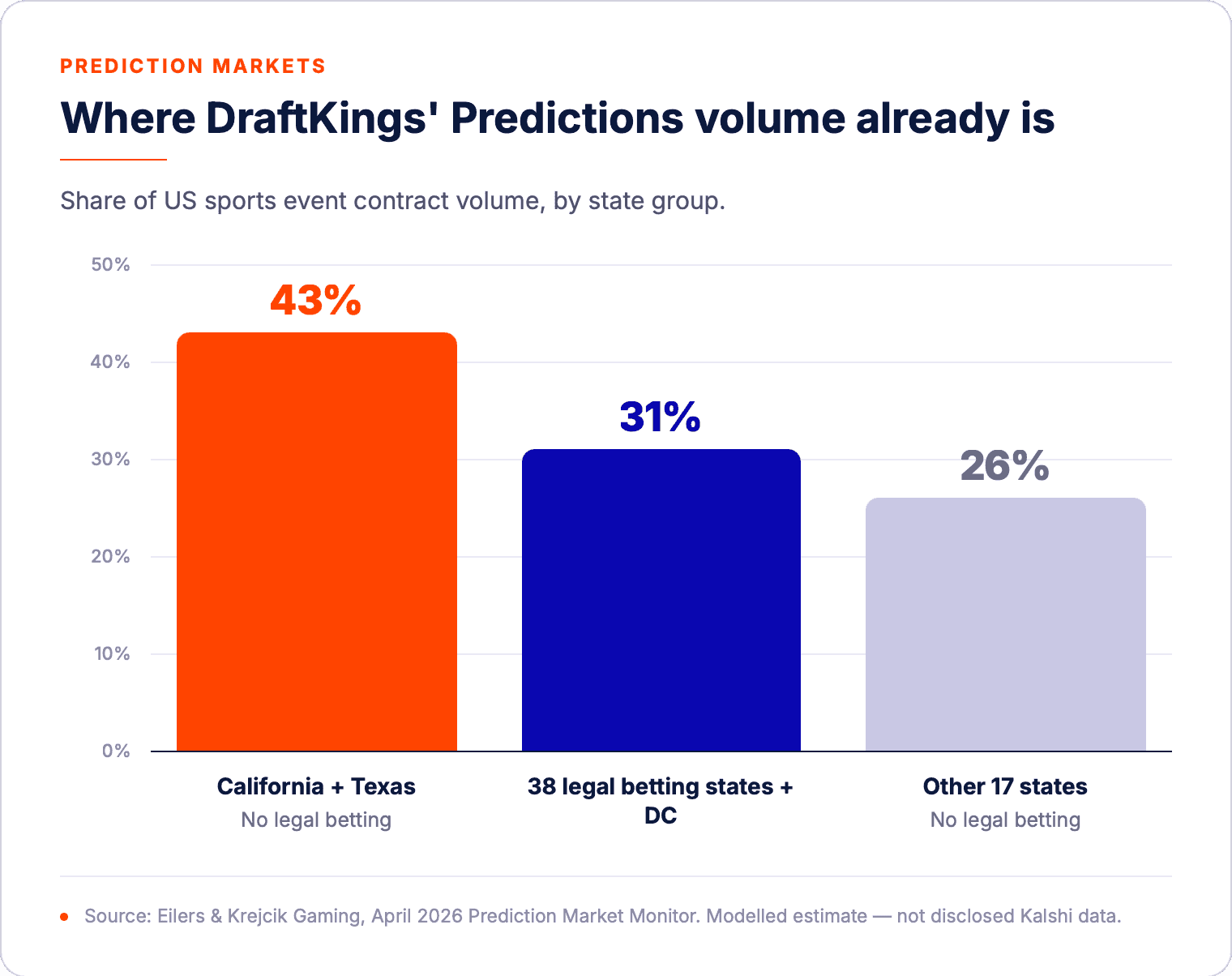
That figure comes with a caveat worth carrying into the piece: Kalshi does not publish state-by-state volume, so EKG built the 69%/43% estimates from national volume data layered against search trends, digital ad spend and its own competitive index, weighted by each state's adult population. It is a modelled estimate, not disclosed trading data, though it is the best public approximation currently available.
The scale of the underlying market explains why.
California and Texas together hold around 65 to 71 million residents, roughly a fifth of the US population, and neither has a functioning legal sportsbook market.
California alone hosts 21 major professional sports franchises, more than any other state.
Texas has 11 professional teams across the four major leagues.
Georgia, the third target, has its own sizeable sports betting appetite tied up in a slow-moving legislative and referendum process that has stalled for several sessions running.
Put together, DraftKings is not discovering a new market. It is placing paid media directly on top of a market its own industry's data already says is the largest concentration of demand in the country.
Would DraftKings push into other states?
Almost certainly, and the shortlist is fairly predictable. Eleven states currently have no legal sports betting in any form: Alabama, Alaska, California, Georgia, Hawaii, Idaho, Minnesota, Oklahoma, South Carolina, Texas and Utah.
DraftKings has now covered three of the biggest by population, plus Florida, leaving seven candidates that split cleanly into two tiers.
The likelier next moves are South Carolina, Oklahoma, Minnesota and Alabama.
None have outright constitutional gambling bans, several have active legislative sports betting bills already moving, and advertising a federally regulated product into a state that is visibly working toward legalising betting anyway is an easier story for DraftKings to tell regulators and the public.
Utah and Hawaii sit at the other end. Both ban nearly all forms of gambling outright, and Utah is already the state Kalshi sued pre-emptively after signalling plans to prohibit prediction markets entirely. An ad campaign there would be walking toward litigation rather than around it. Alaska and Idaho are small enough in population that the commercial case for a dedicated push is thin.
A hedge against a revenue miss
The push also lands at an awkward moment for the company.
DraftKings' 2026 revenue guidance of $6.5 billion to $6.9 billion came in below analyst expectations of roughly $7.3 billion, and that shortfall does not include any revenue from Predictions, which management currently excludes from guidance entirely. CEO Jason Robins has separately projected that Predictions could generate up to $10 billion in gross revenue over time. Read against the guidance miss, an aggressive four-state ad push looks less like opportunism and more like a company leaning harder on the one growth lever that is not yet baked into its numbers.[3]
DraftKings' own market-making division, backed by its data science team and real-time pricing infrastructure, is what lets it price and provide liquidity for these contracts in the first place, the same infrastructure that already prices its sportsbook odds.
A licensing bet, not just a marketing one
The more structurally interesting move happened before the ad campaign. DraftKings forfeited its sports betting licence application in Nevada to pursue prediction markets instead, a decision FanDuel mirrored. That is a company choosing to trade a state-regulated licence for the broader, federally regulated umbrella the Commodity Futures Trading Commission provides. It is a bet that event contracts, positioned as regulated derivatives rather than gambling products, are the more durable long-term structure, even where that bet is legally contested.
That contest is real and growing. DraftKings' Predictions app has already drawn individual lawsuits alleging it functions as an unlicensed sportsbook.
Across the wider sector, Kalshi, Robinhood and Crypto.com are fighting more than a dozen cease-and-desist orders and lawsuits from state regulators, including Nevada, New Jersey, Maryland and Massachusetts, plus a pre-emptive suit from Kalshi against Utah.
Roughly ten state regulators have now sent cease-and-desist or warning letters to prediction market operators or their licensees.
Multiple tribes and tribal gaming groups have separately written to the CFTC arguing that sports event contracts violate the Indian Gaming Regulatory Act, an argument that lands directly on markets like Florida, where the Seminole Tribe's compact is supposed to be the exclusive legal route to sports wagering.
An industry split down the middle
The prediction markets question has also cracked the incumbent operator field in two.
DraftKings, FanDuel and Fanatics Betting & Gaming have all launched their own prediction products.
Caesars and MGM have stayed on the sidelines, wary that any involvement with prediction markets could jeopardise their existing state gaming licences. That is not a small distinction. It is tech-first operators betting on a federal framework against land-based, tribal-anchored operators protecting the state licensing relationships they have spent years building.
Florida sits at the uncomfortable centre of that split. It is the only one of DraftKings' four target states with any legal sports betting at all, and that legality exists solely because of the Seminole Tribe's exclusive compact with Hard Rock Bet. DraftKings advertising a CFTC-regulated product into that market is, in effect, using federal derivatives law to compete in a state where a tribal monopoly was designed to be the only legal option.
What to watch next
The near-term signals worth tracking are whether DraftKings extends the same state-specific ad treatment to South Carolina, Oklahoma, Minnesota or Alabama, whether any of the individual lawsuits against DraftKings Predictions gain traction as a test case for the sportsbook-versus-derivative argument, and whether the tribal coalition's IGRA complaint to the CFTC produces any federal response.
Judges have so far been inconsistent, granting Kalshi a preliminary injunction in Nevada before that same judge reversed course, and siding with the regulator in Maryland.
Nothing about the legal footing here is settled, which is precisely why an operator the size of DraftKings pushing ahead with paid advertising is notable in itself.
Editor's Insight
What strikes me most is the confidence. DraftKings is not tiptoeing into contested legal territory, it is running paid state-specific ad campaigns in the exact states where roughly a dozen cease-and-desist actions are already playing out against the sector, and where its own Predictions product has drawn individual lawsuits alleging it is an unlicensed sportsbook.
That is a company betting the CFTC framework holds before the courts have actually settled it.

Louis Hobbs is the Sports Editor at SportsBoom, overseeing daily coverage across a wide range of sports while shaping the site’s editorial direction and breaking news agenda.
When he’s not editing the website from home or SportsBoom’s London office, Louis can usually be found in the darts or snooker press room. He has covered both sports extensively for SportsBoom, reporting live from venues for over three years and building strong relationships across the professional circuits.
With a background in interviews, exclusives and live event reporting, Louis combines on-the-ground insight with sharp editorial judgement to ensure SportsBoom delivers authoritative, engaging and timely sports journalism.
Comments
0 comments
No comments yet. Be the first to share your thoughts!
References
- 1.legalsportsreport - DraftKings Launches Predictions Ad Campaigns In Largest Non-Betting States
- 2.ingame - EKG Report: California, Texas Drive 43% Of Sports Event Contract Volume
- 3.RG - U.S. Sports Betting Revenue & Statistics 2026
Related Resources to Betting News
- MLB’s Polymarket Exclusivity Tested as Five Teams Partner With Kalshi
- Which US States are Posting the Biggest Gambling Revenue Gains in 2026
- Colorado Introduces New Betting Protection Law: Which States Will Follow Next?
- New York's Sports Betting Tax Take Jumped $50M After World Cup Results Favoured the Books
- Prediction Markets Gain Sportsbook-Level Legitimacy as Genius Sports Strikes Polymarket and Kalshi Deals
- Could Real-Time Statistics Change How Americans Bet on Sports?
- U.S. Sportsbooks Are Likely to Break Their All-Time Hold Record This Summer
- Has Live Betting Become More Popular Than Pre-Match Betting?
- Why Fast Rewards Drive Online Gambling Growth
- The reason why U.S. Betting Operators are becoming Media Ecosystems
- Are Branded Slot Games Still Effective at Attracting New Players?
- Gamification in Online Casinos: Where Games and Gambling Converge
- Simplicity Over Value: Why Casual Bettors Accept Worse Odds
- Are Same-Game Parlays the Fast Food of American Sports Betting?
- Why Power Laws Rule the Sports Betting Industry
- Online Casinos Vs Sports Betting Market
- Have Sportsbooks Become Too Reliant on the NFL Calendar?
- Can Artificial Intelligence Make Bettors Smarter Than Sportsbooks?
- The Real Reason Sportsbooks Keep Adding New Betting Features
- Why Live Betting Is Changing How Fans Watch Games