
NFL Betting
Can Prediction Market Awareness Among NFL Bettors Convert into Trades?
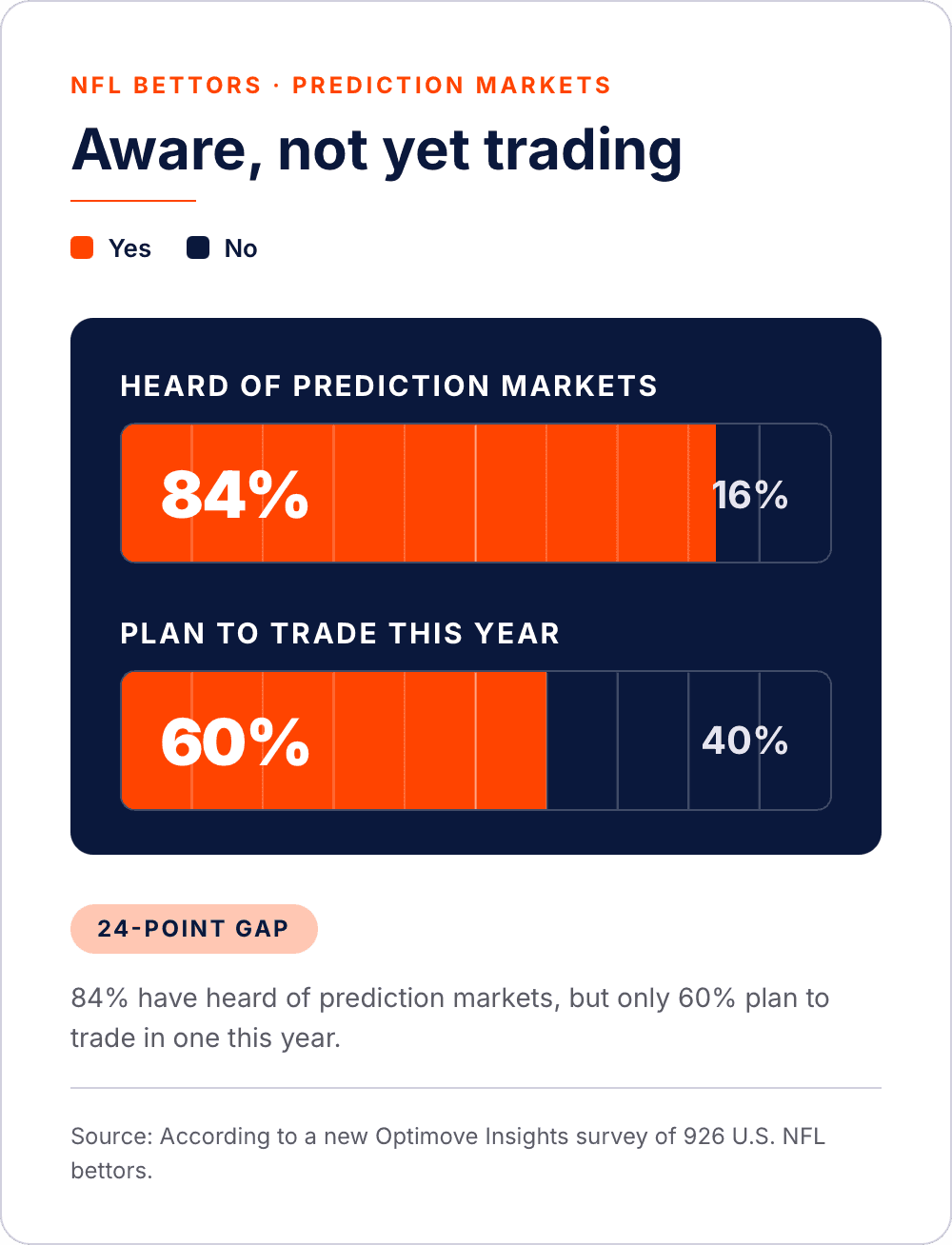
New survey data puts prediction market awareness among U.S. NFL bettors at 84%, with 60% saying they intend to trade event contracts this season. The numbers suggest the category has moved past introduction and into competition for the first trade.

SportsBoom offers honest and impartial bookmaker reviews to help you make informed choices. While we may earn commissions through affiliate links, our content remains independent and free from promotional influence. For more information, see our Content Transparency and How We Review pages.
Credit: Getty Images
Prediction markets have stopped being a niche curiosity for U.S. sports bettors.
According to a new Optimove Insights survey of 926 U.S. NFL bettors, fielded in August 2026 immediately ahead of the season, 84% say they've heard of prediction markets, leaving only 16% unaware.[1]
Of that same group, 60% say they plan to trade, buy, or sell event contracts this year.
Those two figures sit at the centre of the report, and together they say something more specific than "prediction markets are popular.”
Awareness at 84% puts the category in line with recognition levels for established betting verticals, not emerging ones. And intent at 60% suggests most of the NFL betting audience isn't weighing prediction markets from a distance, they're planning to use them during the exact window when deposit activity and betting attention peak for the year.
For context on how that shift has played out on the operator side, see our earlier coverage of Kalshi's MLB team branding deals and the contradiction they created with MLB's league-level Polymarket exclusivity, a sign that the commercial land-grab arrived well before this kind of demand data did.
Awareness isn't the same as understanding
The report is careful to separate what 84% awareness actually measures. It's recognition of the category by name, not comprehension of how it works.
A bettor who's heard of prediction markets may still not understand event contract pricing, settlement, or how holding a position differs from placing a traditional wager.
That distinction matters for how operators read the "education is over" conclusion the report reaches. The recommendation isn't that explanation becomes unnecessary, it's that explanation moves.
Rather than sitting at the top of a marketing funnel, it needs to happen inside the product itself. At the moment someone opens their first contract, watches a price move, or holds a position through to settlement.
We touched on the mismatch between stated intent and actual legal access in an earlier piece looking at state-by-state prediction market availability, worth revisiting alongside this data, since national intent figures like the 60% here still run into a patchwork of local rules.
Intent is a decaying asset
The report's more pointed argument is about timing. Sixty per cent stated intent is, in its own words, "an opportunity that decays.”
Stated plans routinely overstate eventual behaviour, and the report expects the share of bettors who actually place a trade this year to land below that figure.
The practical takeaway for operators is that demand isn't the constraint, conversion and retention are. A bettor who intends to trade this season but doesn't do so in their first session is unlikely to come back with the same motivation, particularly with several platforms competing for the same attention during the NFL window.
That puts the emphasis on compressing time to first trade. Fewer steps between signup and a live position, markets surfaced around the teams a bettor already follows, and a first contract designed to feel small and low-stakes rather than intimidating.
What happens after the season ends
The report's most useful framing may be its retention argument. Because the surveyed audience is defined entirely by NFL betting, a customer acquired in September on the strength of football markets has no built-in reason to return once the season is over. That's not a risk confined to one vertical, for this audience, it's the central question.
The report recommends operators plan for that transition early: building trading habits across market types, introducing non-sports contracts to bettors who show range beyond football, and segmenting on trading frequency, market variety, and position size rather than deposit size alone. Those behavioural signals, it argues, identify durable users well before revenue figures would.
The bigger picture
Read together, the two headline numbers describe a category that's cleared its first hurdle. NFL bettors know what prediction markets are, and most say they intend to use them.
What the report frames as the real contest, winning the first trade, making the second one easy, and giving bettors a reason to come back once football ends, is now a retention and product question rather than an awareness one.

Meet Louis Hobbs, our resident sports guru with a knack for all things darts and snooker. His expertise goes beyond the ordinary, offering deep insights that set him apart. Louis also has a strong passion for US sports, particularly basketball and American football.
Comments
0 comments
No comments yet. Be the first to share your thoughts!
References
- 1.Optimove - Prediction Markets Are Mainstream With NFL Bettors