
Betting Academy
UFC Betting Strategies: How to Find Value in Fight Odds
The UFC is the hardest sport to bet on consistently. Unlike team sports, there is no home advantage, no back-to-back schedule fatigue, and no in-season momentum to exploit. Every fight is a one-on-one confrontation between two elite athletes who have spent their careers in gyms specifically to solve the problem standing in front of them on fight night.

SportsBoom offers honest and impartial bookmaker reviews to help you make informed choices. While we may earn commissions through affiliate links, our content remains independent and free from promotional influence. For more information, see our Content Transparency and How We Review pages.
UFC Betting Strategies
Do UFC Betting Market Inefficiencies Exist?
The most important thing to understand about UFC betting markets is that they are less efficient than people assume but not inefficient in ways that are easy to exploit.
Researchers found that, while overall the markets are broadly efficient, slight underdogs in the UFC showed positive returns across the data sample. Critically, a statistically significant long shot bias was also identified. The very short-priced favorites are among the worst bets in the sport. [1]
A separate study, published in the American Journal of Management, replicated this finding. It concluded UFC odds are not strictly weak-form efficient, and bets on slight underdogs outperform across a long sample, while extreme long shot bets significantly underperform. [2]
This tells you that the UFC market has a predictable irrationality baked in. The public overloads on dominant favorites, and books shade odds to exploit that. The edge, if there is one, sits in the middle of the odds distribution like fighters in the -150 to +130 band.
Strategy 1. Fade the Famous Fighter
When a fighter has a globally recognized name, is a pay-per-view draw and a highlight reel machine, their odds are shorter than their actual win probability warrants. Books know the public will back them regardless of current form, and they shade the number accordingly.
Economist Steven Levitt found that sportsbooks take positions on the side they expect to win, exploiting predictable bettor irrationality. [3] The public's tendency to back famous fighters creates exactly the kind of predictable irrationality books are built to profit from.
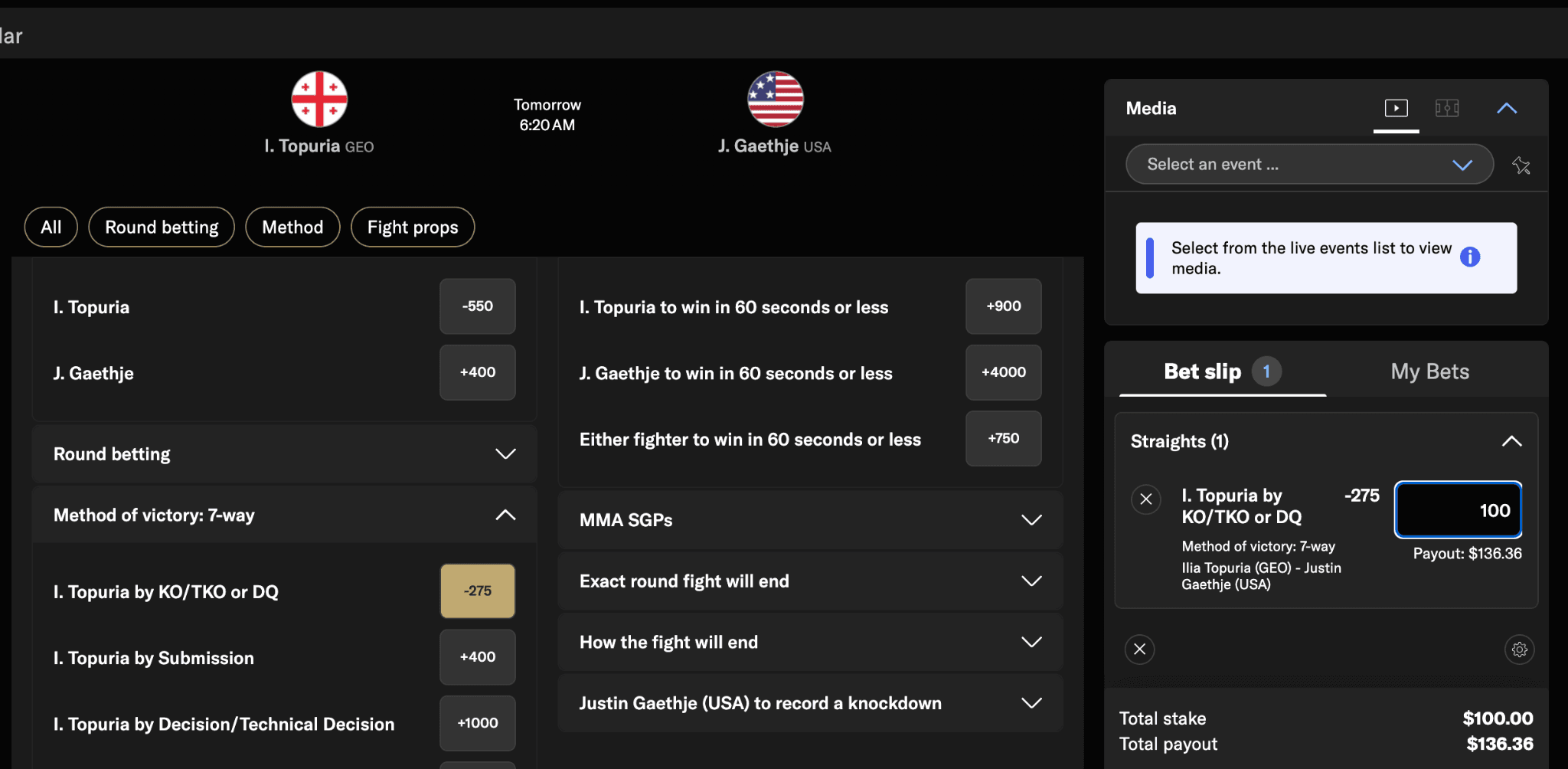
Credit: Ilia Topuria vs Justin Gaethje Betting Odds – Screenshot captured by Chad Nagel on 15 June, 2026 – 11:48 UTC
Consider the lightweight title unification fight at UFC Freedom 250. I took Ilia Topuria to knock out Justin Gaethje at -275 when the lines opened, placing $100 on the Georgian. At first glance, -275 looks steep. Gaethje, despite being a legitimate legend, is one of the most statistically vulnerable elite fighters in the history of the sport.
According to official UFC statistics compiled by FightMetric, Gaethje absorbs 7.66 significant strikes per minute, the worst rate among ranked lightweight fighters, by a considerable margin. For context, the average for a ranked UFC fighter sits at approximately 3.47 significant strikes absorbed per minute. [4]
Gaethje absorbs more than double that rate. At 37 years old, with the associated reaction time and chin durability declines that come with accumulated ring mileage, that number becomes more alarming.
Topuria, on the other hand, has gone on a historic finishing run, knocking out Alexander Volkanovski, Max Holloway, and Charles Oliveira in successive fights. These are three of the best featherweight and lightweight fighters of their era. When a fighter has shown both the power and precision to finish world champions repeatedly, and his opponent is absorbing strikes at twice the rate of his peers, the -275 opening line is not chalk.
Even though Gaethje ended up causing a huge upset after Topuria quit on his stool, I would still take this bet again. My model predicted Topuria to knock out the American on 80% of the chances, but I guess UFC Freedom 250 ended up being in that 20%.
Strategy 2. Weight Class Debuts Create Pricing Errors
One inefficiency in UFC betting is how books initially price a fighter making their first appearance in a new weight class. Books rely on what they know, which is everything the fighter did at their previous weight, and then adjust imprecisely for the unknown but are handicapped by very limited historical data.
The result is systematic mispricing, and it skews in a consistent direction: the fighter moving up is almost always overpriced as an underdog, because the public perceives a larger fighter as inherently more dangerous, while the fighter moving up tends to bring skill levels, timing, and power that have been developed against the same or better competition.
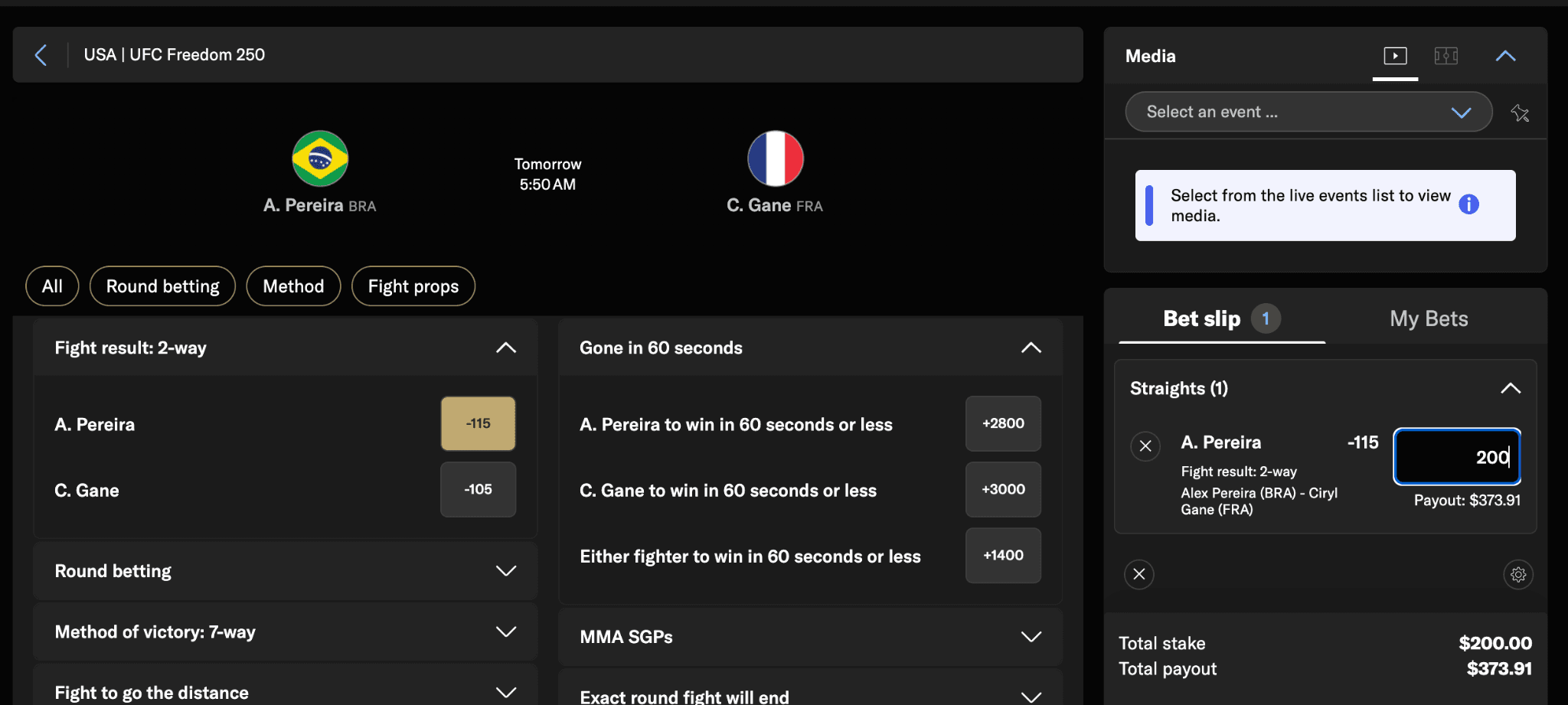
Credit: Alex Pereira vs Ciryl Gane Betting Odds – Screenshot captured by Chad Nagel on 15 June, 2026 – 11:48 UTC
I made this precise calculation betting $200 on Alex Pereira at -115 to beat Ciryl Gane in the UFC Freedom 250 interim heavyweight title fight. Pereira is paying near-even money because it is his first fight at heavyweight. That is irrational pricing. Pereira is one of the most decorated strikers to ever enter the Octagon, a two-division UFC champion, a Glory kickboxing world champion, and a fighter whose output at light heavyweight already exceeded what heavyweight opposition has historically encountered.
Gane, meanwhile, is significantly overrated by the casual betting market. Across 13 UFC fights, he has just four KO/TKO victories. His fighting style is built around movement and footwork, which is an effective enough approach against the lumbering heavyweights he has previously faced. But an approach that degrades rapidly once the opposition can keep pace with him on his feet.
Pereira is 6'4" and walked around at over 220 pounds during his light heavyweight campaign. The reach disadvantage Gane might enjoy over a conventional heavyweight simply does not exist here.
The betting market prices previous fights without adequately accounting for competitive context. Pereira was fighting the best light heavyweights in the world. While Gane's résumé is filled with unathletic cans.
UFC Freedom 250 once again delivered upsets as Gane hurt Pereira with a sneaky jab and then teed off on the Brazilian, who never recovered. I’d still back Pereira to win the rematch, especially since the odds would now shift further in Gane’s favor. If you can get a +100 or higher on the Brazilian, take that all day.
Strategy 3. The Age and Absorb Rate Intersection
The single most undervalued data point in UFC handicapping is the intersection of a fighter's age and their strike absorption rate. Statistical models of UFC fight data show that a fighter's win percentage begins a measurable decline around age 33. A fighter who is knocking on 40 and competing against prime opposition is operating with substantially degraded reaction time, recovery capacity, and chin durability. [5]
However, just focusing on age can trigger false signals. I recommend combining age with accumulated damage, what analysts call "fight mileage." An older fighter who has eaten punches for breakfast throughout their career, like Gaethje has, carries far greater physiological wear than their birth year implies. Research on MMA fighter longevity identifies striking-focused fighters who absorb high volumes of damage as among the most at-risk for abrupt performance decline. [6]
The KO/TKO risk premium compounds with age. Fighters who have already been knocked out face elevated susceptibility to repeat stoppages due to cumulative neurological effects, and this risk increases measurably after 34. [7]
Gaethje has been stopped three times in his career by Khabib Nurmagomedov, Tony Ferguson, and Max Holloway. Each stoppage is a data point in an age-and-absorb model that points firmly in one direction.
When a fighter on the tail end of his career with a poor absorb rate is being bet up by the public based on heart and reputation, fading the dumb money is the only play.
Strategy 4. Line Movement and the Fame Tax Ceiling
The third bet I recently made was $300 on Max Holloway over Conor McGregor at UFC 329, at -325. If McGregor had a neutral public profile with no film career, no whiskey empire, and no mythological status in Ireland, Holloway would be -600 or more.
The Hawaiian is the most decorated fighter in featherweight history, a former champion, a volume striking machine, and a man who was knocking out men at an elite level as recently as this calendar year.
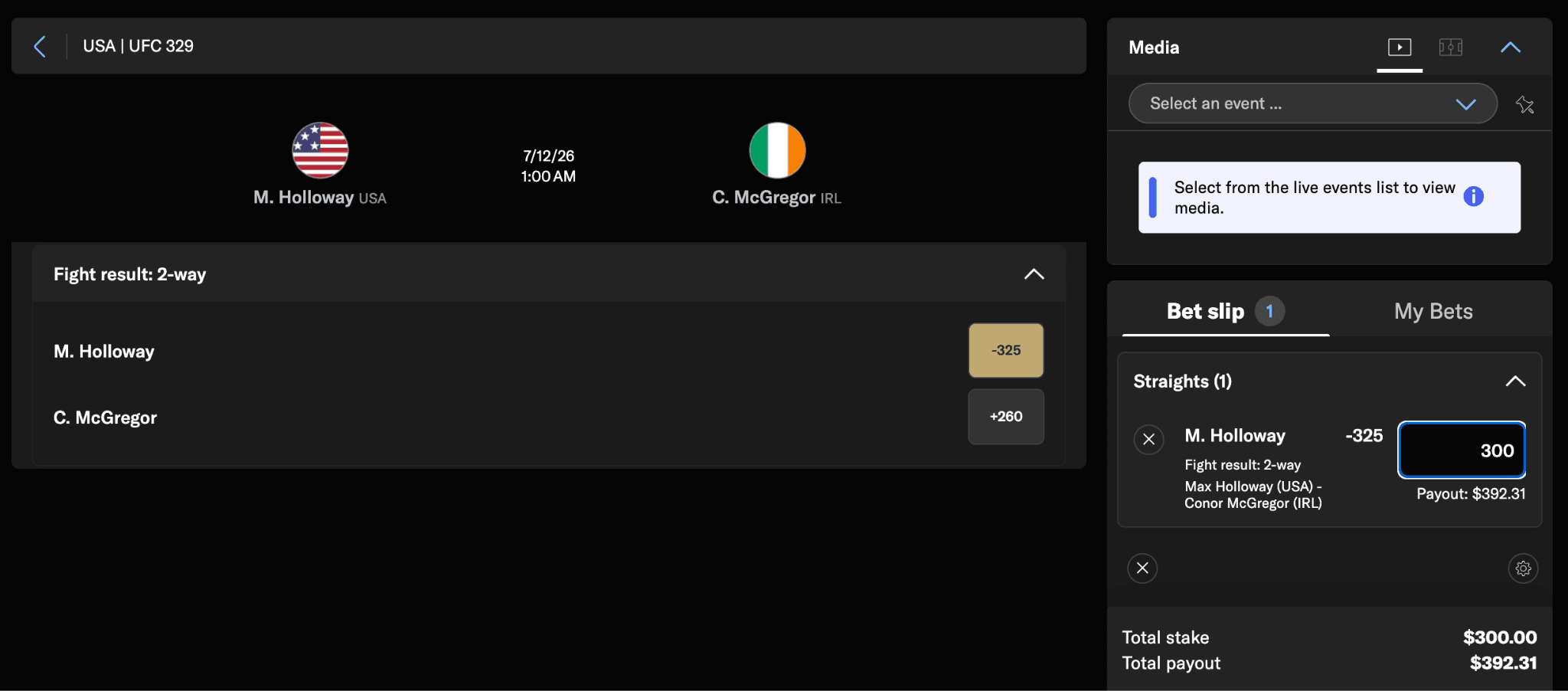
Credit: Holloway vs McGregor Betting Lines – Screenshot captured by Chad Nagel on 15 June, 2026 – 11:48 UTC
In the other corner is McGregor, who has not won a fight in the UFC since 2020. That is six years of inactivity punctuated by a broken leg, various legal proceedings, and a public lifestyle that does not suggest monastic preparation.
Public money on famous athletes with declining performance is one of the most reliable fade opportunities in sports wagering. [8] The line exists where it does because books know they will absorb enormous recreational money on McGregor, and they need the number to be closer to even money to manage exposure. Holloway at -325 is one of the best value bets I have seen in years.
Final Nugget of Wisdom
Most novice UFC bettors get too caught up in who hits harder or who has better jiu-jitsu. Forget trying to analyze fighting styles. Instead look for spots where the market price has gone haywire. This tends to happen when famous names enter the Octagon, fighters enter new weight classes, and when athletes are shot but are still living off their prior reputation.
All you need to do is take a look at McGregor vs Holloway. Who in their right mind would take McGregor at +260? This is a guy whose last win was 6 years ago.

Chad Nagel is a passionate sports fanatic who has worked in the sports and betting industry for over a decade. He spent most of his career as an editor-in-chief for Soccer Betting News, South Africa’s leading soccer betting newspaper, owned by Hollywoodbets. His articles have also featured in some of the most respected sports media platforms in the world, such as SPORTbible, Sports Illustrated, Combat Sports UK, and many others.
Comments
0 comments
No comments yet. Be the first to share your thoughts!
References
- 1.Efficient Market Insights and Favorite-Longshot Bias in Mixed Martial Arts Betting - Markets - Journal of Economics and Finance. KM Miller. Published February 2026. Accessed June 14, 2026
- 2.Weak Form Efficiency in Sports Betting Markets - American Journal of Management, Robbins, T. East Carolina University. Accessed June 15, 2026
- 3.Why Are Gambling Markets Organised So Differently From Financial Markets? - The Economic Journal (Royal Economic Society) Levitt, S.D. Published April 2024.. Accessed June 14, 2026
- 4.UFC Striking Statistics — SCORE Sports Data Repository - Brendan Karadenes. Published March 2023.. Accessed June 14, 2026
- 5.Going Deeper Into MMA Fighter Longevity: Does Age Matter? - Bloody Elbow. Published July 2013. Accessed June 14, 2026
- 6.FightTracker: Real-Time Predictive Analytics for Mixed Martial Arts Bouts - Berthet, V. University of Lorraine / Sorbonne. Published December 2023. Accessed June 14, 2026
- 7.Predicting UFC Matches Using Regression Models - KTH Royal Institute of Technology, Stockholm. Sebastian apelgren and Christoffer Eklund. Published April 2024. Accessed June 14, 2026
- 8.Artificial Intelligence in UFC Outcome Prediction and Fighter Strategy Optimisation - Sheng Yan, Linjun Liu and Comite Ubaldo. Published November 2024. Accessed June 14, 2026
Related Resources to Betting Academy
- MLS Betting Strategies
- How Quarter and Half Betting Works: Full Breakdown
- How to Use Alternate Spreads for Better Value
- How Second Chance Bets Work: The Expert Playbook for 2026
- Top NBA Betting Strategies Based On Academic Research
- How to Hedge a Sports Bet: Formula, Examples & Profit Calculator
- The Ultimate Guide to Cover Betting in the USA in 2026
- What is Same Game Multi (SGM) Betting?
- Player Bet Builder
- Why NFL Betting Is Bigger Than Every Other US Sport Combined
- Why Do Betting Odds Change After Bet Placement?
- How Loss Aversion Affects NFL Bettors When They Lose bets in the 4th Quarter
- Instant Wins Games and NFL Bettors: Why the Speed Is the Point
- Can AI Accurately Guide Your Betting?
- How Discord & Twitter Groups Shape NFL Betting in 2026
- NFL Crash Games: Why the Cash Out is a Two-Minute Drill Win
- NFL Bettors Are Moving to Online Slots: The Science Behind the "Hybrid" Shift
- How Weather Changes NFL Betting Odds and Game Outcomes
- Cash-Out Strategy: When to Lock In Profit or Let Your NFL Parlay Run
- Player Props Betting Explained: Odds, Strategy & How It Works