
Betting Academy
Cover Betting Debunked: The Complete Guide to Spread Betting in American Sports
It’s Sunday afternoon, and it is a good one because your team is leading by 6 points. It gets better because by the final whistle, they win 24-21. Seems like a good day to bet, unless it is not, since you were on a spread bet.

SportsBoom offers honest and impartial bookmaker reviews to help you make informed choices. While we may earn commissions through affiliate links, our content remains independent and free from promotional influence. For more information, see our Content Transparency and How We Review pages.
Cover betting explained
This tripped me up in the beginning until I finally understood what covering a spread was. According to the spread bet, you needed more than the six points to win to “cover.” So yes, you won, but also lost!
Let’s First Define What a Cover Bet is
A cover bet is not per se a bet itself, but the outcome of a spread bet.
Whenever you back a team “covering the spread,” you’re betting they will win by more points than what sportsbooks posted. Backing an underdog against the spread means your wager is that they will either win outright or lose by fewer points.
The thing to note is that your team can still win and fail to cover the spread. And an underdog can lose a game and still manage to cover. This is what makes spread betting different from moneyline betting.
The Mechanics Behind Cover Betting
Point spreads are a bookie’s guiding light to balance team strength and create a two-sided betting market. [1] A market that has to balance. Without spreads, everyone would go for the strongest team. That’s that logic, right?
So, what bookies do is assign “points deficit” to the stronger team that they must overcome. For context:
- A favorite(-) means the team with this - must win by more than the spread to cover.
- Underdogs (+) means this team must win outright or lose by less than the spread to cover.
- The spread-adjusted score is there to see who won the bet. So, you simply apply the spread to the final score to see which team performed better against the number.
To put this into perspective, here is a hypothetical worked example:
- The Kansas City Chiefs are the favorites at -6.5
- The New York Jets are the receiving team with +6.5
If the game ends 27-24, the Chiefs win outright but fail to cover because the difference of 3 is less than 6.5. Here, the Jets win because they have covered the spread with 24 + 6.5 =30.5, and this beats 27.
How Cover Bets Apply to Bookies
First off, you have to realize that sportsbooks are in the business of making money. So, their goal with point spreads is not on the prediction but on money balancing. A bookie’s plan is to attract as many wagers as possible to bet on both sides of the scale so they can collect the “vig.” For context, the vig is the fee you and other bettors pay to the bookie for processing the bet.
To them, it does not matter who wins or loses; they still make their money!
To a sportsbook, if one side gets too much money, they move the spread to try to tempt more people towards the other side. [2] The -5.5 spread above on the Eagles was to “hook” more Commanders’ fans.
Additional factors they consider include:
- Relative team strength
- The home-field advantage
- Rest and scheduling
- Injury news
- Head-to-head matchup structures
- Historical pace and scoring patterns.
In the American sports betting space, the NFL is driven by any news about the quarterback. If their health or performance is compromised in any way, bookies note it and adjust. Bookies react directly to college sports. Here, they set higher margins because of the high volatility due to the roster inconsistencies. Finally, the NBA. Spreads are heavily reliant on injury and rest.
How Probability Works in Cover Betting
All spreads in the betting world carry an implied probability.
For a -110 odds, a -6.5 spread carries an estimate of 52 to 55% implied probability. Flipping that script to a +6.5 spread, this one has a 45 to 48% implied probability. The - is that the favorite cover, and the - is that the undedog covers. [1]
To use this to your advantage, identify spreads where your actual probability assessment is better than the market’s implied probability.
The Reasons Some Teams Fail to Cover
Those reasons include late-game management, garbage scoring, and player rotation. Here’s more insight into these factors:
Late-Game Management
This usually happens during the final game times when the leading team intentionally slows the game to protect their win. What they are doing is taking the win and not extending the magic, which, honestly, works against someone depending on that margin.
Garbage-Time Scoring
Then there is garbage scoring. This is when the losing team keeps scoring, even if the winning team just stops trying. What happens is that the points added affect the spread, even though the losing team still loses.
Player Rotation
The final factor is when players are rotated during a game. And this happens often in the NBA and college plays. A team with 20 points leading with about 5 minutes on the clock adds subs. Here, the backups extend the game or the opponent’s scoring.
The Reasons Underdogs Are Able To Still Cover
In betting, losing a game sometimes can still win you a bet. It has for me time and time again. Here’s an example:
I bet on an underdog at +7, and they lost 24-20. I won because the spread was less than 7.
Scenarios Where Cover Betting Works and Fails
Here is how cover betting works based on the following factors.
Balanced Pricing Structure: Works
Since spreads always attempt to equalize forecasted matchup strength, cover betting is at its best when these spreads are inflated by public bias. For example, when the underdog has an advantage. Also, if the game’s pace is favorable and if the lines are working in your favor. This is always a judgment call.
High Late-Game Variance: Fails
Single possessions can change results against a spread you’ve wagered on. Here is where cover betting crumbles. It happens when a popular favorite is overpriced. And it can also happen when the key numbers, the lines, are against you.
Additionally, factors like garbage time scoring can shift the final margin out of nowhere.
Pros & Cons
Pros
You can win even if a team loses.
Highly customizable
There is always action.
Cons
Late-game variances can flip the script on you.
One bad possession can cause a loss.
Coach decisions can affect the result.
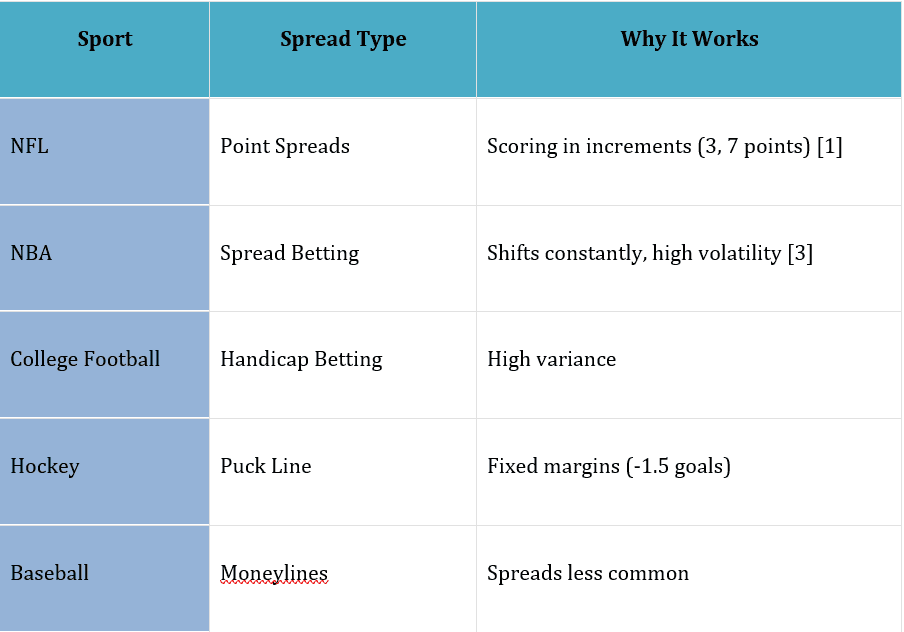
Best Sports for Cover Betting
If cover betting is something you want to try, start here:

What Drives Value in Cover Betting?
Game pace and styles.
Player injuries.
When public perception inflates favorites.
When unpopular underdogs are undervalued.
Are There Risk & Bankroll Management Tactics to Use?
Yes, A 2-5% stake per bet is reasonable, and for peace of mind, stay away from chasing losses. [3]
Cover Betting Works When
You: balance pricing, pick slower matchups or undervalued underdogs, and have a disciplined sizing.
Cover Betting Fails When
You: are emotionally betting, going for inflated favorites. Also, when there are unclear injuries or volatile live spreads.
A Cover Betting Checklist to Always Refer to
Always ask yourself:
Is the spread inflated by public bias?
Are all the injuries fully accounted for?
Does the game pace support the spread?
At the end of the Day
Cover betting is wagering on the outcome of a spread bet. It differs from moneyline and alternative spread betting, and you now know how. Just keep in mind that late-game variance is real, and real value comes from identifying factors like key numbers. Then, to top it all off, having a disciplined bankroll helps.
The best part? You can win even when a team loses. But you have to understand all the above to get here.
FAQs
What does covering mean?
It means that the team outperforms the handicap by the required margin.
Can the team win but fail to cover?
Yes.
Can an underdog lose and still cover?
Yes. If the loss is by fewer points than the spread.
Why -110?
This is the standard sportsbook margin. And it breaks even at 52.38%.
Which sports use spreads?
NFL (primary), NBA (secondary), College Football (primary).

Mitchelle is a skilled iGaming writer who is passionate about creating precise, trustworthy, and well-researched casino content. She specializes in gambling, betting, casino, and iGaming content. She has extensive experience working with leading writing agencies and gaming platforms. Her main focus is creating fact-based content across reviews, guides, and betting insights.
Comments
0 comments
No comments yet. Be the first to share your thoughts!
References
- 1.Football Spread Betting Guide: NFL Point Spread Explained. - Jason Logan, Covers, Aug 20, 2025. Accessed May 27, 2026
- 2.Point Spread Betting Guide: Mechanics and Market Balancing - Scott Erskine, SportsLine, Apr 30, 2026. Accessed May 27, 2026
- 3.Bankroll Management: Bet Sizing Strategies. - Trademate Sports, Feb 13, 2021. Accessed May 27, 2026
Related Resources to Betting Academy
- What is Same Game Multi (SGM) Betting?
- Player Bet Builder
- Why NFL Betting Is Bigger Than Every Other US Sport Combined
- Why Do Betting Odds Change After Bet Placement?
- How Loss Aversion Affects NFL Bettors When They Lose bets in the 4th Quarter
- Instant Wins Games and NFL Bettors: Why the Speed Is the Point
- Can AI Accurately Guide Your Betting?
- How Discord & Twitter Groups Shape NFL Betting in 2026
- NFL Crash Games: Why the Cash Out is a Two-Minute Drill Win
- NFL Bettors Are Moving to Online Slots: The Science Behind the "Hybrid" Shift
- How Weather Changes NFL Betting Odds and Game Outcomes
- Cash-Out Strategy: When to Lock In Profit or Let Your NFL Parlay Run
- Player Props Betting Explained: Odds, Strategy & How It Works
- Buffett Warns Sports Betting Lets Governments Cash In on the Naïve
- The CFTC Takes 5 States To Court Over Prediction Markets & Betting
- Buenos Aires Blocks 251 Unlicensed Online Betting Platforms in Sweeping Regulatory Crackdown
- Responsible Gambling USA: Setting Limits on Betting Apps
- NFL Betting Guide: How to Enjoy the Playoffs & Super Bowl on a Budget
- What does “Free Bet” Mean in Gambling Marketing?
- Teaser Betting Explained: Odds, Spreads & Strategy