
Betting Academy
How to Hedge a Sports Bet: Formula, Examples & Profit Calculator
You threw down $100 on the Seattle Seahawks to win Super Bowl LXI at +950 back in June. It's now late January, and the Hawks have punched their ticket to the big dance. Your book is showing the Kansas City Chiefs as -160 Super Bowl favorites, and you're sitting on a futures ticket worth $1,050 if Seattle wins.

SportsBoom offers honest and impartial bookmaker reviews to help you make informed choices. While we may earn commissions through affiliate links, our content remains independent and free from promotional influence. For more information, see our Content Transparency and How We Review pages.
Hedging bets explained
The question is, hedge or not to hedge? I’ll show you how to use 3rd-grade math to calculate the optimal hedge in under 30 seconds!
Hedging trades maximum upside for return. You will almost always give up some expected value.
What Is Hedging in Sports Betting?
Hedging is placing one or more follow-up bets on different outcomes of the same event to reduce your original risk exposure regardless of the final result. [1]
Say your original bet gains value when circumstances shift in your favor. At that point, betting the opposite outcome at current market odds creates a position where you profit no matter what happens.
A DraftKings parlay bettor refused to hedge a $2,500 bettor and even turned down a $500,000 early cash out offer. He let his parlay ride and cashed out $1.7 million when the Spurs beat the Thunder in Game 7
My Go-To Hedge Stake Formula
To lock in equal profit on both outcomes, the optimal hedge stake is:
Hedge Stake = Original Potential Payout ÷ Hedge Decimal Odds. [2]
For example, you bet $100 on a team at +600 (total payout: $700). The opponent is now -200 (decimal: 1.50) at game time. Your hedge stake is $700 ÷ 1.50 = $466.67. Whether your original pick wins or the opponent does, you’ll take home a profit of $233.33.
If you don't want to eliminate all variance, you can place a partial hedge at any stake below the full amount. A half-hedge reduces downside without surrendering the chance of a bigger win.[3]
Super Bowl LXI Futures Hedge
You placed $100 on the Seattle Seahawks to win Super Bowl LXI at +950 back in the preseason. That gave you a potential total payout of $1,050 ($100 stake + $950 profit). The Hawks defied the odds, won the NFC, and are now headed to New Orleans to face the Kansas City Chiefs.
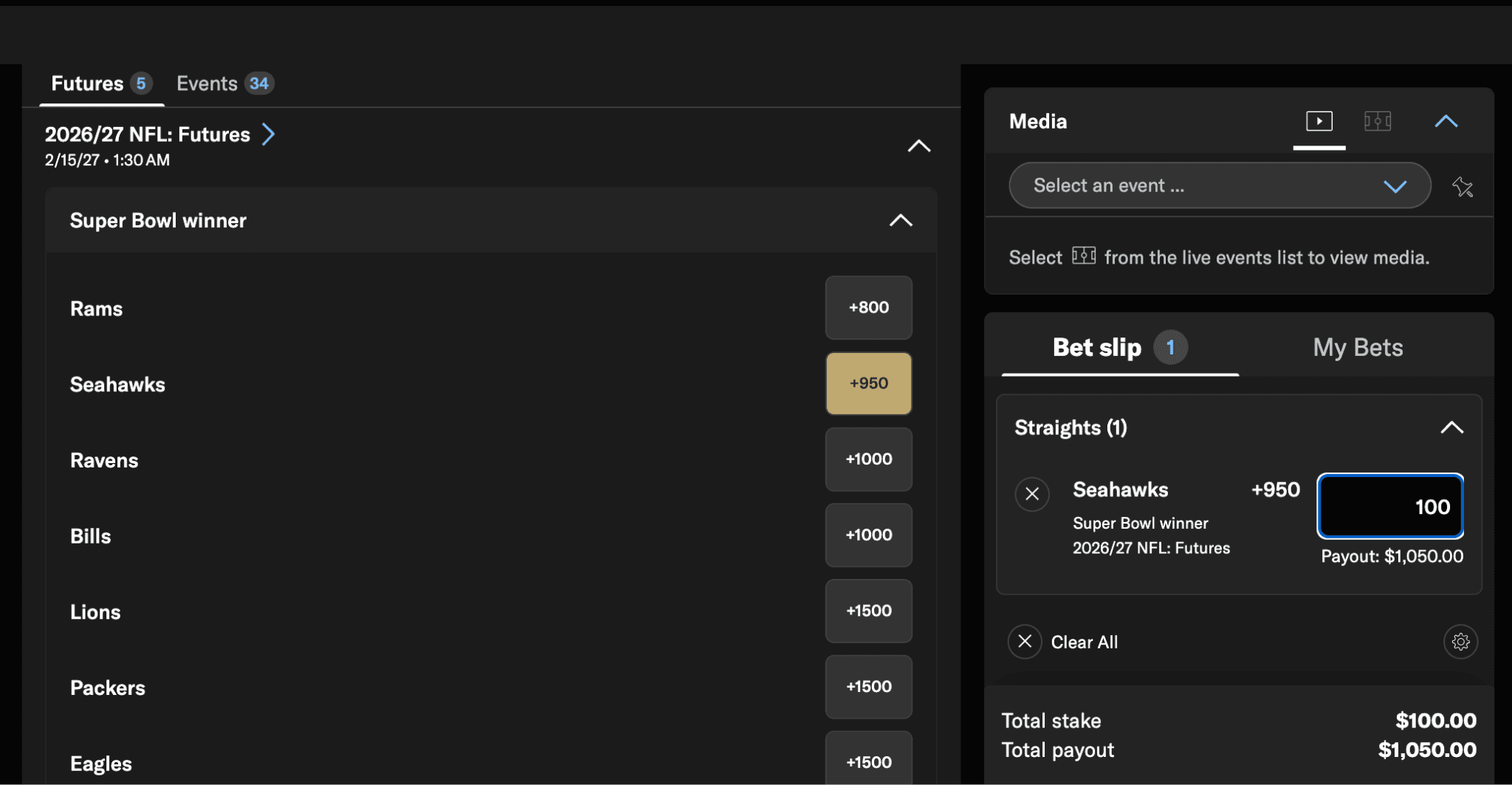
Credit: BetMGM Sportsbook – Screenshot captured by Felix Dubler on June 1
With the game two days away, the Chiefs are installed as -160 favorites by all licensed NFL sportsbooks. The Seahawks are +135 to win the Lombardi outright.
To execute a full hedge, you divide the potential payout of your Seahawks futures ticket ($1,050) by the Chiefs' decimal odds of 1.625, resulting in a hedge stake of $646.15 on Kansas City.
If Seattle wins the Super Bowl, your futures ticket pays out $1,050, but you lose the $646.15 hedge bet, leaving you with a net profit of $303.85.
If the Chiefs win, the hedge bet returns $403.85 in profit ($646.15 × 0.625), while your original $100 futures stake loses, again leaving you with a net profit of $303.85.
A partial hedge is also an option. Whacking $300 on the Chiefs instead of $646 means a Kansas City win returns a $187.50 profit while a Seahawks win returns $637.50. You're not fully covered, but you’ll still walk away with cash in any scenario.
NBA Live Totals Hedge - Knicks vs. Spurs, Game 1
You opened with $100 on the over 218.5 points at -110 for Game 1 of the Knicks-Spurs playoff series. Your potential total payout is $190.91. Both teams came out firing, and at halftime the combined score is 122 points, putting you well ahead of pace for the full-game total.
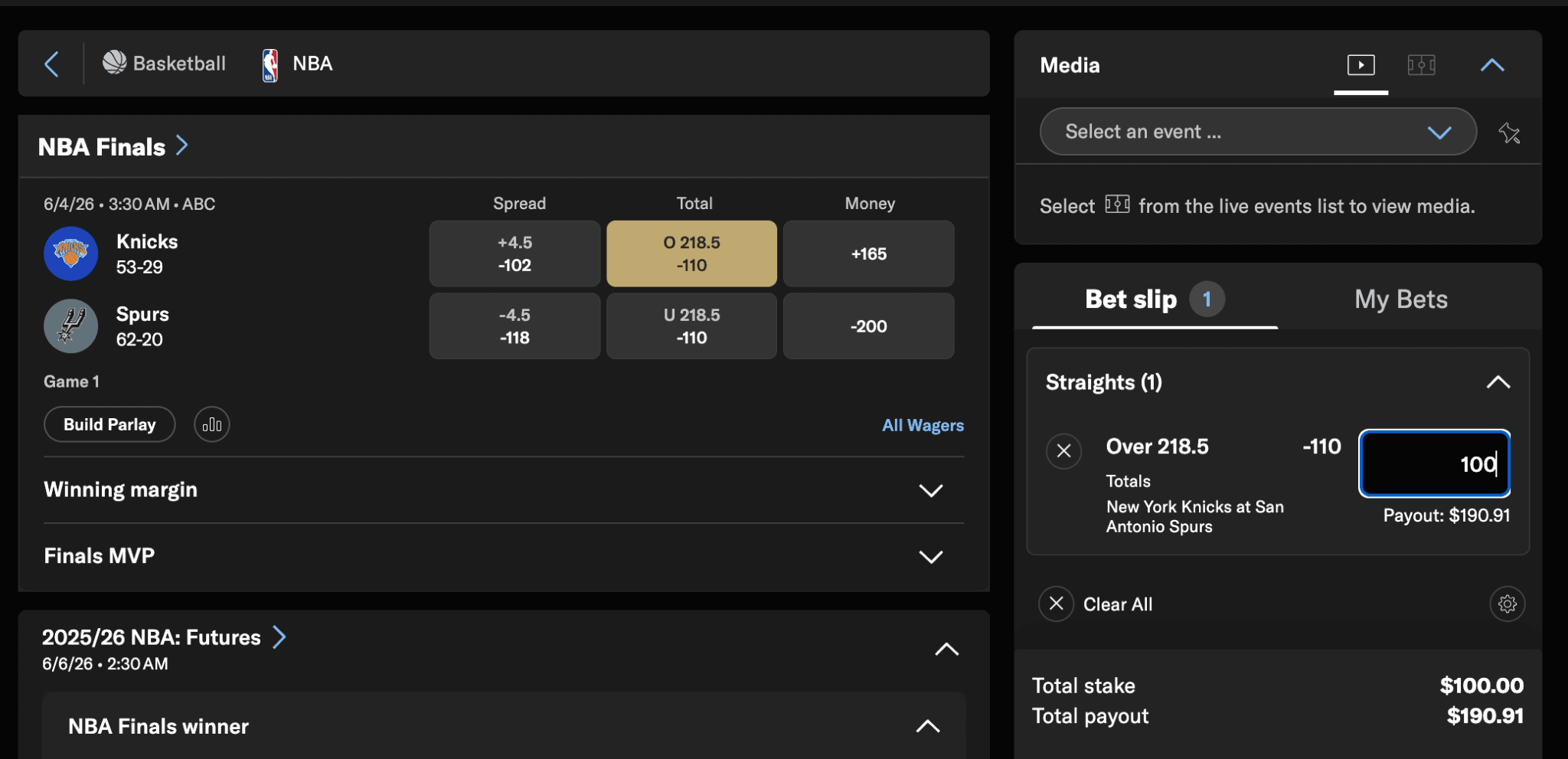
Credit: BetMGM Sportsbook – Screenshot captured by Felix Dubler on June 1
With 122 points already on the board in 24 minutes of game time, you need just 97 more from the remaining 24 minutes to cash. The reputable NBA sportsbook has adjusted, so now the under is paying +160.
To figure out how much to bet on the under, just take $190.91 ÷ 2.6, which works out to be $73.43. Now you can’t lose. It doesn’t matter if 230 or 190 points are scored, you’re going home with $17.48.
As you can see, even though the Spurs and Knicks got hot from the field and dropped 122 points, you aren’t a huge favorite to win. Seeing as the hedge is only locking in a $17.48 win on a $164.34 outlay, I’d just let this one ride or hedge later in the game when the odds have moved even more in my favor.
French Open In-Play Hedge - Tiafoe vs. Arnaldi, 4th Round
You placed $50 on Frances Tiafoe at -110 to beat Matteo Arnaldi in the fourth round at Roland Garros. That gives you a potential total payout of $95.45 ($50 stake + $45.45 profit). Tiafoe played brilliantly in sets one and two, winning both 6-3, 6-4. Arnaldi now needs to win three straight sets to advance.
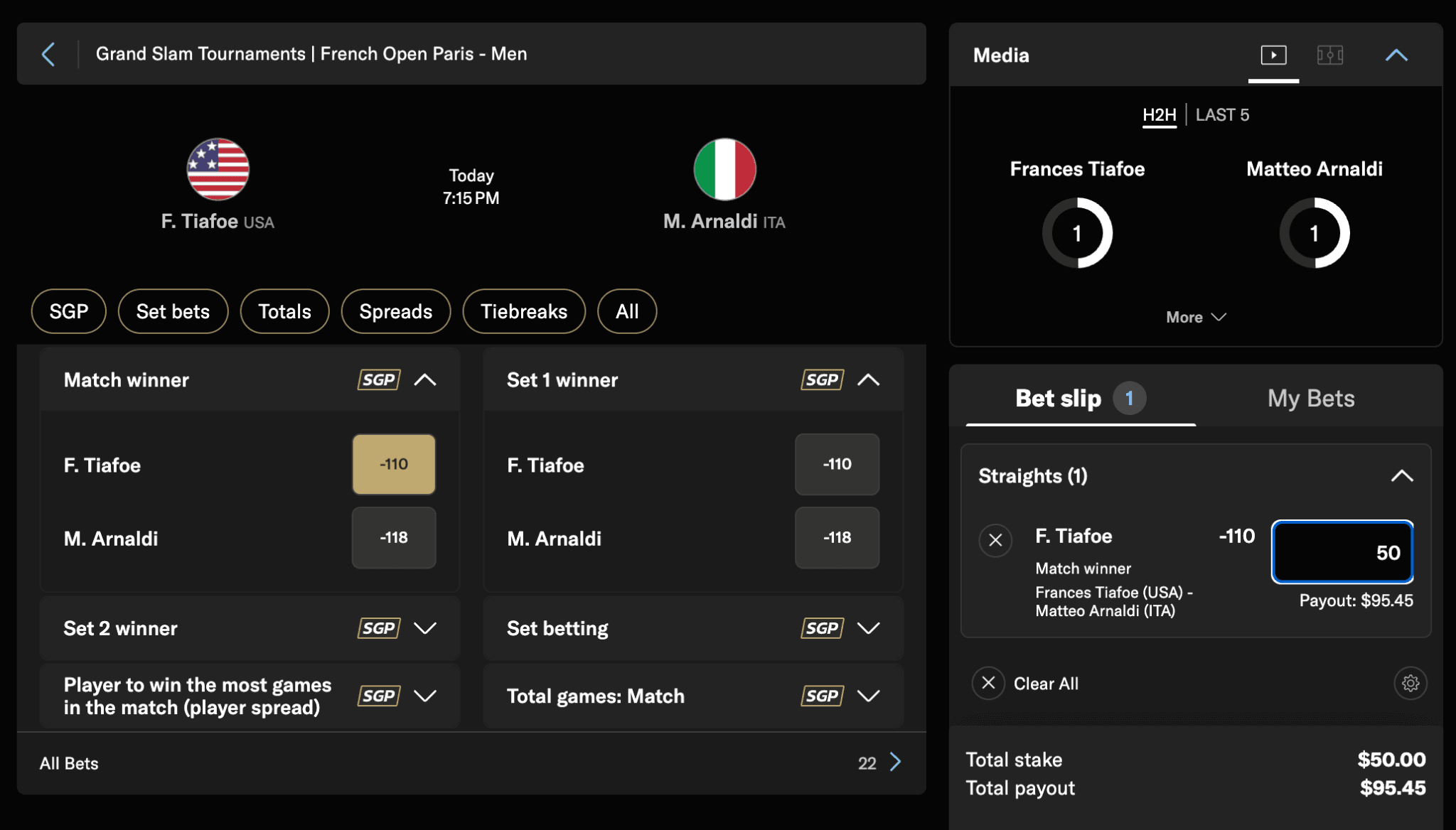
Credit: BetMGM Sportsbook – Screenshot captured by Felix Dubler on June 1
From 0-2 down in a best-of-five match at Roland Garros, a player has historically completed the comeback roughly 5.90% of the time across all Grand Slam Open Era data [6].
However, Arnaldi is a clay-court specialist, and Tiafoe is known to have lapses in concentration when serving out matches. The live market reflects a small but real comeback probability: Arnaldi is available at +700 (decimal: 8.00) to win the match.
To throw on a hedge, just divide the potential payout of your Tiafoe ticket ($95.45) by Arnaldi's live decimal odds of 8.00, producing a hedge stake of $11.93 on Arnaldi.
When Tiafoe clinches match point, you collect $45.45 in profit from the original wager but lose the $11.93 hedge, leaving you with a net profit of $33.52.
If Arnaldi stages the comeback, the hedge bet returns $83.51 in profit ($11.93 × 7), while your original $50 stake loses, resulting in a net profit of $33.51.
The hedge here is really serving as insurance. You're paying $11.93 for the guarantee that a historically rare 0-2 comeback doesn't wipe your $50 stake entirely.
Hedging’s Impact on Expected Value
Hedging usually reduces your long-run expected return at NBA, NFL, and MLS books because it’s unlikely your opposing bet also had unexpected value. And depending on the market, the book can hit you with a steep vig.
Before I hedge, I run through the numbers and work out how much EV I’m giving up. The formula for expected value is: EV = (Win Probability × Potential Win) – (Loss Probability × Stake). [4]
Cast your mind back to the Tiafoe vs Arnaldi match. If the Italian has only a 6% chance of winning from 0-2 down, then your EV of letting it ride = (0.94 × $45.45) – (0.06 × $50) = $39.72 expected profit.
By hedging at $11.93 and guaranteeing a $33.51, you're sacrificing 15.6% of EV, but you've also eliminated the chance of losing $50 on a set-completed match.
Whether that trade is worth it depends on the size of the bet relative to your bankroll, your subjective tolerance for variance, and the utility of a guaranteed return versus a probabilistic one. [5]
When I Opt To Hedge
You should hedge when the potential payout is large relative to your bankroll. A $100 futures bet that has grown to a $1,050 potential return is a significant outcome regardless of your roll, and guaranteeing $300+ is a rational choice.
Alternatively, hedging is the smart move if the game has a looming uncertainty despite your position being favored. I’d be nervous holding an unhedged futures bet on Sinner in a Grand Slam final even if he was up a set and a break. As they say, a bird in the hand is worth two in the bush!
FAQs
What is hedging in sports betting?
Hedging is placing a second bet on the opposite outcome of your original wager after circumstances have moved in your favor, locking in a profit regardless of the final result.
How do you calculate the correct hedge stake?
The formula is: Hedge Stake = Original Potential Payout ÷ Hedge Decimal Odds.
Does hedging always reduce expected value?
Yes, in almost every case. The hedge bet carries sportsbook margin, and unless you have a genuine edge on the hedge side, you're giving something back.
Is it better to hedge or use the sportsbook's cash-out feature?
Hedging manually almost always produces a better guaranteed return than the sportsbook cash-out price. Cash-out offers include a second layer of sportsbook margin on top of the original.
Can you hedge a parlay bet?
Yes, but it requires more complexity and is often negative value if multiple legs remain. The most viable parlay hedge is on the final leg only.

Chad Nagel is a passionate sports fanatic who has worked in the sports and betting industry for over a decade. He spent most of his career as an editor-in-chief for Soccer Betting News, South Africa’s leading soccer betting newspaper, owned by Hollywoodbets. His articles have also featured in some of the most respected sports media platforms in the world, such as SPORTbible, Sports Illustrated, Combat Sports UK, and many others.
Comments
0 comments
No comments yet. Be the first to share your thoughts!
References
- 1.Hedging on Betting Markets - Gustav Axén and Dominic Cortis MDPI. Published August 25, 2020. Accessed June 2, 2026
- 2.Theoretical model and case analysis based on option hedging theory - Qi-an Chen, Xu Zhao, Guohong Zhang, PLOS One, Published June 21, 2023. Accessed June 2, 2026
- 3.High-stakes hedges are misunderstood too - Philip W. S. Newall and Dominic Cortis - Cambridge University Press.. Published January 1, 2023.. Accessed June 3, 2026
- 4.Expected Value in Statistics: Definition and Calculating it - Stephanie Glen, Statistics How To.. Published September 5, 2017. Accessed June 2, 2026
- 5.Betting Your Favorite to Win: Costly Reluctance to Hedge Desired Outcomes - Simone Tang, Richard P. Larrick, INFORMS Management Science. Carey K. Morewedge,. Published October 12, 2016.. Accessed June 2, 2026
Related Resources to Betting Academy
- The Ultimate Guide to Cover Betting in the USA in 2026
- What is Same Game Multi (SGM) Betting?
- Player Bet Builder
- Why NFL Betting Is Bigger Than Every Other US Sport Combined
- Why Do Betting Odds Change After Bet Placement?
- How Loss Aversion Affects NFL Bettors When They Lose bets in the 4th Quarter
- Instant Wins Games and NFL Bettors: Why the Speed Is the Point
- Can AI Accurately Guide Your Betting?
- How Discord & Twitter Groups Shape NFL Betting in 2026
- NFL Crash Games: Why the Cash Out is a Two-Minute Drill Win
- NFL Bettors Are Moving to Online Slots: The Science Behind the "Hybrid" Shift
- How Weather Changes NFL Betting Odds and Game Outcomes
- Cash-Out Strategy: When to Lock In Profit or Let Your NFL Parlay Run
- Player Props Betting Explained: Odds, Strategy & How It Works
- Buffett Warns Sports Betting Lets Governments Cash In on the Naïve
- The CFTC Takes 5 States To Court Over Prediction Markets & Betting
- Buenos Aires Blocks 251 Unlicensed Online Betting Platforms in Sweeping Regulatory Crackdown
- Responsible Gambling USA: Setting Limits on Betting Apps
- NFL Betting Guide: How to Enjoy the Playoffs & Super Bowl on a Budget
- Teaser Betting Explained: Odds, Spreads & Strategy