
Betting Academy
Standard Spread Vs Alternate Spread: What’s the Difference?
You pull up the Knicks-Spurs NBA Finals Game 3 on DraftKings, and there it is: Knicks -2.5 (-110), Spurs +2.5 (-110). That's your standard spread. Two-and-a-half points, even money on the vig, same line you'll see at FanDuel and Caesars.

SportsBoom offers honest and impartial bookmaker reviews to help you make informed choices. While we may earn commissions through affiliate links, our content remains independent and free from promotional influence. For more information, see our Content Transparency and How We Review pages.
Standard Spread Vs Alternate Spread
The oddsmakers set it there because the market says New York is a slight favorite. If you think the Spurs can hang within two, you take them at +2.5 and move on.
But what if you think San Antonio wins this game by 6 or 10? Suddenly -110 for a two-point edge feels like it's leaving money on the table. Fortunately, alternate spreads at NBA sportsbook brands are here to save the day and can be used to increase payouts and/or reduce risk.
What Is an Alternate Spread?
Credit: DraftKings Sportsbook – Screenshot captured by Chad Nagel on June 7
An alternate spread lets you adjust the standard point spread up or down in exchange for different odds. Move the spread in your favor, and you'll pay more juice. Move it against you, demand a bigger margin of victory, and the sportsbook rewards you with a better price.
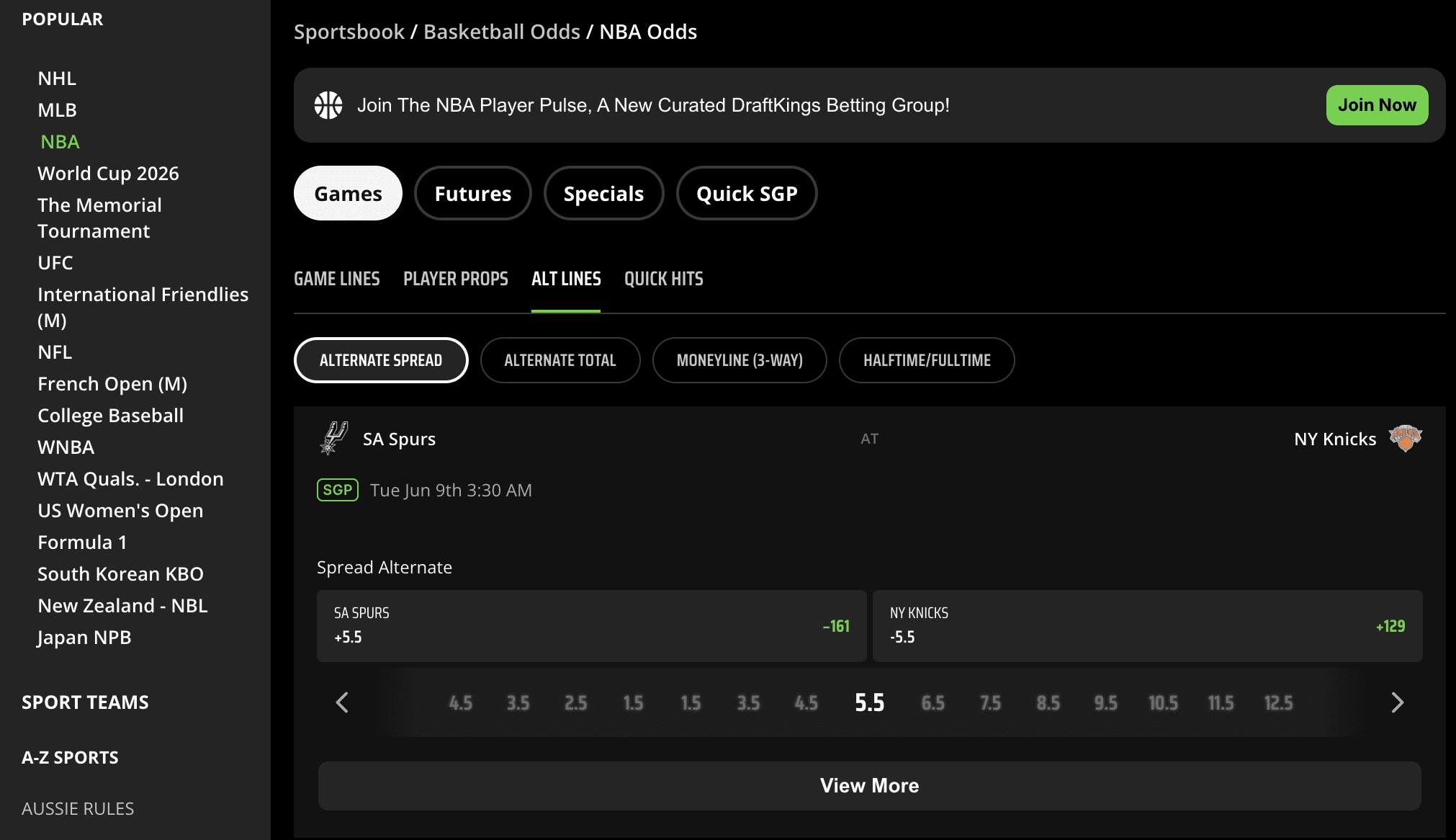
Every major US sportsbook offers alternate spreads across NFL, NBA, MLB, MLS, and NHL. On DraftKings, I went up to +5.5 Spurs at -161 for Game 3 of the Finals when the standard was +2.5. FanDuel offers one of the widest alternate-line catalogs on the market across all four major sports.
On average, adding points to the spread increases the vig by 12%+. (Source: DraftKings Odds)
Books Increase Vig For Alternate Spreads
Every time you buy a point in your favor, the sportsbook bumps the implied probability of your bet winning and offers you lower odds. The books are also a little sneaky and slightly jack up the juice.
The vig on a standard -110/-110 spread is approximately 4.76%. To see why, add the implied probabilities of both sides: at -110, each side implies 52.38%, and 52.38% + 52.38% = 104.76%. That extra 4.76% above 100% is the book's built-in margin. [1]
However, when I increased the spread to +5.5 on Spurs and -5.5 on Knicks, the new odds were -161 and +129. After crunching the numbers I saw that DraftKings had bumped the standard 4.76% vig up to 5.36%.
This isn’t just some one-off occurrence. When the Golden Knights took on the Hurricanes in Game 4 of the Stanley Championship, the standard 1.5 puck line had a 4.35% vig. But once I shifted it up to 3.5, the vig skyrocketed to 5.85%.
This is a little cunning from the sportsbooks because even though you expect higher or lower odds depending on whether you buy/sell points, you don’t think the vig is going to also move. [2]
Three Examples Of Alternate Spread Betting
It doesn’t matter if you’re a diehard MLB, NHL, or NBA fan, you can nudge the spread in your favor on all sports. Check out some of the latest wagers I’ve placed.
NBA Finals, Spurs vs. Knicks, Game 3 June 9
The standard spread had the Spurs +2.5 (-110) and Knicks -2.5 (-110). I thought San Antonio's defense would hold this closer than two points but didn't have high confidence in a Spurs win outright.
So I bought points up to +5.5 and accepted -161 odds on a $100 bet. My break-even probability at -161 was 61.7%. If I believe the Spurs cover +5.5 more than 62% of the time, the bet carries positive expected value. The trade-off is I paid $61 more in implied risk per $100 of potential profit compared to the standard +2.5. That's the cost of a wider cushion.
Red Sox vs. Yankees, June 7
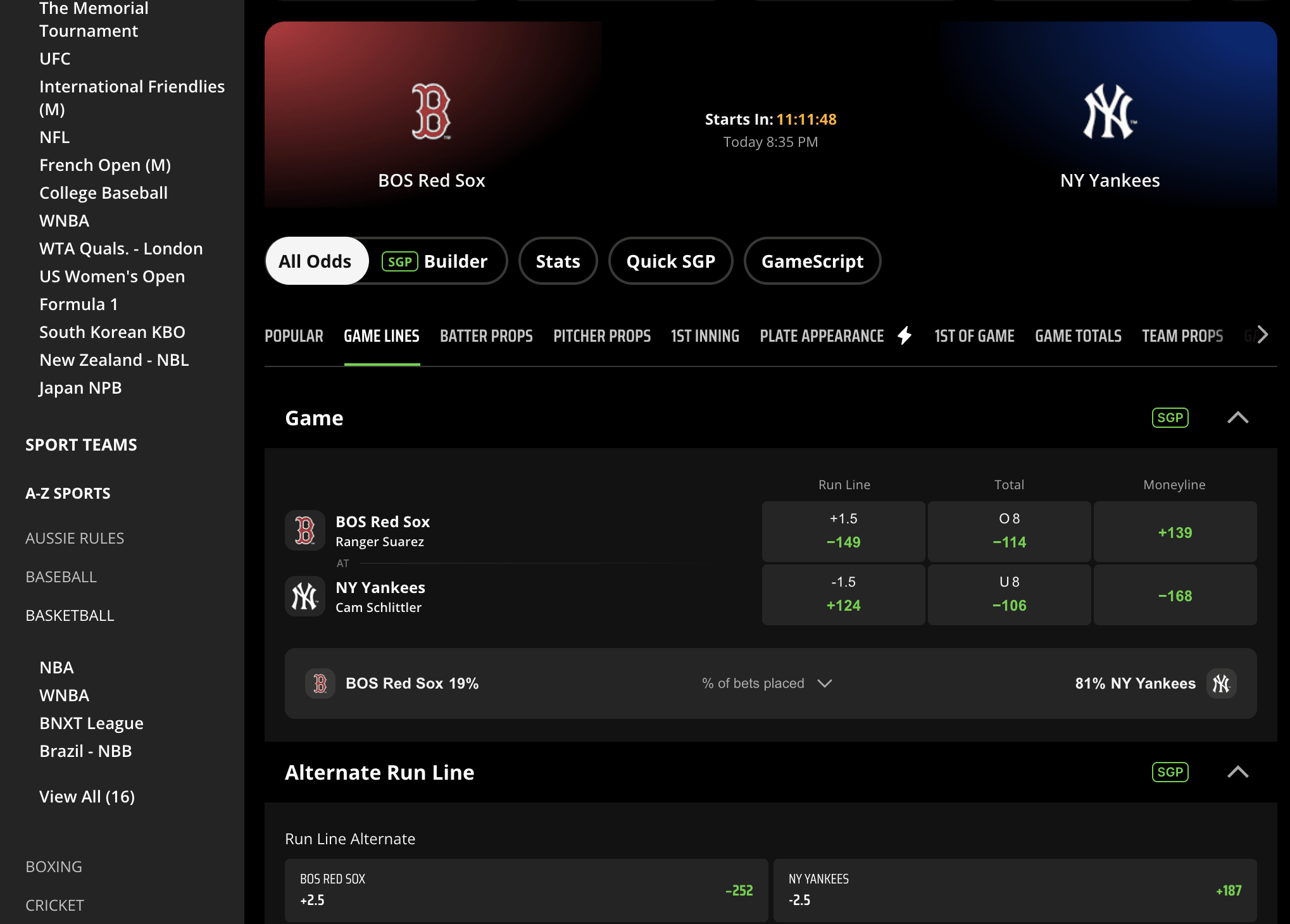
The standard -1.5 for New York was paying only +124. That felt light given how I was reading the pitching matchup. I moved the run line to -2.5 and locked in +187 on the Yankees.
At +187, implied probability is 34.8%, so the question becomes: do the Yankees win by three or more runs more than 35% of the time in this spot?
Credit: DraftKings Sportsbook – Screenshot captured by Chad Nagel on June 7
Baseball run lines are fixed at 1.5 in the standard market, which makes alternate run lines one of the few mechanisms for price discovery on a game you have conviction about.
Stanley Cup Final, Golden Knights, Game 4 June 9
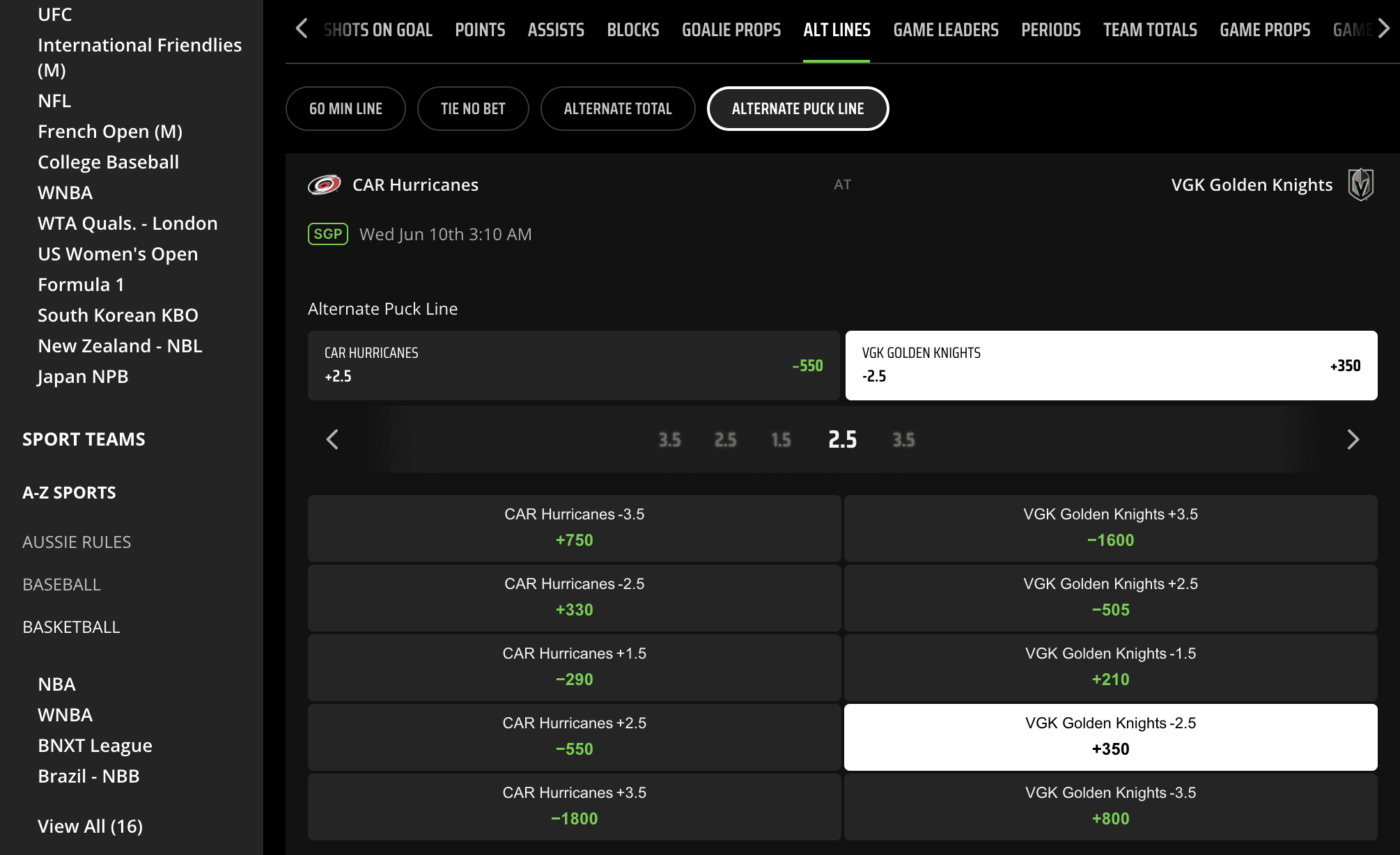
The Golden Knights were slight favorites, and the moneyline was offering only -105. That's a pick'em price with no upside. Moving to the alternate puck line of -2.5, I managed to unlock +350 on a $50 bet, standing to win a $175 profit if Vegas wins by three or more goals.
Credit: DraftKings Sportsbook – Screenshot captured by Chad Nagel on June 7
The Key Numbers Problem in the NFL
NFL scoring increases in primary increments of 3 (field goals) and 7 (touchdowns plus the point-after). Certain margins of victory cluster far more frequently than others.
A peer-reviewed analysis of all NFL regular season games from 2002 to 2022 confirmed that the distribution of margins of victory exhibits local maxima at ±3, ±7, and ±10. [3] A separate empirical dataset found that over 18% of NFL games since 2003 ended with exactly a 3-point margin, more than any other result, with 3 and 7 combined accounting for over 30% of all outcomes. [4]
Because those numbers decide so many bets, books charge a premium to cross them on alternate lines. Moving from +3 to +3.5 (or -3.5 to -2.5) costs more in vig than moving through dead numbers like 8 or 9 that almost never determine a game. [5]
The inverse applies when selling points. So make sure you see exactly how much vig you’re being hit with before you start playing around the spread.
Alternate Spreads and Expected Value
Every alternate spread adjustment should be framed as an expected value calculation. The EV formula: EV = (Win Probability × Potential Win) – (Loss Probability × Stake). [6]
Take the Spurs +5.5 at -161 with a $100 stake. If you estimate the Spurs cover +5.5 in 65% of scenarios, your EV is: (0.65 × $62.11) – (0.35 × $100) = $40.37 – $35.00 = +$5.37
When to Use Alternate Spreads
There are three situations where I opt for alternate spreads. First, when your conviction is about the margin of victory rather than just the result. If you think the Knicks don't just win Game 3 but win comfortably, buying points on the alternate line captures that edge in a way the standard -2.5 doesn't.
Second, when a heavy favorite's moneyline price is punishing, moving the puck line or run line to a larger alternate is often a better value play than laying -200 on the straight result.
Third, as a risk management tool on underdogs, buying extra points on the plus side at the cost of some payout is the right tactic to insulate against a close loss.
What you should not do is buy points through non-key numbers in the NFL where the historical frequency doesn't justify the premium. Books make a killing exploiting bettor tendencies, including the bias toward buying comfort. [7]
Every point you buy for emotional reasons rather than mathematical ones is a point the book profits from. Paying extra for a cushion that statistically isn't worth the price is a textbook manifestation of the probability distortions that behavioral economists have long identified in wagering populations. [8]
My Final Thoughts
Alternate spreads give you control over the risk-reward profile that the standard market doesn't offer. But every point you buy or sell shifts the implied probability, and the book prices that movement in their favor.
Before you opt to shift the spread, run the implied probability on whatever odds you're being offered, compare it to your own estimate, and only pull the trigger when the number says you're ahead!

Chad Nagel is a passionate sports fanatic who has worked in the sports and betting industry for over a decade. He spent most of his career as an editor-in-chief for Soccer Betting News, South Africa’s leading soccer betting newspaper, owned by Hollywoodbets. His articles have also featured in some of the most respected sports media platforms in the world, such as SPORTbible, Sports Illustrated, Combat Sports UK, and many others.
Comments
0 comments
No comments yet. Be the first to share your thoughts!
References
- 1.On the Efficiency of Sports Betting Markets - Robbins T, Coupland M. - East Carolina University Working Paper. Published November 2022.. Accessed June 7, 2026
- 2.How Do Markets Function? - Levitt SD. NBER Working Paper No. 9422. Published January 2003. Accessed June 8, 2026
- 3.A Statistical Theory of Optimal Decision-Making in Sports Betting - PLOS ONE. Dmochowski JP. Published June 28, 2023. Accessed June 7, 2026
- 4.A Stochastic Model for NFL Games and Point Spread Assessment - Description Mohsin M, Gebhardt A , Journal of Applied Statistics, Published September 16, 2022.. Accessed June 8, 2026
- 5.NFL Bettor Biases and Price Setting by Sportsbooks - Applied Economics Letters. Paul RJ, Weinbach AP. Published 2011. Accessed June 8, 2026
- 6.Prospect Theory: An Analysis of Decision under Risk - Econometrica, Vol. 47. Kahneman D, Tversky A. Published March 1979. Accessed June 8, 2026
- 7.Why Are Gambling Markets Organised So Differently from Financial Markets? - Levitt SD - The Economic Journal - Published 2004. Accessed June 7, 2026
- 8.Betting on a Buzz, Mispricing and Inefficiency in Online Sportsbooks - Ramirez P, Reade J, Singleton C, International Journal of Forecasting, Published 2023. Accessed June 8, 2026
Related Resources to Betting Academy
- How Second Chance Bets Work: The Expert Playbook for 2026
- Top NBA Betting Strategies Based On Academic Research
- How to Hedge a Sports Bet: Formula, Examples & Profit Calculator
- The Ultimate Guide to Cover Betting in the USA in 2026
- What is Same Game Multi (SGM) Betting?
- Player Bet Builder
- Why NFL Betting Is Bigger Than Every Other US Sport Combined
- Why Do Betting Odds Change After Bet Placement?
- How Loss Aversion Affects NFL Bettors When They Lose bets in the 4th Quarter
- Instant Wins Games and NFL Bettors: Why the Speed Is the Point
- Can AI Accurately Guide Your Betting?
- How Discord & Twitter Groups Shape NFL Betting in 2026
- NFL Crash Games: Why the Cash Out is a Two-Minute Drill Win
- NFL Bettors Are Moving to Online Slots: The Science Behind the "Hybrid" Shift
- How Weather Changes NFL Betting Odds and Game Outcomes
- Cash-Out Strategy: When to Lock In Profit or Let Your NFL Parlay Run
- Player Props Betting Explained: Odds, Strategy & How It Works
- Buffett Warns Sports Betting Lets Governments Cash In on the Naïve
- The CFTC Takes 5 States To Court Over Prediction Markets & Betting
- Buenos Aires Blocks 251 Unlicensed Online Betting Platforms in Sweeping Regulatory Crackdown