
Betting News
Is Sydney Sweeney's Novig Campaign a Masterstroke or a Misfire?
Novig's first national campaign has made a new prediction market famous almost overnight. Industry experts tell SportsBoom whether that attention is worth what it has cost.

SportsBoom offers honest and impartial bookmaker reviews to help you make informed choices. While we may earn commissions through affiliate links, our content remains independent and free from promotional influence. For more information, see our Content Transparency and How We Review pages.
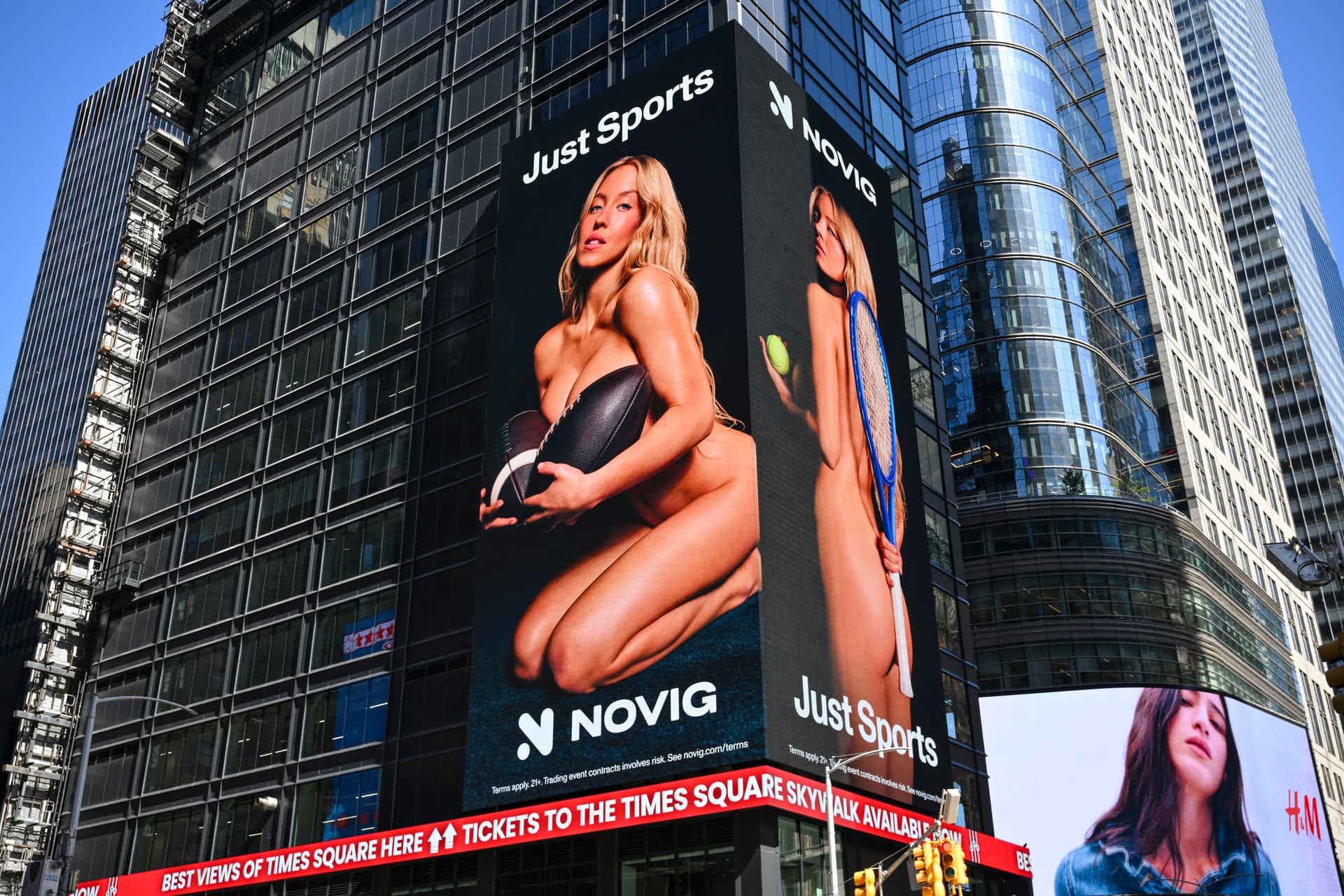
Very few brands get the whole sports and entertainment world talking about them within a month of launching nationally. Novig has done it with a single campaign.
The sports-only prediction market released its "Just Sports" campaign on September 9, having launched nationwide the previous month under a federally regulated framework.
The creative is simple and deliberately provocative. Sydney Sweeney appears in a series of shots with sports balls and athletic gear strategically covering her body, and the script contrasts Novig with broader rivals: no war, no death, no politics, just sports.
The campaign has spread widely, and so has the backlash. Female athletes have accused the campaign of sexualising women and setting women's sports back. Others have called it tacky. Some worry that sexualised, gambling-adjacent creative will reach younger audiences, even though Novig describes itself as a 21+ platform.
Supporters see a textbook exercise in attention marketing by a challenger brand.
SportsBoom put the central question to four marketing and industry experts: is the campaign a success or a failure?
No such thing as bad publicity?
Start with the case for the defence. Novig is a newcomer in a category dominated by far better-known names, and its first job is to get noticed. On that measure, the campaign has worked.
Jonathon Narvey, CEO and Founder at Mind Meld PR Inc, argues that the controversy is part of the plan.
"You've heard the old saying, 'there's no such thing as bad publicity?' This definitely qualifies. Good advertising, or more broadly, good marketing, isn't always about putting out a 'good' message that everyone likes. It's often about pushing boundaries, creating a controversy and watching the fireworks,” Narvey told SportsBoom.us in an exclusive interaction.
He sees a simple funnel from outrage to acquisition:
"Everyone's talking about your brand? Great, now some of them at least might go over to your website to see what it's about, and maybe actually buy something."
Novig appears to think the same way. Co-founder and CEO Jacob Fortinsky told Front Office Sports that Sweeney was the one who approached Novig about a partnership, and said her pull as a centre of attention forces the company into the national discourse. There is also a recent precedent.
After Sweeney's divisive American Eagle campaign in 2025, the retailer's shares rose significantly. For some marketers, that is proof that outrage around Sweeney can pay off.
Attention and acquisition are different things, though.
Mauricio Rios, Director of Strategy at Miami-based sports management firm Global Field Sports Consulting, says the campaign achieved what it set out to do, but the conversation then moved somewhere Novig did not intend:
"The campaign was clearly designed to provoke and attract attention, and it succeeded in putting Novig in the spotlight. What the company may not have anticipated was the reaction from women in sport and female fans and bettors, who questioned what the ad says about their place in sports. That reaction has shifted much of the conversation away from Novig's 'just sports' message. The question now is whether the visibility will bring in customers, or whether people will remember the controversy more than the platform,” Rios told SportsBoom.us in an exclusive interview.
That is the tension at the heart of this campaign. Everyone has seen the imagery, but that doesn't mean they have taken in the message.
Does "just sports" actually land?
Novig's positioning is the strongest part of the campaign. Rivals such as Kalshi and Polymarket let users trade on elections, geopolitics and much else. Novig has staked out a narrower claim. The campaign landing page describes it as a prediction market purpose-built for just sports.
Rich Pleeth, CEO and co-founder of Finmile, rates the positioning highly. He warns, however, that the delivery may be working against it:
"I like 'just sports', it's clear, easy to remember and gives Novig a focus against platforms where you can trade on almost anything. The equipment and the script communicate that, the debate now becomes around the imagery, has that become bigger than the message,” Pleeth exclusively told SportsBoom.us.
Dr. Morissa Schwartz, Forbes 30 Under 30 entrepreneur and founder of GenZ Publishing, agrees that the positioning is sharp. She sets a harder test for whether it works:
"'Just sports' is a sharp positioning line because it gives a newcomer a simple contrast with broader event markets. The ad communicates the sports theme, but the celebrity may be more memorable than the product. The decisive test is whether a viewer can explain what Novig offers and why to choose it after the scroll has stopped,” Schwartz said in an exclusive interview with SportsBoom.us.
This is the campaign's fundamental weakness. The concept of Sweeney wearing nothing but "just sports" is clever, and the visual pun ties directly to the product. But the ad has only done its job if viewers leave knowing that Novig is a sports-only prediction market and why that matters. Viewers who only remember that Sweeney posed nude have got the joke and missed the pitch.
The women problem
Criticism from women in sport is the most damaging part of the reaction, and it has been the loudest.
Pleeth warns against treating it as background noise, and against treating it as the unavoidable cost of being bold:
"I wouldn't assume all women will react the same way, but I also wouldn't dismiss the criticism as the inevitable price of being provocative. Your first big campaign tells people who you're trying to attract. If female fans see it and think, 'This clearly isn't for me,' you've potentially made future growth harder before they've even tried the product. That's difficult to spot in a report celebrating millions of views. People who decide a brand isn't for them don't necessarily leave a comment."
His last point exposes a blind spot in how viral campaigns are usually judged. Impressions, shares and press mentions are easy to count. The customers who quietly decide a brand is not for them never show up on a dashboard.
Narvey takes the opposite view. He argues that Novig simply spoke to the audience it already has:
"According to gaming industry polls, it seems like the majority of sports bettors are men. I doubt that the brand was trying to alienate women. They were simply catering to their core demographic. It's exactly the same as when Sports Illustrated runs their 'swimsuit' edition."
The commercial logic holds in the short term. The long-term arithmetic is less kind. Women's sport is one of the fastest-growing areas of fan engagement in the US. A sports-only platform that makes female fans feel unwelcome in its very first campaign may be giving up a growth market before it has competed for i
Responsible marketing and the regulatory spotlight
The campaign also arrives at a sensitive moment for the category. Sports prediction markets face active court challenges in 2026, and state regulators and tribal gaming interests are watching closely for evidence that these platforms behave like unregulated sportsbooks.
Dr. Schwartz says the campaign's reach, rather than its content alone, is what should concern Novig:
"I would expect extra scrutiny when a gambling-adjacent campaign uses sexualized celebrity creative across broad-reach channels. The responsible-marketing questions are where the ads run, who actually sees them, how clearly age restrictions appear, and whether the imagery implies a link between betting and sexual success. That is a review of risk, not a conclusion that Novig has breached a rule. In a developing prediction-market category, a brand should not build its growth plan around winning the most attention while leaving those questions for later."
Scale is the core of the problem. Novig says it specifically restricted the campaign to users aged 21 and over. Yet the campaign runs nationally across digital, social, online video and out-of-home placements throughout football season. A billboard cannot check ID, and a viral image does not stay with its intended audience once it has been shared.
Narvey plays down the provocation, arguing that the campaign is less exceptional than the outrage suggests:
"Sure, Sydney Sweeney's posing nude behind carefully-placed footballs are risque. No question. Is it showing more skin than an underwear ad, or a commercial for shampoo? Maybe not."
"'Sex sells' may be an overused phrase when it comes to marketing. But it's hardly a new idea. And as historical wild West saloons or the modern city of Las Vegas show, sex and gambling have always kind of been linked in the customer's mind."
That historical link is exactly what responsible gambling codes were written to break, so Narvey's defence doubles as the regulator's charge sheet. A prediction market fighting the argument that it is gambling by another name gains little from openly embracing gambling's oldest marketing clichés.
Would it survive in the UK?
In a stricter market, the answer is less certain.
Pleeth notes that UK rules target the campaign's most obvious risk factors directly:
"Gambling advertising rules prohibit strong appeal to under 18s and links between gambling and seduction, sexual success or enhanced attractiveness. Both the celebrity's audience and the creative would need careful assessment, the UK loves rules! That isn't the same as saying nudity automatically makes an ad unlawful, or that this one would definitely be banned. But 'we're 21+' would not be enough to settle it in the UK."
Under the UK framework, what matters is who the ad appeals to, not only who can legally sign up. Sweeney's fanbase is young and extends well beyond sports bettors. UK regulators would ask about that audience before they asked about skin.
The script adds a further wrinkle. At one point Sweeney jokes that viewers can't trade her, she just looks good. It is a knowing gag. It also directly places the celebrity's attractiveness alongside the product, which is the kind of association UK rules scrutinise.
Equity over endorsement: a model others will follow?
The most commercially interesting part of the deal may not be the ad at all. Sweeney joins Novig as a strategic partner and equity holder, and she has said she helped shape the campaign rather than simply lending her face to it.
Rios sees this as part of a wider trend, though not the end of traditional endorsements:
"Equity partnerships appear to be becoming more common across different kinds of talent, but I do not think traditional endorsements will disappear. In entertainment, Sydney Sweeney's role at Novig has a close parallel in Lily Collins's partnership with IM8: both actresses are ambassadors and shareholders. In sport, IM8 has also partnered with shareholders Giannis Antetokounmpo and tennis star Aryna Sabalenka. Kylian Mbappé's agreement with On offers another model, combining cash and equity."
"Equity can give talent a reason to stay involved in a brand's growth over time. A conventional fee still makes sense for a specific campaign, and the two approaches can coexist in one deal. For Novig, the question is whether Sweeney's involvement helps build the brand beyond this first burst of attention."
Narvey offers a more pragmatic reading. On his account, the structure is about cash flow and control as much as commitment:
"Maybe the company doesn't have cash on hand to just pay a fee with no strings attached. Or they just want to make sure that the celebrity feels invested in the company, so that they don't pull a Rachel Zegler and Snow White kind of shenanigan. Stopping their celebrity from going off script and undermining the campaign reduces financial and legal risks for both sides."
Either way, the equity structure changes how the campaign should be judged. A paid endorser can move on once the campaign ends. A shareholder has a stake in what the brand becomes. If Sweeney's value to Novig rests on more than one controversial shoot, the partnership could outlast the backlash.
The verdict: success, with an asterisk
Judged by its first objective, the campaign has succeeded. Weeks into its national rollout, Novig is known far beyond its niche, and its "just sports" line is sharp enough to distinguish it from Kalshi and Polymarket. For a challenger with limited budget and limited time, that is a real achievement.
Every expert SportsBoom spoke to, however, ended up at the same question. They asked whether the imagery has overtaken the message, whether visibility will become customers, and whether Sweeney's involvement will build the brand after the initial burst. None of them could answer yes with confidence.
The costs are also real, even if they are harder to measure. Some female fans have been alienated, and they are unlikely to say so in the comments. The ad has handed a talking point to critics who argue that prediction markets are sportsbooks with better lawyers. And in any stricter jurisdiction, the "21+" defence would not settle the questions this creative raises.
SportsBoom's verdict is that the campaign is a success as a launch and unproven as a brand strategy. Novig has won the attention battle convincingly. Whether that was worth the cost will only become clear once the coverage fades. The measure then will be whether people remember a sports-only prediction market, or only remember Sydney Sweeney.

Meet Louis Hobbs, our resident sports guru with a knack for all things darts and snooker. His expertise goes beyond the ordinary, offering deep insights that set him apart. Louis also has a strong passion for US sports, particularly basketball and American football.
Comments
0 comments
No comments yet. Be the first to share your thoughts!
Related Resources to Betting News
- How One Bonus-Abuse Network Created $3.2m in Fraud Exposure
- Which US States Have Banned Prediction Markets
- Prediction Markets' 16-Fold Volume Surge Shows Why Sportsbooks Should Be Worried
- DraftKings’ Four-State Prediction Push Reveals Its Bigger US Market Bet
- MLB’s Polymarket Exclusivity Tested as Five Teams Partner With Kalshi
- Which US States are Posting the Biggest Gambling Revenue Gains in 2026
- Colorado Introduces New Betting Protection Law: Which States Will Follow Next?
- New York's Sports Betting Tax Take Jumped $50M After World Cup Results Favoured the Books
- Prediction Markets Gain Sportsbook-Level Legitimacy as Genius Sports Strikes Polymarket and Kalshi Deals
- Could Real-Time Statistics Change How Americans Bet on Sports?
- U.S. Sportsbooks Are Likely to Break Their All-Time Hold Record This Summer
- Has Live Betting Become More Popular Than Pre-Match Betting?
- Why Fast Rewards Drive Online Gambling Growth
- The reason why U.S. Betting Operators are becoming Media Ecosystems
- Are Branded Slot Games Still Effective at Attracting New Players?
- Gamification in Online Casinos: Where Games and Gambling Converge
- Simplicity Over Value: Why Casual Bettors Accept Worse Odds
- Are Same-Game Parlays the Fast Food of American Sports Betting?
- Why Power Laws Rule the Sports Betting Industry
- Online Casinos Vs Sports Betting Market