
Betting
Why American Bettors Keep Chasing Parlays (And Why the Math Disagrees)
A bettor puts down $50 on a Sunday night three-bet parlay: Kansas City Chiefs -6.5, Green Bay Packers Moneyline, and Over 47.5 Total Points all at -110. If all three of these bets win, the parlay returns $595. Now, if you made the same three individual bets (single bets) for $50 (total), you’d get back about $155 if all three wins.

SportsBoom offers honest and impartial bookmaker reviews to help you make informed choices. While we may earn commissions through affiliate links, our content remains independent and free from promotional influence. For more information, see our Content Transparency and How We Review pages.

Why Parlays Continue to Dominate US Sports
The return is quite different even though the bets are exactly the same. And this is why casual bettors love parlays.
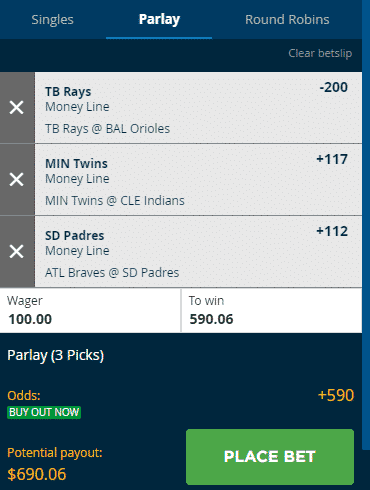
Caption:3-leg parlay on TB Rays, MIN Twins, and SD Padres with a $100 wager and $690.06 payout
The Compounding Vig Problem
First, learn about the odds of placing a single bet to understand parlay bet returns. Winning a spread bet at -110 odds equates to about a 52.4% chance of winning. This sounds fair enough. But parlays dramatically alter your chances of winning across multiple bets.
Let’s take a look at a 2-bet parlay, with each bet at -110 odds. The chance of winning both bets is 0.524 x 0.524 = 0.2745, or about a 27.5% chance. Most sportsbooks are paying around +300 to +310, about a 24% chance. The difference between the real odds (27.5%) and what sportsbooks pay (24%) is the extra cost they charge.
The vig increases with every bet. Even more heinous are the odds on a three-bet parlay at -110 odds each. The real chance of winning that would be 0.524 x 0.524 x 0.524=0.1438, or about 14.4%. But sportsbooks know that and set the prices accordingly, taking more than your fair share of money. That means you, as a bettor, have to beat the odds more than 14.4% of the time to break even on these parlays. [1]
Why Bettors Keep Playing Parlays Even Though the Odds Are Bad
People normally bet on parlays because of the wins. But they rarely do the math. Let's say you place a parlay and it wins, of course, you'll be thrilled and will want to share it with friends (followers). This is quite normal, and it usually happens a lot on the internet.
A $50 parlay win paying $595, for example, gets a lot of attention online. But the excitement of winning three separate $50 bets is not the same, even if the profit is the same. Winning parlay tickets are always shared on socials (especially Instagram and X). But losing one's are always branded as a "one bad call" ticket.
Sportsbooks aid this mentality by making parlays easy to find within their apps. Parlay builders sit at the top of the screens within betting menus. The potential payout updates in real-time, showing how much the bet could win. It’s easy to add additional wagers. With one simple tap, the potential payout skyrockets. This makes bettors think they have a much better chance of winning.
Also, parlay payouts make you feel like you're in control. A bettor can place 3 parlay bets on sports and think that's a smart move. But it's quite the opposite. Parlays often involve mixing together different chances that may go wrong (or not).
Where the Logic Actually Breaks
If you have a 55% chance to win each of three independent bets, you should place them separately. Do not go for a parlay.
- Three separate $100 bets at -110: each bet has a small positive expected value, so together you expect about $2.73 profit.
- One $100 three-leg parlay at +264: the parlay wins only if all three legs win (16.6% probability). Expected value: approximately −$39.58, which is a significant loss. [2]
Reason why this happens: multiplying small advantages across legs reduces the overall chance of winning the whole parlay, while the payout doesn't scale enough to make up for the house edge. So the parlay turns a positive expectation into a negative one.
Same-game parlays are even worse because the legs are correlated. Bookmakers factor that correlation into the odds (and include an additional margin), so combining correlated outcomes doesn’t help you avoid the vig. [3]
Industry Context: Mobile Design and Same-Game Growth
Online NFL sportsbooks have made parlay betting simpler with the design of their apps. A parlay 7 years ago took time and thought. Now, you only need about 30 seconds on a phone during a game. This easy access makes parlays appealing to bettors. And the main reason is that people now can bet between quarters instead of before the game.
Same-game parlays are popular because they are perceived as less risky (it’s just one game, not three). But the math remains the same: Sportsbooks mark these bets up. The same-game parlay's simplicity can make you lose more than you think.
What the Market is Actually Pricing
Parlays benefit bookies more than bettors. And the main reason is that each leg has vig. So, if you put in more legs, the house edge heightens. It's quite exciting to do parley betting, but they lose value fast.
The best way to go about it is to beg each pick on its own. The singles maintain a small positive edge that adds up. If you’re looking to compare sportsbooks for the best odds on individual bets, checking payout rates across platforms matters more than chasing a big parlay slip. Parlays require all picks to hit and the payout is rarely worth the decreased win probability.

Mitchelle is a skilled iGaming writer who is passionate about creating precise, trustworthy, and well-researched casino content. She specializes in gambling, betting, casino, and iGaming content. She has extensive experience working with leading writing agencies and gaming platforms. Her main focus is creating fact-based content across reviews, guides, and betting insights.
Comments
0 comments
No comments yet. Be the first to share your thoughts!
References
- 1.How to Calculate Parlay Odds - BettorEdge, Dec 10, 2025. Accessed May 29, 2026
- 2.The Math Behind Parlay Betting - Establish The Run, Jack Miller, Apr 4, 2024,. Accessed May 29, 2026
- 3.The Mathematics of Correlation and Sportsbook Pricing - Wizard of Odds, Joey Shackelford, Dec 01, 2025. Accessed May 29, 2026
Related Resources to Betting
- Prediction Markets
- Can Online Casinos Replicate the Social Experience of Land-Based Gaming?
- What is the Psychology Behind Jackpot Slots and Players’ Preferences
- Live Sports Betting Odds: Is Sports Betting Better Today?
- Why Slots Drive 80% of US Online Casino Revenue in 2026
- Betting Odds vs Sports Analysts: Who Predicts Games Better?
- Why sportsbooks encourage same-game parlays in the U.S. betting market
- Longshot Parlays in US Sports Betting
- Why Mobile Betting Has Replaced Vegas Trips for Millions of American Bettors
- Are There Reasons Why Free Bets Rule US Sportsbook Offers?
- Instant Withdrawals are the New Standard Driving Player Expectations in Online Betting
- Is There a Reason Why NBA Odds Are Different from Other US Sports?
- How Sportsbooks Legally Shrink Their State Tax Bills
- How Sportsbooks Doubled Their Take From American Bettors
- The Reasons NBA Over-Under Totals Are Much Harder to Predict
- MLB Player Props Betting Guide
- MLB Odds Explained: How to Identify Mispriced Lines
- Offshore Betting Sites vs Legal US Sportsbooks: Who Wins?
- Why It’s Easy to Deposit But Harder to Withdraw in US Betting Apps
- Rhode Island finally gets a second sportsbook after 7 years of a monopoly