
Betting News
Why Your Brain Loves Long Shots More Than Your Bankroll Does
When you pull up the NFL futures market and daydream about the Giants winning the Super Bowl at +7000, you’re falling victim to what academics call the favorite-longshot bias. I’m going to show how to avoid this common pitfall and determine when underdogs actually are worth betting on.

SportsBoom offers honest and impartial bookmaker reviews to help you make informed choices. While we may earn commissions through affiliate links, our content remains independent and free from promotional influence. For more information, see our Content Transparency and How We Review pages.

Reason Bettors Love Betting on Underdogs
The Bias Has a 70-Year Paper Trail
Researchers have been documenting the favorite-longshot bias (FLB) since the 1940s, and it continues to hold up across decades of data. In betting market terms, longshots are overbet relative to their true probability of winning, and favorites are underbet. [1]
Using a large-scale dataset, Erik Snowberg and Justin Wolfers found evidence in favor of the view that misperceptions of probability rather than a rational love of risk causes the favorite-longshot bias. [2] Essentially unsophisticated bettors are looking at underdogs in terms of how much they can win without taking the time to determine the actual likelihood of their bet paying out.
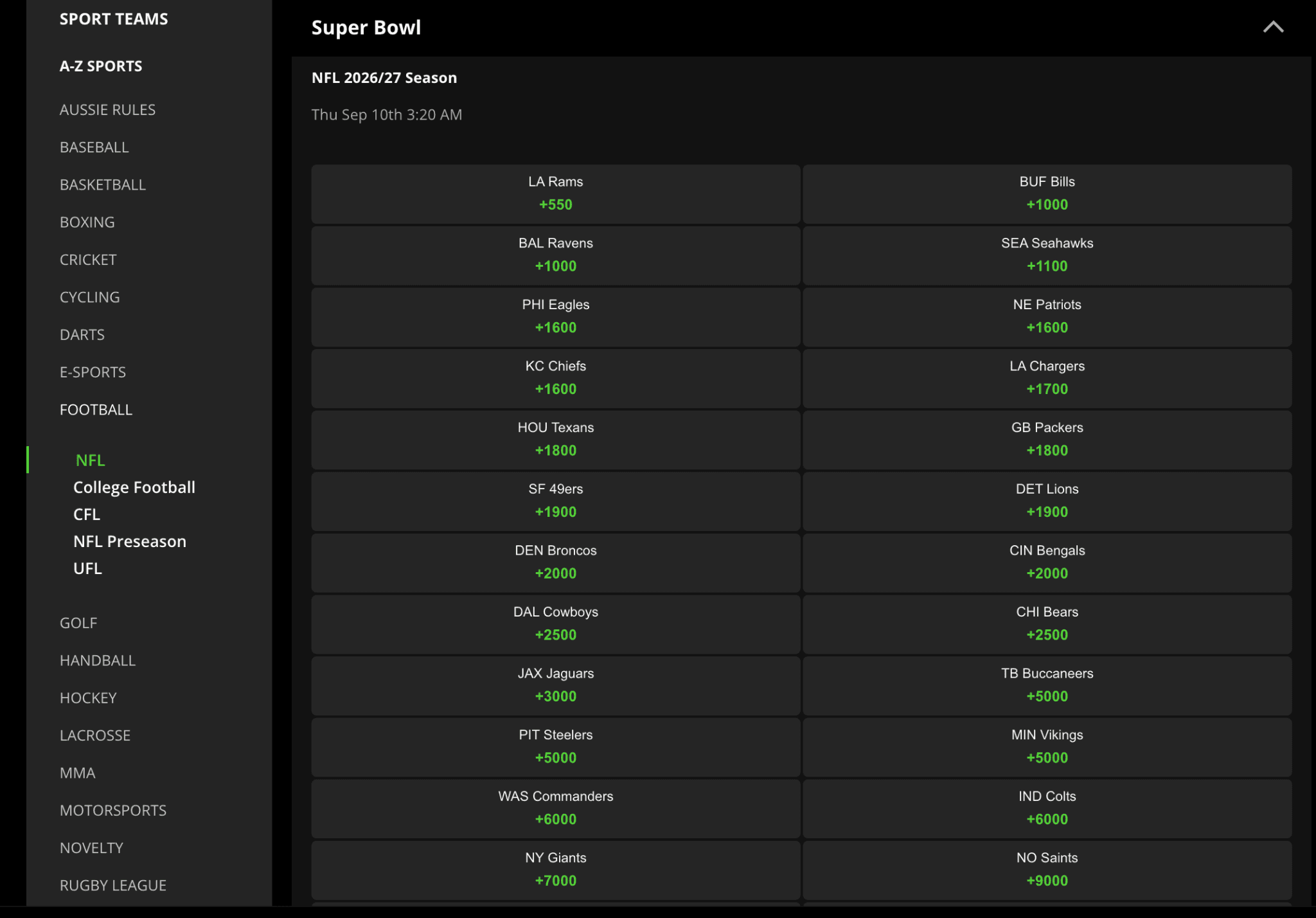
Credit: DraftKings Sportsbook – Screenshot captured by Chad Nagel on June 8
The theory behind FLB is Cumulative Prospect Theory, developed by Daniel Kahneman and Amos Tversky. It contends that people attribute excessive weight to events with low probability and insufficient weight to events with high probability. For example, individuals may unconsciously treat an outcome with a probability of 99% as if it were 95% and an outcome with a 1% probability as if it were 5%. [3]
Why the Public Bets Who They Love
Casual NBA and NFL bettors fall victim to sentiment bias. They make wagering decisions that are unrelated to fundamentals and let their relationship to the team influence their actions. [4]
For example, it doesn’t matter if the Dallas Cowboys or Inter Miami are trash this season, millions of fans of these franchises will still pile money onto them week in, week out based on name recognition, emotional attachment to the team, or simply because their lineups are stacked with well-known faces.
As public money floods in, it can actually distort the lines as the sportsbook adjusts to balance their action. So you can have a scenario where the Cowboys are legitimate underdogs, but because they’ve attracted so much action, the books are forced to make them the favorite. In a case like this it actually makes sense to bet on the other team.
Unsophisticated bettors continue to overvalue heavy underdogs, and there is a decoupling between the predicted winning probabilities and the observed frequency. [5] So in terms of expected backing, heavy favorites should outperform backing heavy underdogs over time.
However, blindly betting favorites is also not a winning strategy. The most successful bettors typically ignore the extreme ends of the market and focus on edge cases like minor NBA home underdogs who are playing a team playing their second game in a row.
The Psychological Pull Of Underdogs
Pettit, Doyle, and Lount argue that the psychological experience of underdogs and favorites inherently involves a coexistence of past and future thinking. They believe competitive status activates distinct cognitive and motivational patterns that extend beyond sport into how observers emotionally engage with competition. [6]
People root for underdogs because the narrative arc of struggle, defiance, and unexpected triumph maps onto deeply held cultural values. And when you've got money on them, that emotional engagement intensifies.
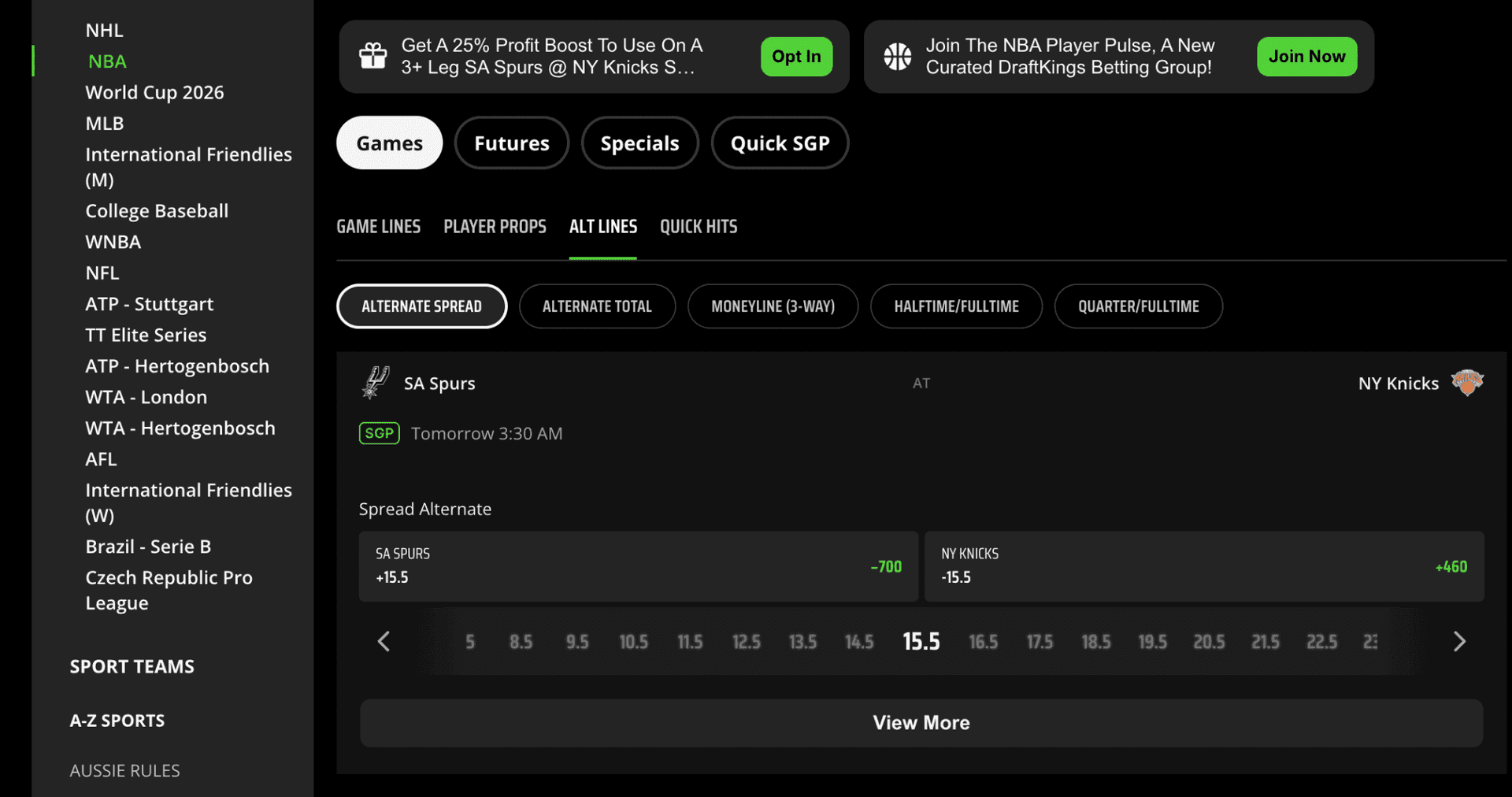
Credit: DraftKings Sportsbook – Screenshot captured by Felix Dubler on June 8
There’s also the phenomenon of chasing losses and loss aversion. Research on end-of-day betting behavior in racetracks shows that bettors who are behind by the final race of the day shift toward longshots, because a small longshot bet can generate enough profit to break even. Instead of thinking rationally and focusing on value, they opt for variance and look for horses that can deliver the return they need. [7]
What This Means in Practice
Over the long run, bettors lose around 5% of their money backing favorites but can lose approximately 40% backing extreme longshots. [8] The sportsbook margin is heavily loaded onto the big-price end of the market, precisely where emotional demand is highest.
However, specific situational underdog edges exist like home underdogs or divisional dogs in Week 1. What makes them exploitable is that line movement driven by public sentiment creates moments when the probability implied by the odds diverges from the true probability. So for the most part you should ignore both longshots and heavy favorites and look for key scenarios where mild underdogs can cause an upset.

Chad Nagel is a passionate sports fanatic who has worked in the sports and betting industry for over a decade. He spent most of his career as an editor-in-chief for Soccer Betting News, South Africa’s leading soccer betting newspaper, owned by Hollywoodbets. His articles have also featured in some of the most respected sports media platforms in the world, such as SPORTbible, Sports Illustrated, Combat Sports UK, and many others.
Comments
0 comments
No comments yet. Be the first to share your thoughts!
References
- 1.Explaining the Favorite-Longshot Bias: Is it Risk-Love or Misperceptions? - Erik Snowberg and Justin Wolfers, SSRN / Journal of Political Economy, NBER Working Paper 15923. Published May 2010.. Accessed June 6, 2026
- 2.Explaining the Favorite-Longshot Bias: Is it Risk-Love or Misperceptions? - Erik Snowberg and Justin Wolfers, Journal of Political Economy, Vol. 118(4), pp. 723–746.. Published August 2010. Accessed June 6, 2026
- 3.Prospect Theory - Wikipedia synthesis of Kahneman and Tversky (1979, 1992).. Accessed June 8, 2026
- 4.Casual Bettors and Sentiment Bias in NBA and NFL Betting - Applied Economics, 52(53). Taylor & Francis. Published 2020. Accessed June 8, 2026
- 5.The Favorite-Longshot Bias: An Overview of the Main Explanations - ResearchGate. Ottaviani and Sørensen (2008), Handbook of Sports and Lottery Markets.. Accessed June 8, 2026
- 6.Underdogs and Favorites: Past, Present, and Future - Nathan C. Pettit, Sarah P. Doyle, and Robert B. Lount Jr, Social and Personality Psychology Compass, 18(6).. Published May 2024. Accessed June 8, 2026
- 7.Prospect Theory in the Wild: Evidence from the Field - Colin F. Camerer, in Choices, Values and Frames, eds. Kahneman and Tversky. Cambridge University Press, 2000. Accessed June 8, 2026
- 8.The Favorite-Longshot Bias: Why Bettors Overrate Underdogs in Sports - Boyd's Bets. Published May 2025. Accessed June 8, 2026